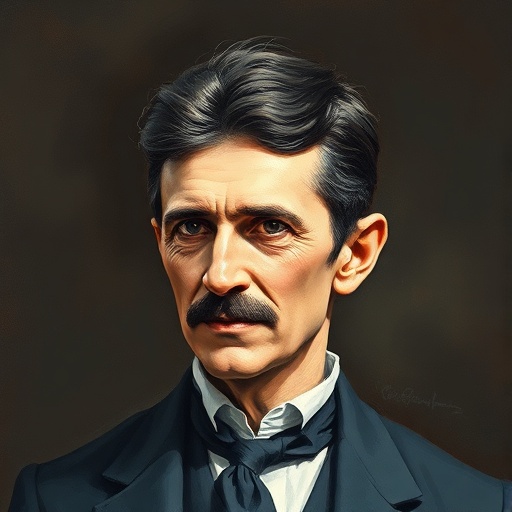
Nikola Tesla — "The greatest good for the greatest number is the only goal worth striving for."
The greatest good for the greatest number is the only goal worth striving for.
The greatest good for the greatest number is the only goal worth striving for.
Click any product to generate a realistic preview. Up to 3 at a time.
* Initial load can take up to 90 seconds — revising the preview in another color is nearly instant.
"I have been so absorbed in my work that I have neglected my personal life."
"It's not the love you make. It's the love you give."
"I myself have made my own discoveries in the greatest solitude, and when I have been alone, undisturbed."
"Restraint has not always been according to my taste, but my pleasurable experiences are a huge reward."
"The wireless transmission of energy is the most important discovery of all time."
Serbian-American inventor and electrical engineer whose alternating-current designs powered the modern electrical grid; died poor and largely forgotten. Closely associated with George Westinghouse (his AC-power business partner) and Mihajlo Pupin (fellow Serbian-American physicist at Columbia). For an intellectual contrast, see Thomas Edison, American inventor and direct-current advocate — Edison's direct-current power-distribution scheme was displaced by Tesla-Westinghouse AC in the 1890s 'War of Currents'. Edison ran a public-relations campaign electrocuting animals to discredit AC — the most famous engineering-ethics rivalry in American history. Tesla's AC won and powers nearly every electrical grid on Earth.
Found in 1 providers: grok
1 source checked
True success means creating the maximum benefit for the most people possible, not personal gain or individual achievement. Real progress is measured by how many lives improve. Ambition directed only at personal wealth or fame is shallow; the highest purpose anyone can pursue is work that lifts humanity broadly, spreading its benefits as widely as possible across society.
Tesla devoted his life to technologies meant to benefit all humanity, not personal wealth. His AC electrical system, wireless power research, and vision of free global energy transmission were explicitly aimed at universal access. He famously clashed with Edison and Westinghouse over commercialization, and died nearly penniless, having sacrificed fortune for his belief that electricity should serve everyone equally.
Tesla worked through the Second Industrial Revolution when electricity was transforming civilization but remained inaccessible to most people. Robber barons monopolized utilities, keeping power expensive and scarce. Simultaneously, utilitarian philosophy from Bentham and Mill dominated progressive thought. Tesla's era debated whether technology's benefits would be hoarded by elites or democratized, making universal-benefit ideals politically charged and urgently practical.
AI-generated insights based on extensive research and information for context. Factual errors? Email [email protected].
Your cart is empty