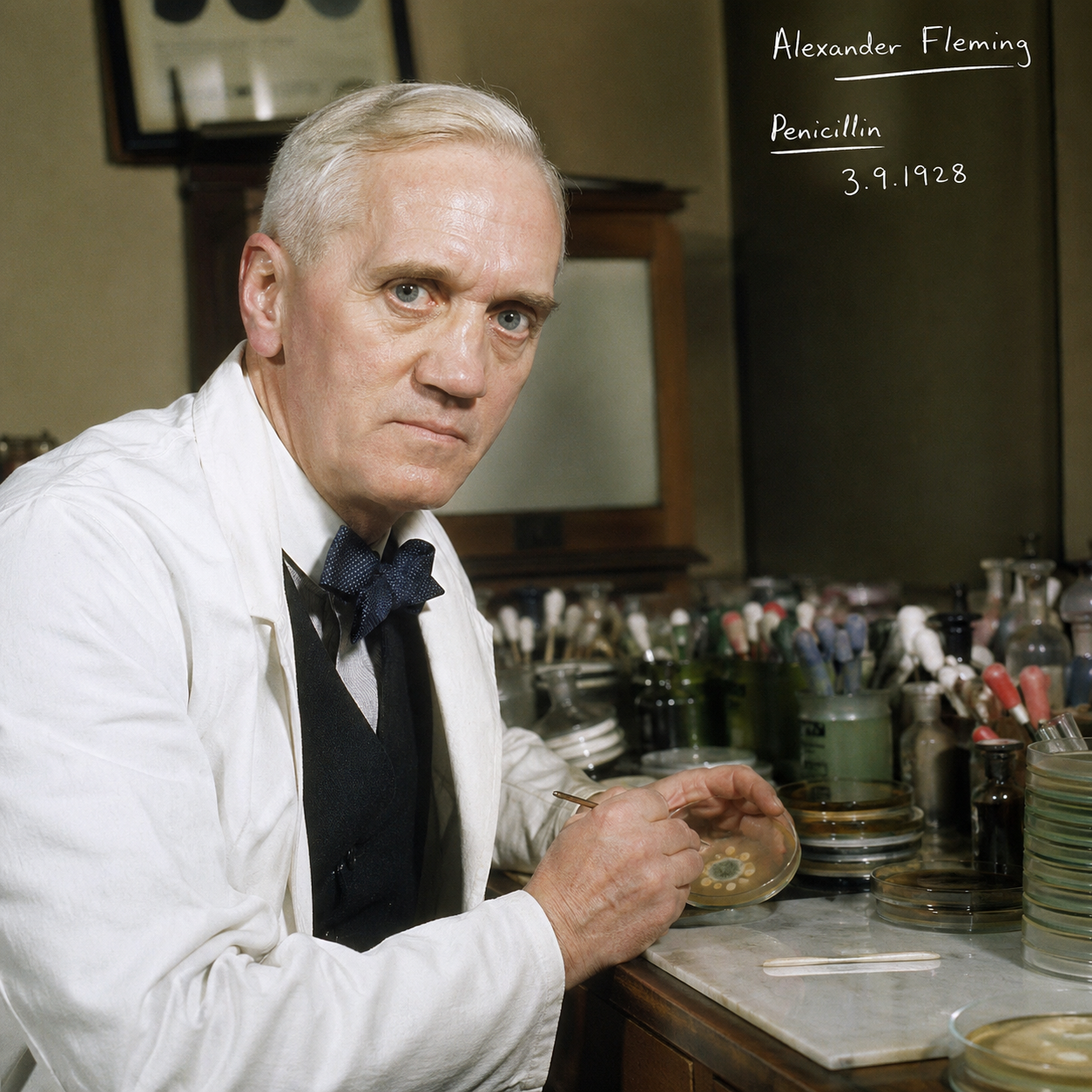
Alexander Fleming — "The greatest joy of a scientist is to see his work used for the benefit of manki…"
The greatest joy of a scientist is to see his work used for the benefit of mankind.
The greatest joy of a scientist is to see his work used for the benefit of mankind.
Click any product to generate a realistic preview. Up to 3 at a time.
* Initial load can take up to 90 seconds — revising the preview in another color is nearly instant.
"I have been fortunate in my life to have seen the benefits of my discovery."
"It was not easy to convince people of the importance of penicillin in the early days."
"I did not invent penicillin. Nature did that. I only discovered it by accident."
"I never thought of myself as a great man, just a man who made a great discovery."
"The thought that I might have discovered something which would be of value in treating disease was, of course, uppermost in my mind."
Found in 1 providers: grok
1 source checked
Scientific achievement finds its ultimate purpose not in discovery itself but in practical human benefit. A scientist's deepest fulfillment comes when research leaves the laboratory and tangibly improves or saves lives. Pure intellectual pursuit is not the end goal—the true measure of scientific success is real-world impact on human welfare, the transformation of abstract knowledge into healing, relief, and extended life for ordinary people.
Fleming discovered penicillin accidentally in 1928, but watched it remain a laboratory curiosity for over a decade. He served as a military physician in WWI, witnessing soldiers die from infected wounds treatable by antibiotics that didn't yet exist. When penicillin reached mass production in WWII, Fleming saw his accidental discovery save millions of lives in real time—earning him the 1945 Nobel Prize as proof science had genuinely served humanity.
Fleming worked during both World Wars, when bacterial infections killed more soldiers than combat itself. His 1928 discovery came in an era when medicine remained powerless against common infections like pneumonia and sepsis. WWII's mass penicillin production (1943–45) transformed battlefield medicine overnight. The mid-20th century saw science broadly framed as civilization's shield against disease and death, making Fleming's conviction that science exists to serve humanity deeply resonant with public sentiment.
AI-generated insights based on extensive research and information for context. Factual errors? Email [email protected].
Your cart is empty