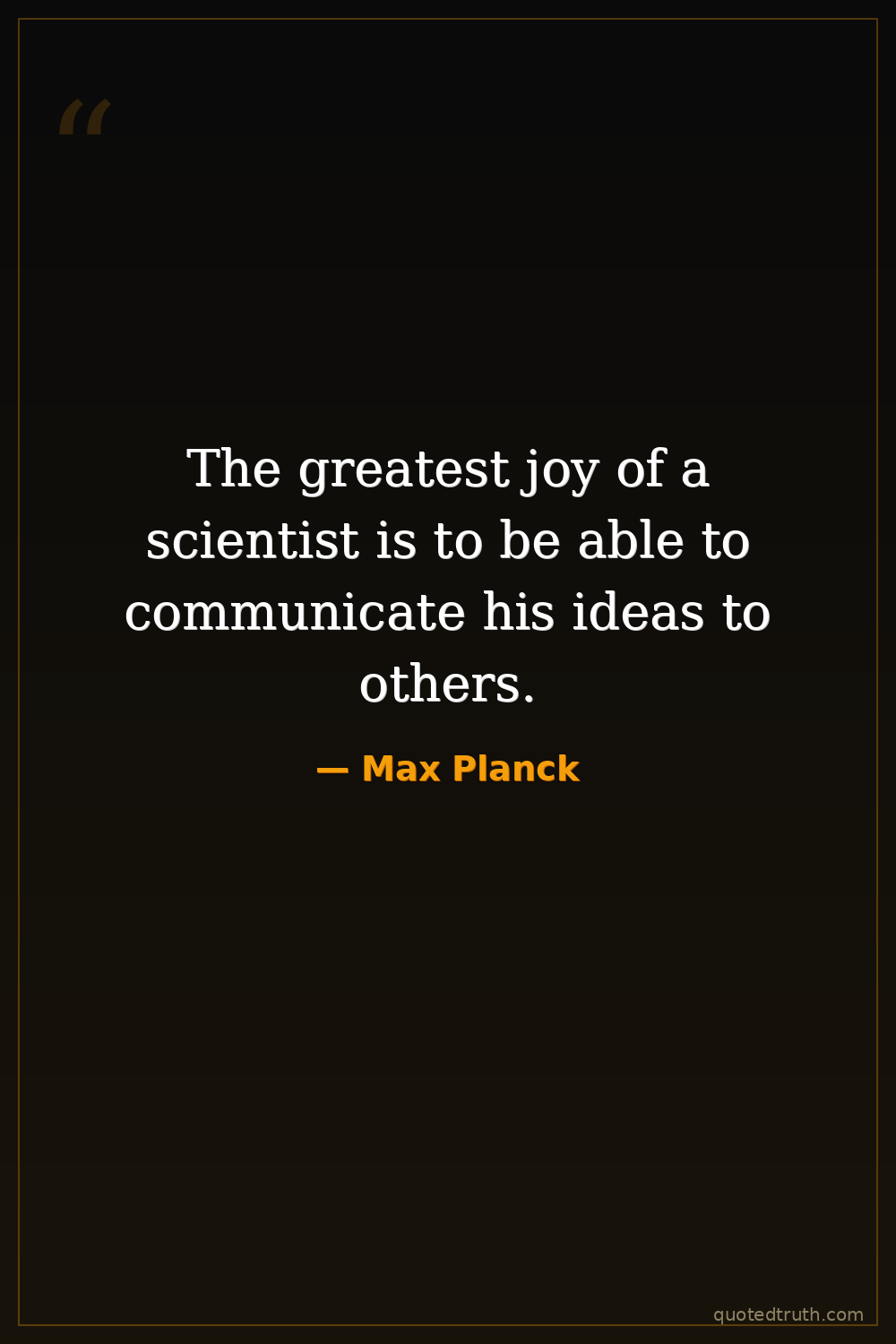
Max Planck — "The greatest joy of a scientist is to be able to communicate his ideas to others…"
The greatest joy of a scientist is to be able to communicate his ideas to others.
The greatest joy of a scientist is to be able to communicate his ideas to others.
Click any product to generate a realistic preview. Up to 3 at a time.
* Initial load can take up to 90 seconds — revising the preview in another color is nearly instant.
"The true scientist is a man who is always asking questions, and never satisfied with the answers."
"The constant changes in the scientific worldview show how important it is to remain open to new ideas."
"Physical science is that department of knowledge which is concerned with the laws of nature."
"A scientist is happy, not in resting on his attainments but in the steady acquisition of fresh knowledge."
"It was a dark and stormy night..."
Found in 1 providers: grok
1 source checked
Planck is saying that the deepest satisfaction in scientific work does not come from personal discovery alone, but from sharing those discoveries with other people. Figuring something out in isolation is incomplete; the real reward arrives when you can explain your thinking clearly enough that colleagues and students understand it, build on it, and carry it forward. Science, in this view, is fundamentally a communal act of communication rather than a private intellectual conquest.
Planck spent decades as a professor at the University of Berlin and edited Annalen der Physik, roles defined by teaching and peer exchange. He famously recognized Einstein's 1905 relativity paper and championed it publicly, and he mentored generations of physicists. His 1918 Nobel Prize for the quantum hypothesis only mattered because he published and defended it. The quote reflects a man whose career was built on lecturing, correspondence, and patiently persuading skeptical colleagues of radical new physics.
Planck worked from the 1890s through the 1940s, when physics was being overturned by quantum mechanics and relativity. Scientific journals, international conferences like the Solvay meetings, and university seminars were the main channels where these revolutionary ideas were debated and accepted. German science led the world until Nazi policies shattered it in the 1930s, scattering colleagues into exile. In that environment, the ability to communicate ideas across borders and generations was not decorative but essential to physics advancing at all.
AI-generated insights based on extensive research and information for context. Factual errors? Email [email protected].
Your cart is empty