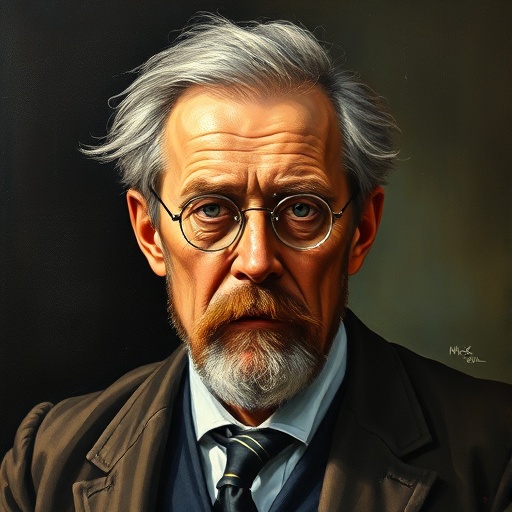
Max Planck — "The universe is not only stranger than we imagine, it is stranger than we can im…"
The universe is not only stranger than we imagine, it is stranger than we can imagine.
The universe is not only stranger than we imagine, it is stranger than we can imagine.
Click any product to generate a realistic preview. Up to 3 at a time.
* Initial load can take up to 90 seconds — revising the preview in another color is nearly instant.
"Anybody who has been seriously engaged in scientific work of any kind realizes that over the entrance to the gates of the temple of science are written the words: 'Ye shall have faith.' It is a qualit…"
"There are no contradictions in nature. There are only contradictions in the human mind."
"Anybody who has been seriously engaged in scientific work of any kind realizes that over the entrance to the gates of the temple of science are written the words: 'Ye must have faith.'"
"The quantum hypothesis will never make the slightest sense to anyone who cannot accept the existence of a real, objective world independent of our observations."
"The quantum of action, as I called it, was a purely formal assumption and I really did not think much about it."
Often attributed to Planck, but more commonly attributed to Arthur Eddington or J.B.S. Haldane.
Date: Attributed
Art & CreativityFound in 1 providers: grok
1 source checked
Reality goes beyond what human minds are built to grasp. Our imagination has limits, shaped by everyday experience, but the actual workings of the universe exceed even our wildest guesses. We can measure and model parts of it, yet some aspects may forever remain outside what we can mentally picture or fully comprehend, no matter how creative or intelligent we become.
Planck discovered that energy comes in discrete packets called quanta, shattering classical physics in 1900. His work birthed quantum mechanics, revealing a subatomic world where particles behave as waves and observation changes outcomes. Though personally conservative and religious, Planck spent decades wrestling with implications so bizarre even Einstein resisted them. This quote captures his humility before a reality his own equations had uncovered but could not intuitively explain.
The early twentieth century overturned centuries of Newtonian certainty. Between 1900 and 1930, quantum theory, relativity, and expanding-universe cosmology replaced a clockwork cosmos with something paradoxical. Planck lived through two world wars, the rise of Nazism, and the loss of his son to the Gestapo. Science was revealing nature as fundamentally probabilistic and counterintuitive, while Europe itself seemed to abandon rational order, deepening the sense that reality exceeded human frameworks.
AI-generated insights based on extensive research and information for context. Factual errors? Email [email protected].
Your cart is empty