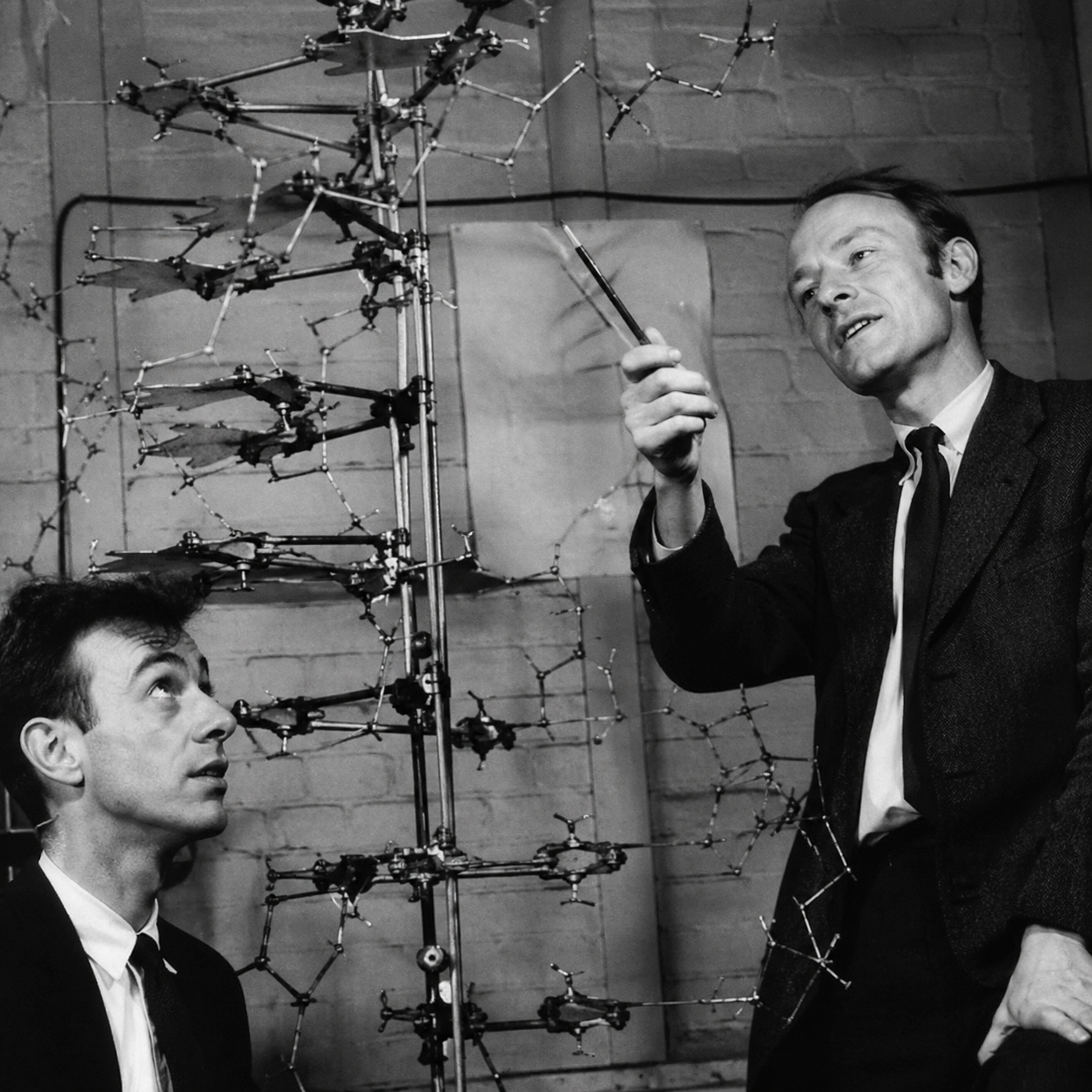
Francis Crick — "The greatest obstacle to discovery is not ignorance, but the illusion of knowled…"
The greatest obstacle to discovery is not ignorance, but the illusion of knowledge.
The greatest obstacle to discovery is not ignorance, but the illusion of knowledge.
Click any product to generate a realistic preview. Up to 3 at a time.
* Initial load can take up to 90 seconds — revising the preview in another color is nearly instant.
"An honest man, armed with all the knowledge available to us now, could only state that in some sense, the origin of life appears at the moment to be almost a miracle, so many are the conditions which …"
"It is not the strongest of the species that survives, nor the most intelligent that survives. It is the one that is most adaptable to change."
"It is important to be open to new ideas, but not so open that your brains fall out."
"There is no soul."
"If you want to get ahead in science, you have to be a bit of a maverick."
Found in 1 providers: grok
1 source checked
False certainty is more dangerous than admitting you don't know. When someone believes they already have the answer, they stop questioning, dismiss contradicting evidence, and defend wrong assumptions. Genuine ignorance keeps the mind open and curious. Real breakthroughs happen when thinkers challenge what everyone accepts as settled. Confidence in a wrong model actively prevents discovery; an open mind is the prerequisite for finding out what is actually true.
Crick spent his career dismantling confident scientific consensus. When he and Watson pursued DNA's double helix in 1953, leading chemist Linus Pauling—twice a Nobel laureate—was confidently advancing a flawed triple-helix model. Biology's establishment assumed proteins, not DNA, carried hereditary information. Crick's outsider perspective as a physicist entering biology let him question these entrenched truths. Later he tackled consciousness research when most scientists dismissed it as unanswerable, again defying institutional assumption.
Crick worked during mid-20th century science's golden age—post-WWII funding, technological confidence, and rapid discovery created a culture where expert authority went largely unchallenged. In molecular biology, the dogma that proteins were the master molecules of heredity was so entrenched it delayed acceptance of DNA's role for years. By the late 20th century the information age deepened the problem: abundant but shallow access to facts made confident false beliefs easier to form and harder to dislodge.
AI-generated insights based on extensive research and information for context. Factual errors? Email [email protected].
Your cart is empty