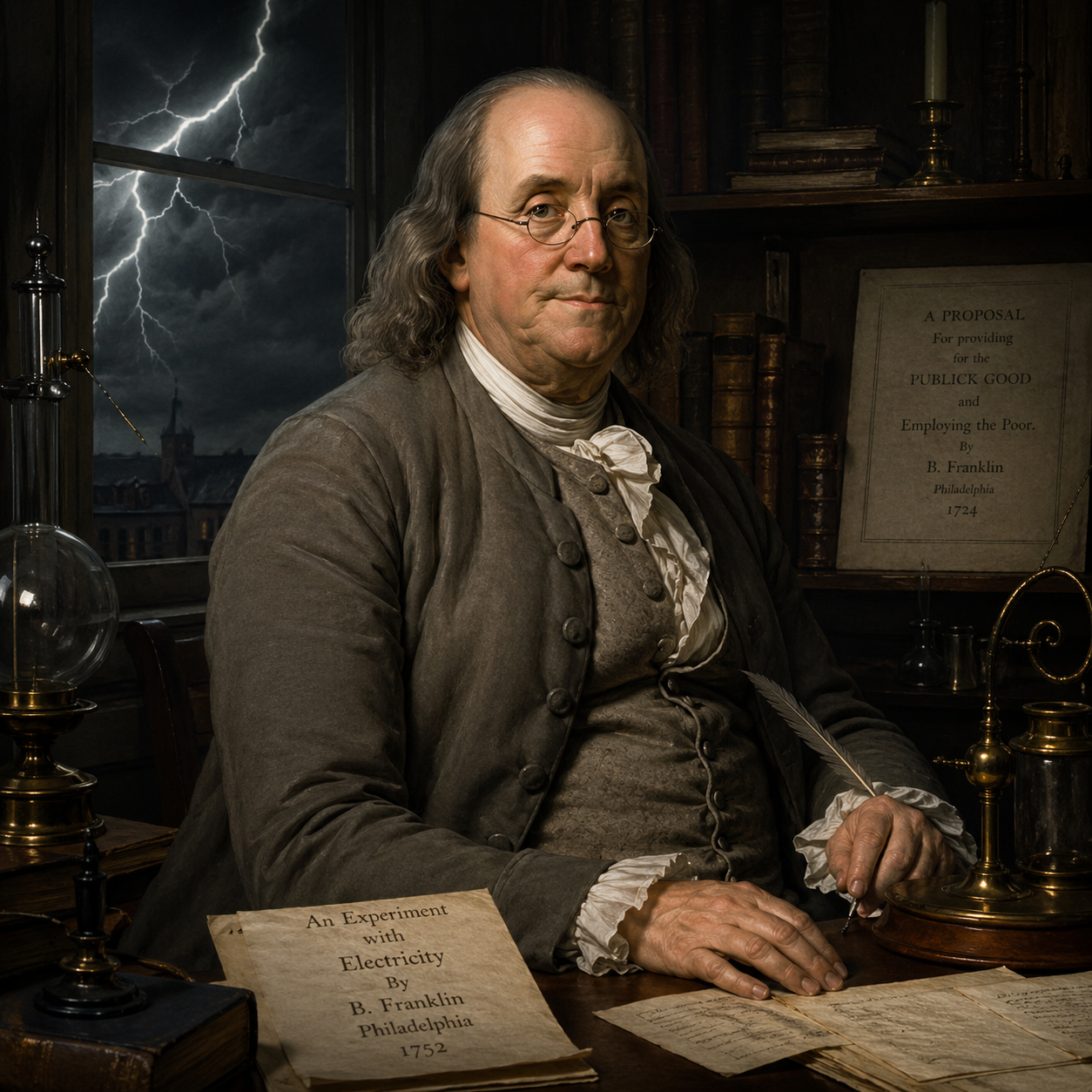
Benjamin Franklin — "The heart of a fool is in his mouth, but the mouth of a wise man is in his heart…"
The heart of a fool is in his mouth, but the mouth of a wise man is in his heart.
The heart of a fool is in his mouth, but the mouth of a wise man is in his heart.
Click any product to generate a realistic preview. Up to 3 at a time.
* Initial load can take up to 90 seconds — revising the preview in another color is nearly instant.
"Never confuse motion with action."
"Hunger is the best sauce."
"Wish not so much to live long as to live well."
"Preparation is the burden of fools."
"There are three faithful friends: an old wife, an old dog, and ready money."
Polymath Founding Father, diplomat, and Poor Richard's Almanack author who helped draft the Declaration of Independence and the Constitution. Closely associated with John Adams (fellow Founder, Massachusetts statesman) and Thomas Jefferson (fellow Declaration drafter). For an intellectual contrast, see Thomas Hutchinson, last royal governor of colonial Massachusetts — Franklin leaked Hutchinson's loyalist correspondence to Boston in 1772 to inflame revolutionary sentiment — Hutchinson represented the colonial-aristocrat crown-loyalty that Franklin's revolution was organized to dismantle.
Found in 1 providers: deepseek
1 source checked
Fools let their emotions run their mouths — they speak before thinking, broadcasting whatever they feel without filter. Wise people do the opposite: they hold their words in their hearts, deliberating and weighing consequences before choosing speech carefully. The contrast is impulse versus intention. Today we'd say: think before you speak. What you say without reflection exposes your character flaws; what you choose to say — or withhold — reveals your wisdom.
Franklin was a career communicator — printer, diplomat, pamphleteer, and statesman. He taught himself rhetoric by rewriting Addison's Spectator essays and famously avoided direct contradiction in argument, preferring hedged phrasing. As American envoy to France, silence and wit were diplomatic tools. He published maxims like this in Poor Richard's Almanack to shape colonial values. His own life demonstrated the principle: calculated speech earned him more lasting influence than bluster ever could.
Colonial America in the 1700s was a culture of public discourse — coffeehouses, taverns, pamphlets, and town assemblies made speech a political act. The printing press democratized ideas but made careless words dangerous; seditious libel prosecutions were real. Puritan ethics still prized restraint as moral virtue. Meanwhile, revolutionary rhetoric was building, and knowing when to speak boldly versus when to hold back separated effective statesmen from dangerous agitators.
AI-generated insights based on extensive research and information for context. Factual errors? Email [email protected].
Your cart is empty