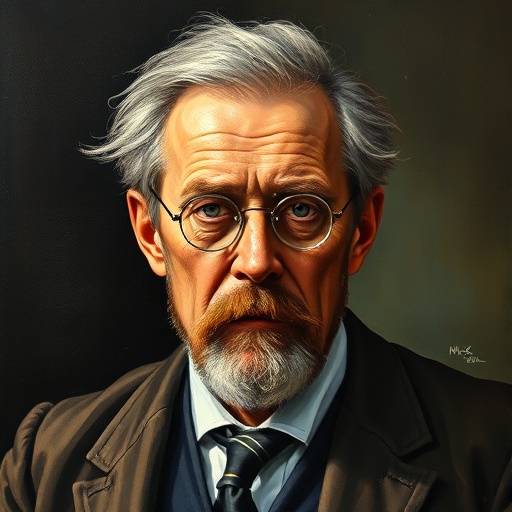
Max Planck — "The highest aim of physics is to find the one all-embracing law which governs al…"
The highest aim of physics is to find the one all-embracing law which governs all natural phenomena.
The highest aim of physics is to find the one all-embracing law which governs all natural phenomena.
Click any product to generate a realistic preview. Up to 3 at a time.
* Initial load can take up to 90 seconds — revising the preview in another color is nearly instant.
"The ultimate goal of all science is to understand the universe."
"A scientist is a man who tries to understand the world by experiment, and a philosopher is a man who tries to understand the world by thought."
"The scientist's highest aim is to find the truth."
"The pioneer in a new field of knowledge is never a popular man."
"All great discoveries are made by men whose feelings run ahead of their thinking."
Found in 1 providers: grok
1 source checked
Planck argues physics should not settle for describing separate forces or isolated effects. Its ultimate goal is to uncover a single master principle that explains everything in nature, from falling apples to radiating stars, under one unified framework. Every smaller discovery is a stepping stone toward that grand synthesis. Science advances by simplifying, not multiplying, its fundamental rules, always reaching for the deepest common thread beneath observable reality.
Planck spent his career hunting unifying principles. His 1900 blackbody radiation work introduced the quantum of action h, a constant he hoped would bridge thermodynamics and electromagnetism. Deeply influenced by his mentor Kirchhoff and by Maxwell's unifications, Planck viewed physics as a search for absolute, observer-independent laws. Even after quantum theory fractured classical certainty, he kept defending the idea that nature obeys one coherent order, a conviction rooted in his religious and philosophical worldview.
Planck worked during the transition from classical to modern physics, roughly 1880 to 1947. Maxwell had just unified electricity, magnetism and light; thermodynamics seemed complete; many believed physics was nearly finished. Then relativity, radioactivity, and quanta shattered that confidence. Planck lived through two world wars, the collapse of imperial Germany, and the Nazi era, which killed his son. Against that chaos, the dream of one all-embracing law offered intellectual and moral stability.
AI-generated insights based on extensive research and information for context. Factual errors? Email [email protected].
Your cart is empty