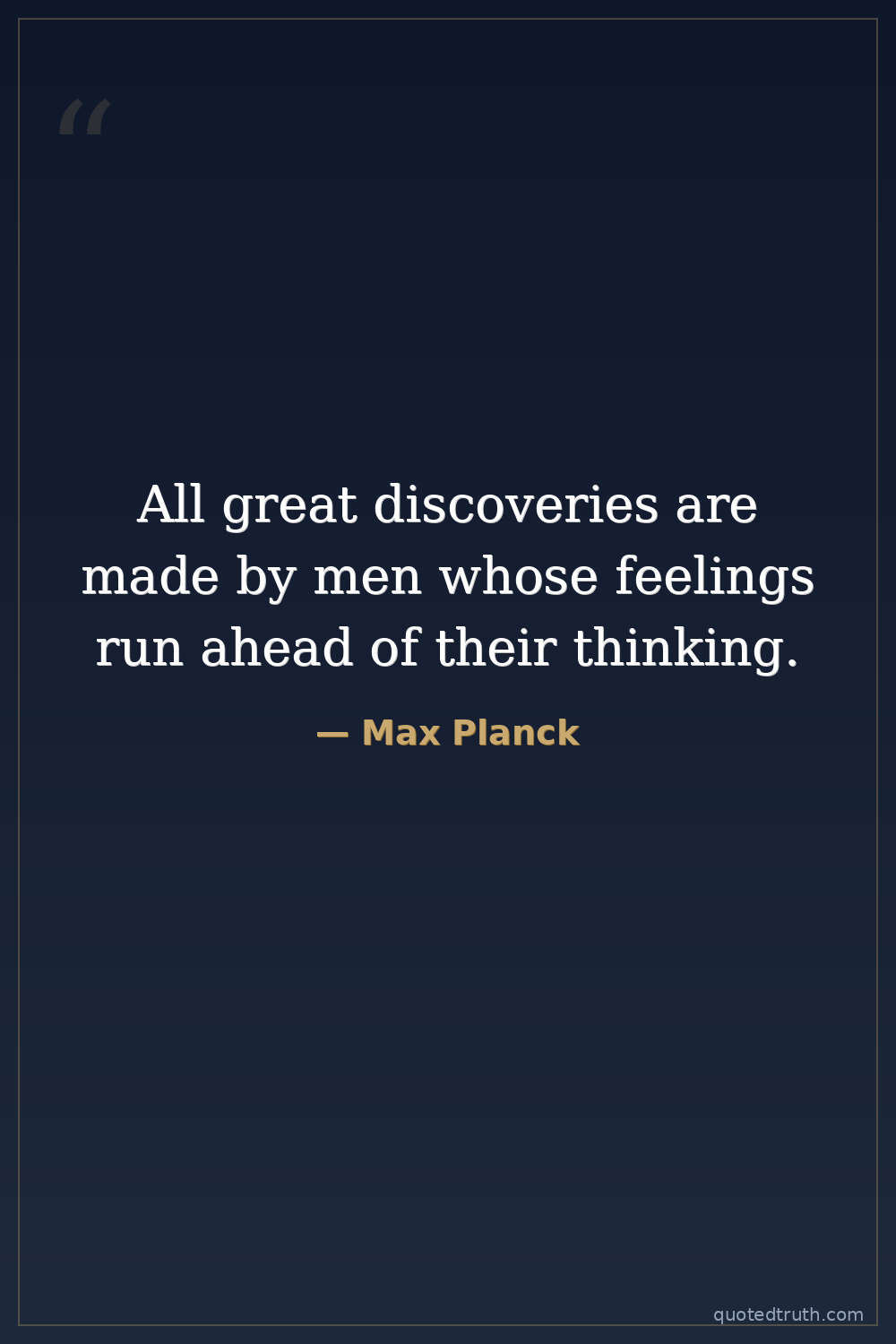
Max Planck — "All great discoveries are made by men whose feelings run ahead of their thinking…"
All great discoveries are made by men whose feelings run ahead of their thinking.
All great discoveries are made by men whose feelings run ahead of their thinking.
Click any product to generate a realistic preview. Up to 3 at a time.
* Initial load can take up to 90 seconds — revising the preview in another color is nearly instant.
"The ultimate goal of all science is to understand the universe."
"A scientist is happy, not in resting on his attainments but in the steady acquisition of fresh knowledge."
"The highest aim of physics is to find the one all-embracing law which governs all natural phenomena."
"The human mind, no matter how highly trained, cannot grasp the universe. We are in the position of a little child, entering a huge library whose walls are covered to the ceiling with books in many dif…"
"A scientist must be a man of faith, not in the sense of a believer in dogma, but in the sense of a man who believes in the possibility of discovering new truths."
Found in 1 providers: deepseek
1 source checked
Major breakthroughs in science or any field rarely come from pure logic alone. They emerge when someone has a strong intuition, hunch, or emotional conviction about a truth before they can prove it rationally. Feelings like curiosity, wonder, or unease with existing answers push people toward new ideas, and reasoning only catches up later to verify what intuition already sensed was real.
Planck lived this directly. In 1900, he reluctantly proposed that energy comes in discrete packets to solve the blackbody radiation problem, a step he later called an act of desperation that contradicted his classical physics instincts. His intuition that something was deeply wrong with established theory preceded the mathematical framework, launching quantum mechanics despite his own conservative temperament and initial discomfort with the implications.
Planck worked during the collapse of classical physics (roughly 1890-1930), when Newtonian certainty gave way to relativity and quantum weirdness. Scientists faced phenomena like blackbody radiation, the photoelectric effect, and atomic spectra that Victorian-era physics could not explain. Germany was a world center for theoretical physics, and researchers like Einstein, Bohr, and Heisenberg were making intuitive leaps into counterintuitive territory, remaking reality's foundations through imagination as much as calculation.
AI-generated insights based on extensive research and information for context. Factual errors? Email [email protected].
Your cart is empty