Carl Linnaeus — "The highest good is to know God and His works."
The highest good is to know God and His works.
The highest good is to know God and His works.
Click any product to generate a realistic preview. Up to 3 at a time.
* Initial load can take up to 90 seconds — revising the preview in another color is nearly instant.
"The more I collect and examine, the more I marvel at the infinite wisdom of the Creator."
"A plant is a living being, but it cannot feel."
"It is not wealth or ancestry, but rather the spirit of the age, which has raised me to the highest pinnacle of fame."
"Man is the masterpiece of creation."
"There are as many species as the infinite being created diverse forms in the beginning, which, following the laws of generation, produced many others, but always similar to them: therefore there are a…"
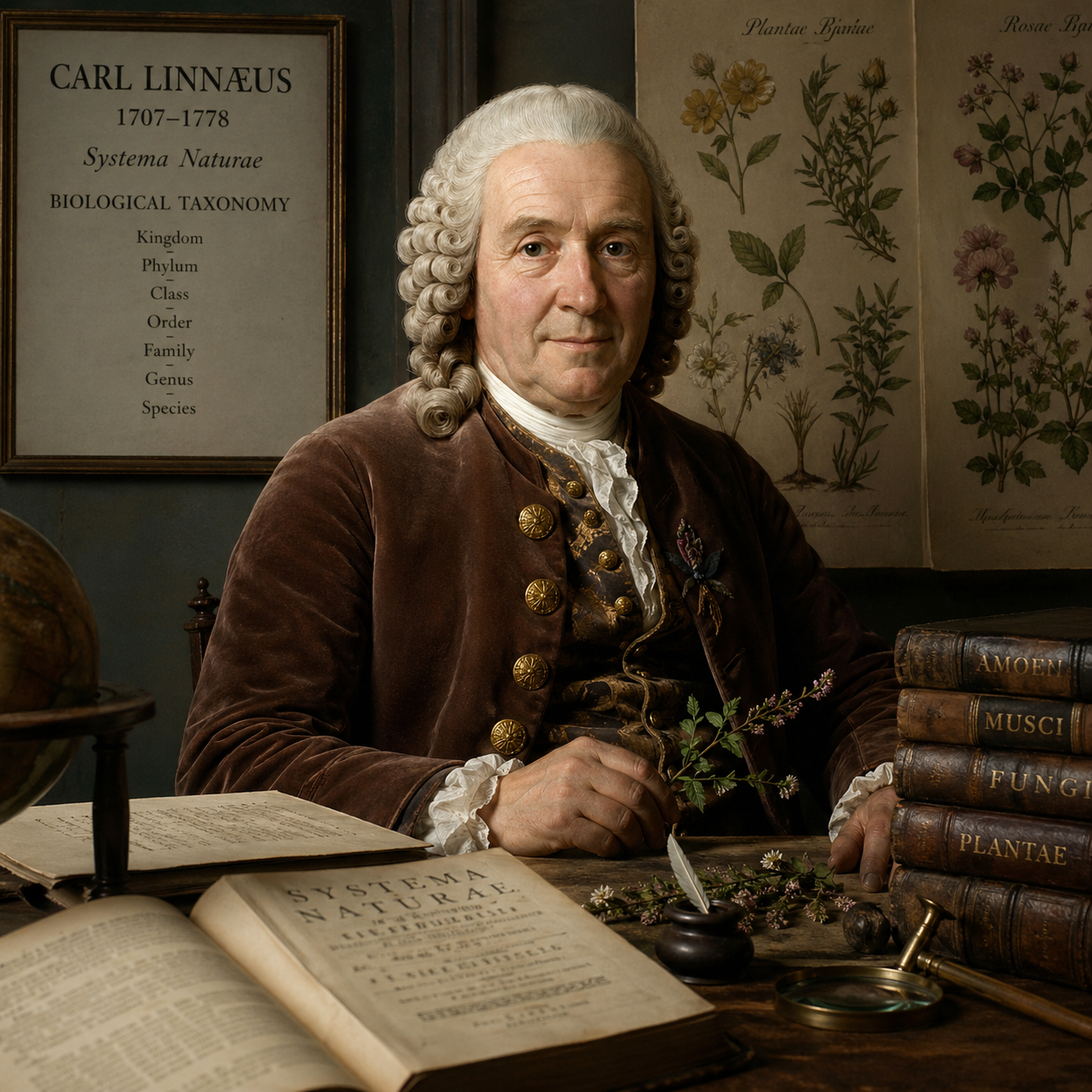
Swedish botanist and the father of modern taxonomy whose Systema Naturae (1735) introduced binomial nomenclature for naming all species. Closely associated with Joseph Banks (British naturalist who carried Linnaean classification on Cook's voyages). For an intellectual contrast, see Comte de Buffon, French naturalist and Histoire Naturelle author (1749-1788) — Buffon explicitly attacked Linnaean fixed-categories taxonomy as artificial and rejected the binomial system; his gradualist, environment-shaped natural history was the explicit alternative. Anticipates the fixed-species-vs-evolution debate Darwin would later resolve.
Found in 1 providers: grok
1 source checked
The greatest thing a person can achieve is understanding God and the natural world He created. Knowledge—especially of nature—is a moral and spiritual pursuit, not mere intellectual curiosity. Studying the world is an act of reverence, elevating science and observation to a sacred calling. Learning becomes the highest form of worship and the most meaningful use of a human life.
Linnaeus spent his career systematically cataloguing God's creation—naming roughly 7,700 plant species and 4,400 animal species. He was a devout Lutheran who viewed taxonomy as literally reading God's blueprint for life. His own motto was 'God created, Linnaeus organized.' He believed revealing order in nature revealed the divine mind, making his scientific work inseparable from religious faith. For Linnaeus, naming species wasn't academic exercise—it was devotion.
The 18th-century Enlightenment saw natural philosophy surge as thinkers tried to reconcile science with religion. Natural theology—the belief that studying nature reveals God's wisdom—was mainstream Protestant thought. Linnaeus's Sweden was deeply Lutheran, where learning was encouraged as piety. Europe was cataloguing thousands of new species from the Americas and Asia, creating urgent need for systematic naming. Understanding God's works was simultaneously scientific ambition and theological imperative.
AI-generated insights based on extensive research and information for context. Factual errors? Email [email protected].
Your cart is empty