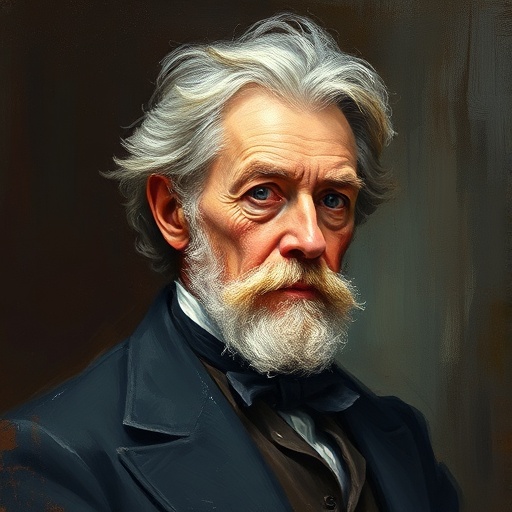
Michael Faraday — "The history of science is his library."
The history of science is his library.
The history of science is his library.
Click any product to generate a realistic preview. Up to 3 at a time.
* Initial load can take up to 90 seconds — revising the preview in another color is nearly instant.
"I am a simple man, and I have found great joy in the study of nature."
"The true measure of a man is not what he has, but what he gives."
"Lectures which really teach will never be popular; lectures which are popular will never really teach."
"A man who is afraid of making mistakes will never make a discovery."
"I am not afraid of failure, for it is through failure that we learn."
Attributed, emphasizing the importance of historical context for a scientist.
Date: Mid 19th Century (approx.)
EducationalFound in 1 providers: grok
1 source checked
A scientist's true foundation is the accumulated record of past discoveries. Anyone serious about understanding the natural world must study what earlier investigators learned, what experiments they ran, and what conclusions they reached. The library, meaning the collected writings and findings of predecessors, is where a researcher lives intellectually. Progress depends on standing on this body of prior work rather than starting from scratch or relying on personal intuition alone.
Faraday was largely self-taught, having left school at thirteen to apprentice as a bookbinder. He read every scientific volume passing through the shop, including Jane Marcet's Conversations on Chemistry and Encyclopaedia Britannica entries on electricity. This immersion in scientific literature launched his career when he attended Humphry Davy's lectures. Lacking formal mathematics training, Faraday relied on absorbing the experimental history of others to build his revolutionary work on electromagnetic induction.
Faraday worked during the early-to-mid 1800s, when science was transitioning from gentleman-amateur pursuit to professional discipline. The Royal Institution, where he spent his career, embodied this shift by making knowledge publicly accessible through lectures and publications. Scientific journals were proliferating, and cumulative experimental tradition was replacing isolated discovery. Britain's industrial revolution created hunger for applied knowledge, and institutional libraries became essential infrastructure for the emerging community of working scientists.
AI-generated insights based on extensive research and information for context. Factual errors? Email [email protected].
Your cart is empty