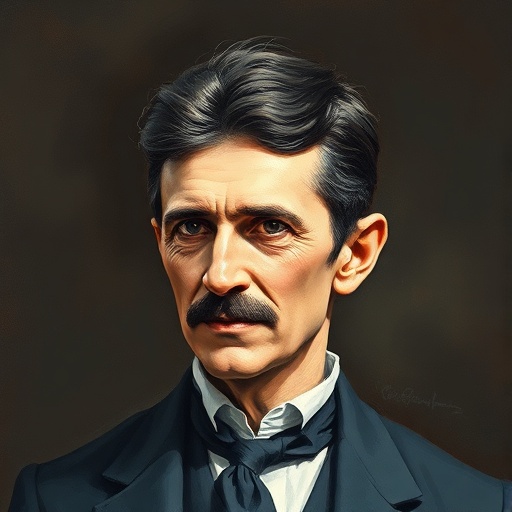
Nikola Tesla — "The human being is a self-propelled automaton, fatally bound to the circuit of t…"
The human being is a self-propelled automaton, fatally bound to the circuit of the universe.
The human being is a self-propelled automaton, fatally bound to the circuit of the universe.
Click any product to generate a realistic preview. Up to 3 at a time.
* Initial load can take up to 90 seconds — revising the preview in another color is nearly instant.
"The ultimate purpose is the complete mastery of mind over the material world, the harnessing of human nature to human needs."
"If the genius of invention were to reveal to-morrow the secret of immortality, of eternal beauty and youth, for which all humanity is aching, the same inexorable agents which prevent a mass from chang…"
"The future of humanity lies in the utilization of the sun's energy."
"The world has been too slow to grasp the true significance of my inventions."
"There are three possible solutions to the problem of increase of human energy: nutrition, peace, work."
Serbian-American inventor and electrical engineer whose alternating-current designs powered the modern electrical grid; died poor and largely forgotten. Closely associated with George Westinghouse (his AC-power business partner) and Mihajlo Pupin (fellow Serbian-American physicist at Columbia). For an intellectual contrast, see Thomas Edison, American inventor and direct-current advocate — Edison's direct-current power-distribution scheme was displaced by Tesla-Westinghouse AC in the 1890s 'War of Currents'. Edison ran a public-relations campaign electrocuting animals to discredit AC — the most famous engineering-ethics rivalry in American history. Tesla's AC won and powers nearly every electrical grid on Earth.
Attributed, often in discussions of his philosophical views on free will and determinism.
Date: Early 20th Century
WisdomFound in 1 providers: grok
1 source checked
Humans believe they act freely, but this quote argues otherwise — we are self-operating machines governed entirely by nature's laws. Like electrical circuits that must follow their fixed paths, we cannot escape the forces driving us. 'Fatally bound' means inescapably, not tragically. We are components in a vast cosmic system, moving according to principles we didn't choose and cannot override, no matter how autonomous we feel.
Tesla spent his life mastering electrical circuits — systems where current flows along predetermined paths dictated by physics, with no deviation possible. He was a committed determinist who believed human thought was as predictable as mechanical systems, once hoping to photograph thought itself. His AC motor work demonstrated that rotation, energy, and motion obey immutable laws. To Tesla, calling a human an automaton was scientific precision, not insult — the universe was one vast, elegant circuit.
Tesla worked during the late 1800s and early 1900s, when mechanistic determinism dominated science. Darwin had recently shown humans were natural organisms, not divine exceptions. Helmholtz and others treated the nervous system as an electrical machine. Industrialization surrounded people with self-operating machinery, making automaton metaphors viscerally real. Einstein's emerging physics was reordering humanity's place in the cosmos. Whether free will could exist in a universe governed by fixed physical laws was an urgent, unresolved question.
AI-generated insights based on extensive research and information for context. Factual errors? Email [email protected].
Your cart is empty