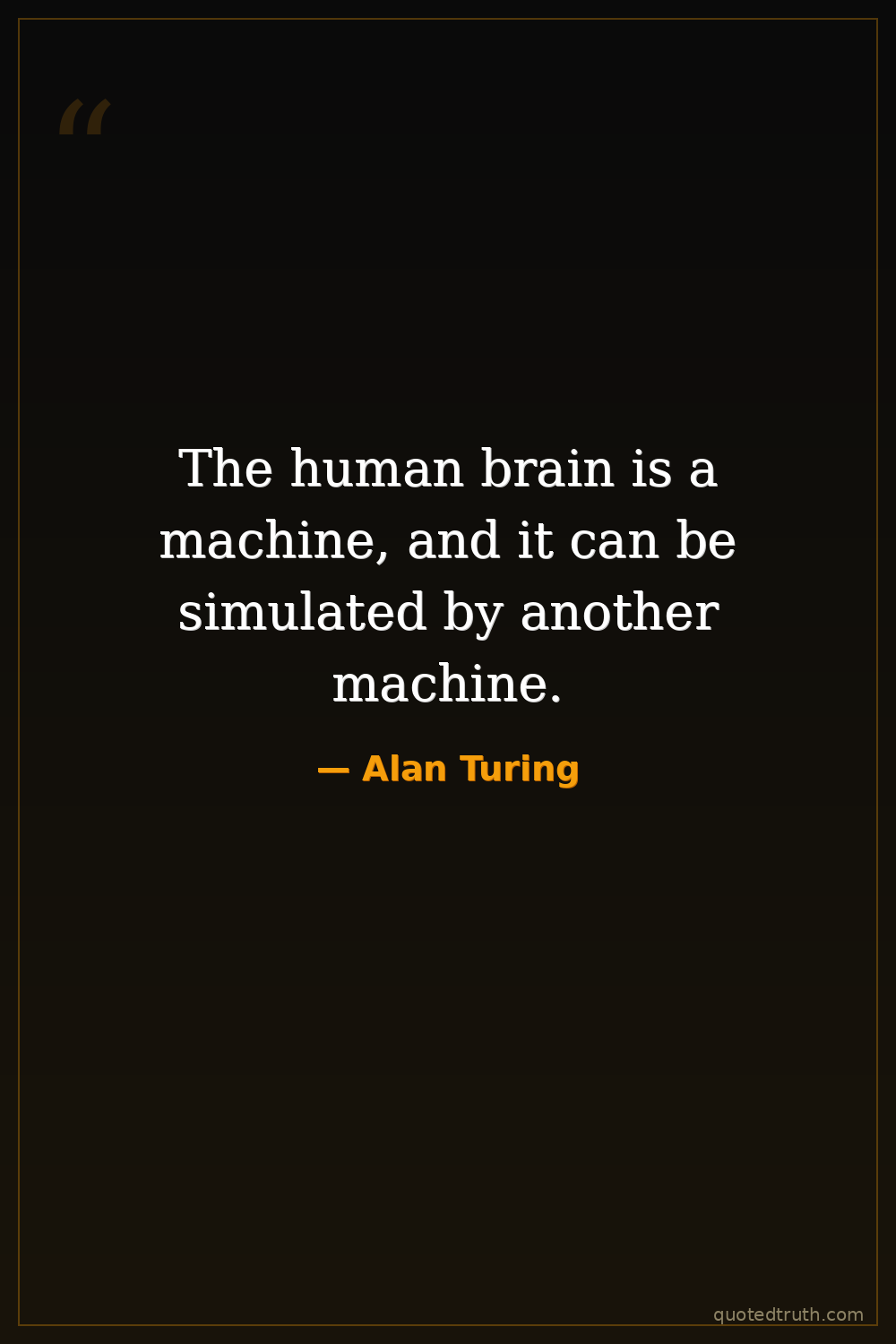
Alan Turing — "The human brain is a machine, and it can be simulated by another machine."
The human brain is a machine, and it can be simulated by another machine.
The human brain is a machine, and it can be simulated by another machine.
Click any product to generate a realistic preview. Up to 3 at a time.
* Initial load can take up to 90 seconds — revising the preview in another color is nearly instant.
"The question is not 'Can machines think?' but 'Can machines do what we (as thinking entities) can do?'"
"The problem of constructing a universal machine is not insoluble."
"The human brain is an electrical machine."
"The machine should be able to make mistakes."
"The only real valuable thing is intuition."
Attributed, general implication from his writings, but exact quote is elusive.
Date: Approx. 1950
ShockingFound in 1 providers: grok
1 source checked
The human brain operates according to physical and logical rules, not magic or mystery. Because it follows rules, any process it performs can theoretically be reproduced by another rule-following system. Intelligence, thought, and reasoning are not uniquely biological — they are computational patterns that can be replicated in silicon or any sufficiently capable substrate.
Turing spent his career formalizing what computation means, inventing the theoretical Turing Machine to define the limits of mechanical reasoning. His 1950 paper introduced the Turing Test precisely because he believed machine intelligence was achievable. He viewed the brain as a biological computer, not a mystical organ — a conviction that drove his foundational work in artificial intelligence.
In the 1940s and 1950s, the brain was widely treated as categorically beyond mechanical explanation. Religious and philosophical traditions held human consciousness as uniquely sacred. Turing's era saw the first electronic computers emerge from wartime necessity — his Colossus-adjacent codebreaking work at Bletchley Park proved machines could perform tasks once requiring human expertise, making the brain-as-machine argument urgent and controversial.
AI-generated insights based on extensive research and information for context. Factual errors? Email [email protected].
Your cart is empty