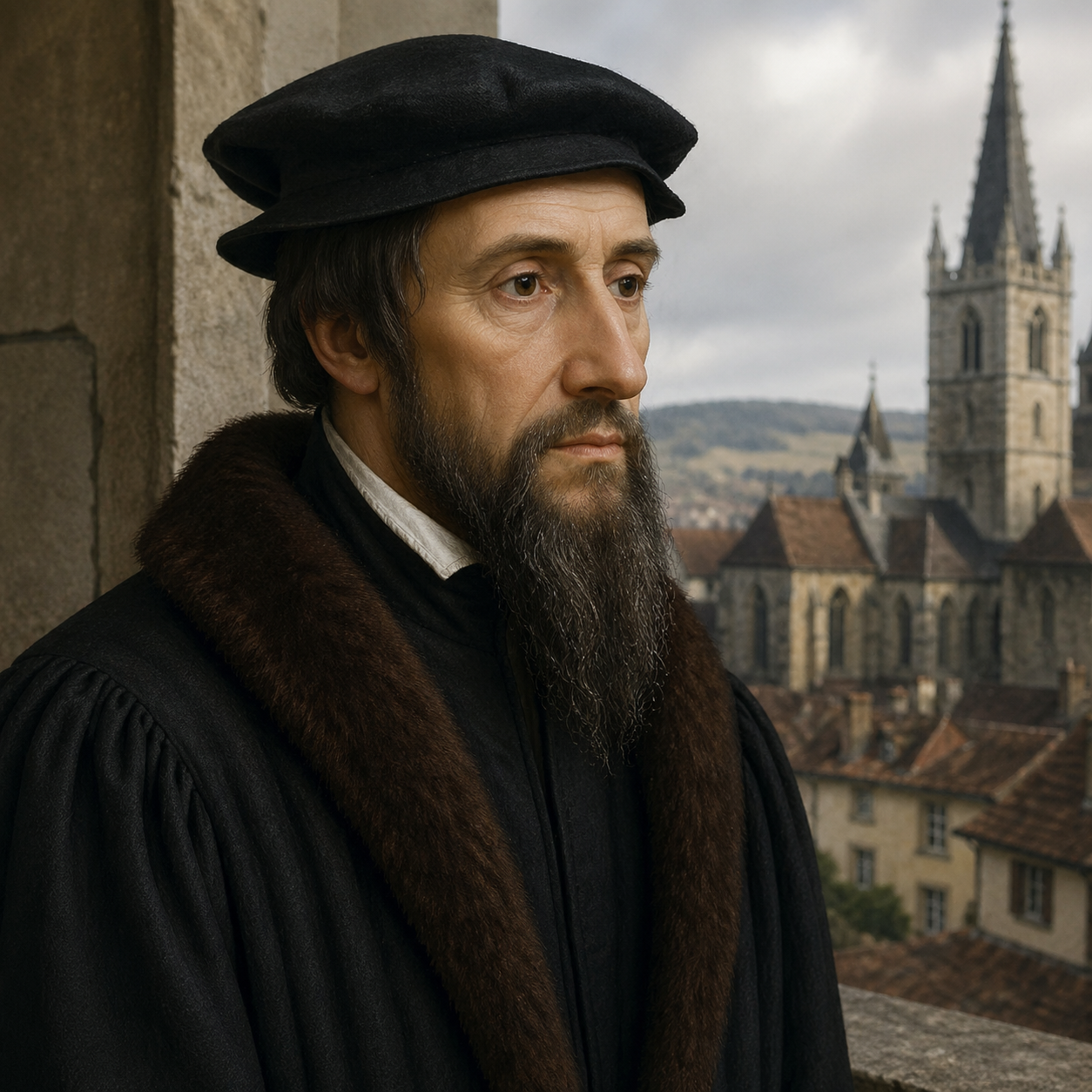
John Calvin — "The human heart is an idol factory."
The human heart is an idol factory.
The human heart is an idol factory.
Click any product to generate a realistic preview. Up to 3 at a time.
* Initial load can take up to 90 seconds — revising the preview in another color is nearly instant.
"God will not suffer that one of his children should be lost."
"The elect are preserved by the power of God unto salvation."
"Wherever we see the Word of God purely preached and heard, and the sacraments administered according to Christ's institution, there, it is not to be doubted, is a church of God."
"When God chooses a man, he does not consider what he is, but what he will make him."
"We are poor, miserable sinners, but God is rich in mercy."
French theologian whose Institutes of the Christian Religion (1536) systematized Protestant Reformed doctrine, including predestination. Closely associated with Martin Luther (Reformation founder, Calvin's predecessor). For an intellectual contrast, see Jacobus Arminius, Dutch Reformed theologian (1560-1609) — Arminius's rejection of strict double-predestination founded Arminianism — the theological tradition modern Methodism, most evangelicalism, and Pentecostalism descend from. The Calvinist-Arminian debate has divided Protestantism for 400 years.
Found in 1 providers: grok
1 source checked
The human heart perpetually invents substitutes for God — money, power, status, pleasure, ideology. Idolatry isn't confined to ancient pagans carving wooden statues; it is a universal, ceaseless human activity. Every person instinctively displaces the divine with something they can control or comprehend, manufacturing devotion toward whatever they value most. The heart, left unchecked, operates as a relentless production line of false gods competing for allegiance.
Calvin's doctrine of total depravity held that sin corrupts every human faculty, including will and intellect. As Geneva's chief reformer, he systematically stripped churches of icons, relics, and altarpieces, viewing them as products of exactly this tendency. His Institutes of the Christian Religion elaborates this diagnosis at length. The quote anchors his entire reform project: before right worship can be built, one must understand how deeply misdirected fallen human religious instinct already is.
Sixteenth-century Europe was consumed by the Reformation's iconoclasm wars. The Catholic Church filled cathedrals with paintings, statues, and relics that Reformers condemned as idols. Meanwhile Rome sold indulgences, and popular religion blended Christianity with folk superstition. Calvin wrote during the Reformation's most volatile decades, when Zwingli's followers physically smashed church images in Zurich. His quote gave theological grounding to that rupture: the root problem was not the objects themselves but the heart endlessly manufacturing them.
AI-generated insights based on extensive research and information for context. Factual errors? Email [email protected].
Your cart is empty