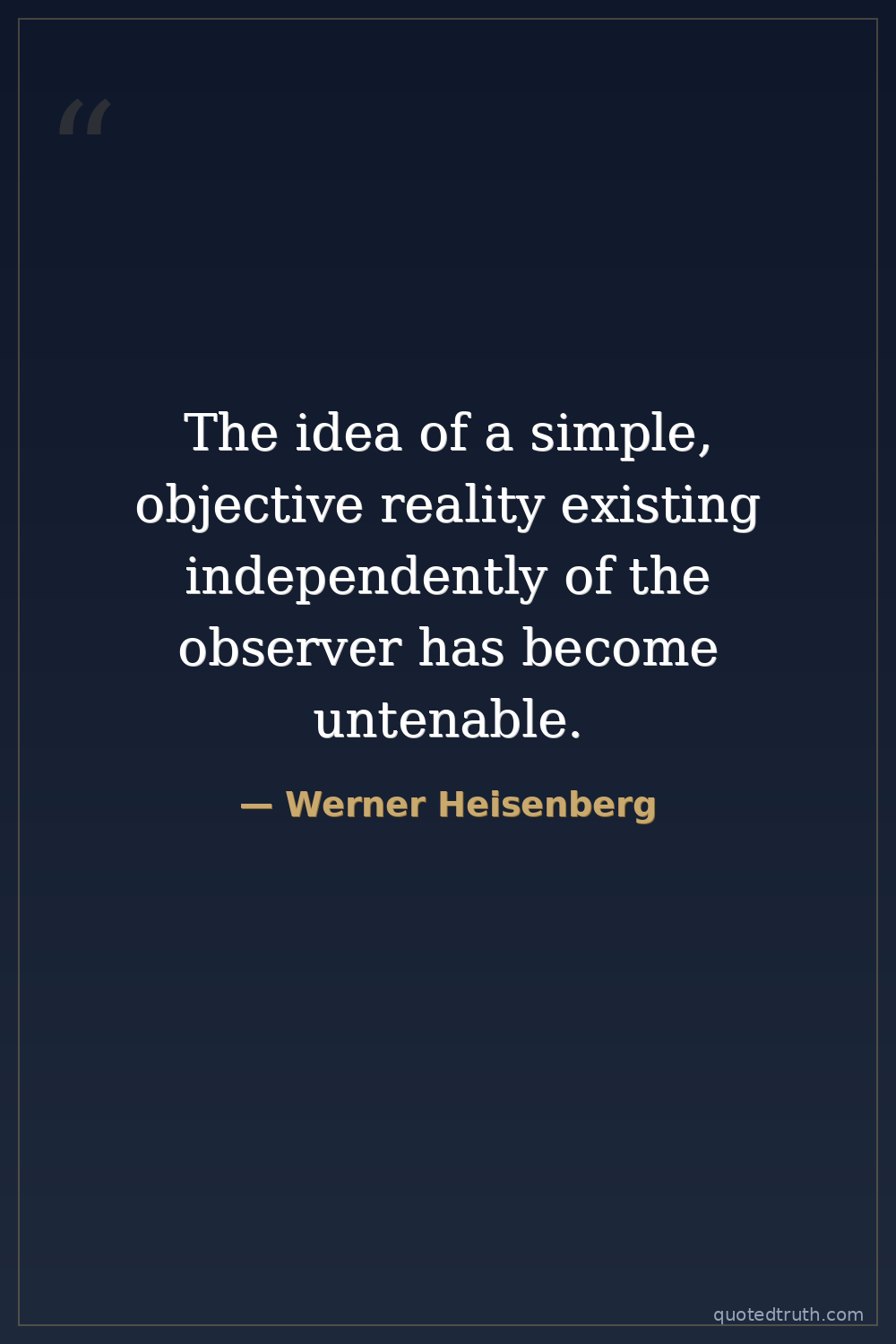
Werner Heisenberg — "The idea of a simple, objective reality existing independently of the observer h…"
The idea of a simple, objective reality existing independently of the observer has become untenable.
The idea of a simple, objective reality existing independently of the observer has become untenable.
Click any product to generate a realistic preview. Up to 3 at a time.
* Initial load can take up to 90 seconds — revising the preview in another color is nearly instant.
"The decision to break with the tradition of classical physics was a very difficult one."
"The uncertainty principle refers to the degree of indeterminateness in the possible present knowledge of the simultaneous values of various quantities with which the quantum theory deals."
"Natural science does not simply describe and explain nature; it is part of the interplay between nature and ourselves."
"An expert is someone who knows some of the worst mistakes that can be made in his subject and how to avoid them."
"One day, when we have learned to understand the elementary particles, we will have understood the whole world."
Summary of quantum mechanics' philosophical impact
Date: 1955 (Physics and Philosophy)
WisdomFound in 1 providers: grok
1 source checked
Heisenberg is saying we cannot describe the world as if it exists in a fixed, mind-independent state waiting to be measured. At the smallest scales, the act of observing changes what is observed, so properties like position or momentum only take definite values once measured. Reality is not a pre-set stage we simply view; it is entangled with how we probe it, making pure objectivity impossible in physics.
Heisenberg formulated the 1927 uncertainty principle, proving that position and momentum cannot both be precisely known. As a co-founder of matrix mechanics and a leader of the Copenhagen interpretation alongside Bohr, he argued physics describes our knowledge of nature, not nature itself. This statement captures the philosophical core of his life's work: measurement is participation, and the classical dream of a detached observer studying an untouched world collapses under quantum experiment.
In the 1920s and 30s, physics was overturning Newtonian certainty. Einstein's relativity had dissolved absolute space and time, and quantum experiments revealed wave-particle duality and probabilistic behavior. Heisenberg worked amid intense debate at Copenhagen, Göttingen, and the Solvay Conferences, clashing with Einstein's 'God does not play dice' stance. Later, under Nazi Germany, he led wartime nuclear research. His view reshaped not only physics but philosophy, influencing existentialism and modern skepticism about objective knowledge.
AI-generated insights based on extensive research and information for context. Factual errors? Email [email protected].
Your cart is empty