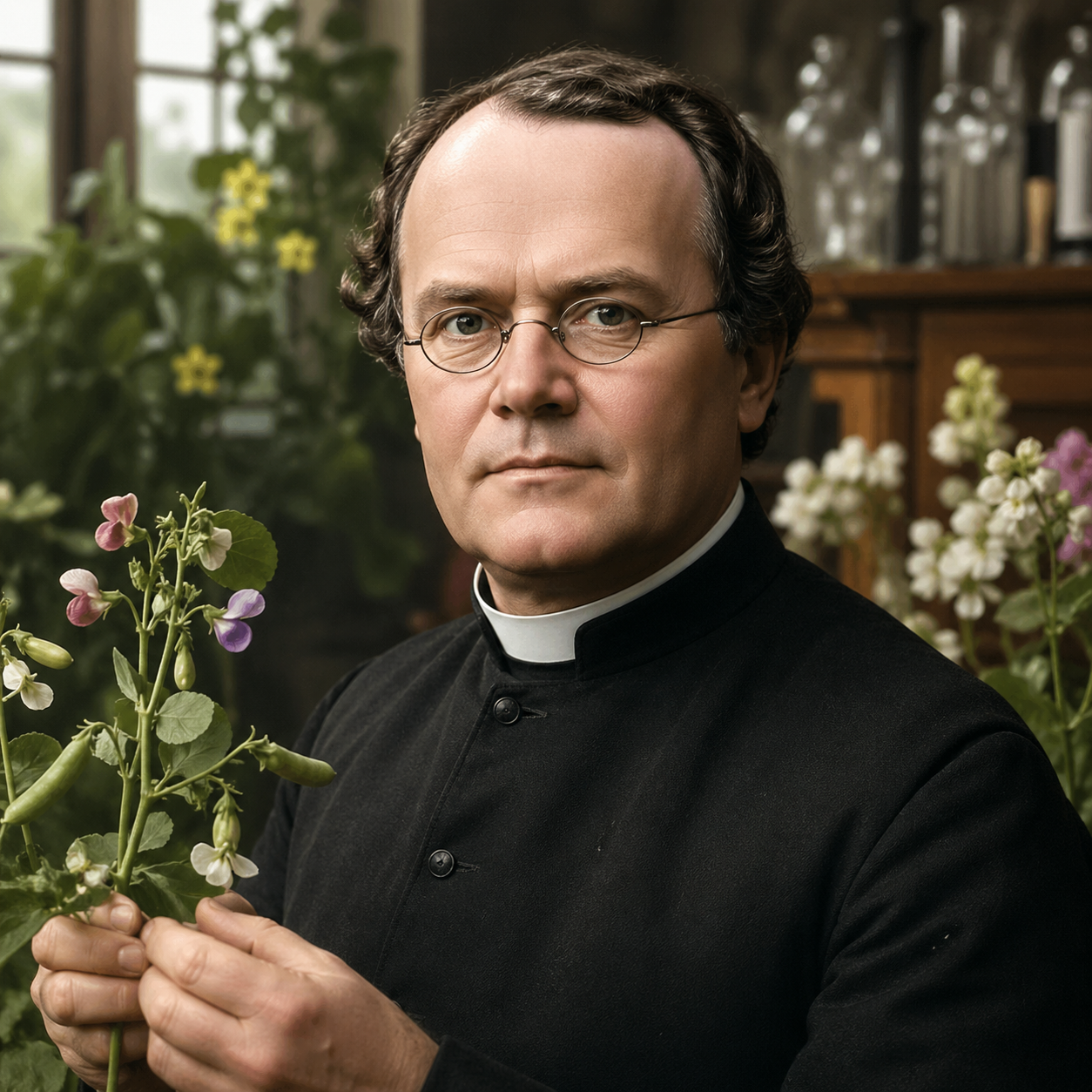
Gregor Mendel — "The laws of heredity are universal, whether in peas or in men."
The laws of heredity are universal, whether in peas or in men.
The laws of heredity are universal, whether in peas or in men.
Click any product to generate a realistic preview. Up to 3 at a time.
* Initial load can take up to 90 seconds — revising the preview in another color is nearly instant.
"I measure, I count, I compare—this is the way of science."
"My scientific studies have afforded me great satisfaction; and I am convinced that it will not be long before the whole world acknowledges the results of my work."
"The experiments have been carried out on a small scale, but the results are clear and unambiguous."
"Thus, on the average, among four plants two have the hybrid trait Aa, one the parental trait A, and the other the parental trait a. Therefore, 2Aa+ A +a or A + 2Aa + a is the empirical simple series f…"
"The numerical relations of the different forms in the successive generations are constant."
Found in 1 providers: deepseek
1 source checked
Biological inheritance operates by consistent mathematical rules across all living organisms. The same patterns governing how traits pass from parent to offspring in plants apply equally to animals and humans. Nature doesn't make exceptions based on species — variation, dominance, and segregation follow predictable ratios everywhere, making heredity a universal science rather than a collection of unrelated observations about different creatures.
Mendel spent eight years cultivating 29,000 pea plants in an Augustinian monastery garden, meticulously tracking seven distinct traits across generations. His monastic discipline and mathematical training led him to see patterns others missed. He believed deeply that divine order underpinned nature, and discovering universal biological laws confirmed his conviction that creation followed rational, consistent principles regardless of the organism studied.
Mendel published his findings in 1866, just seven years after Darwin's On the Origin of Species upended biology. Scientists were desperately seeking the mechanism driving evolution and variation. No one understood how traits were inherited or why offspring resembled parents. Mendel's monastery experiments, largely ignored until 1900, offered the missing mathematical foundation — hereditary units behaving by predictable laws across all life.
AI-generated insights based on extensive research and information for context. Factual errors? Email [email protected].
Your cart is empty