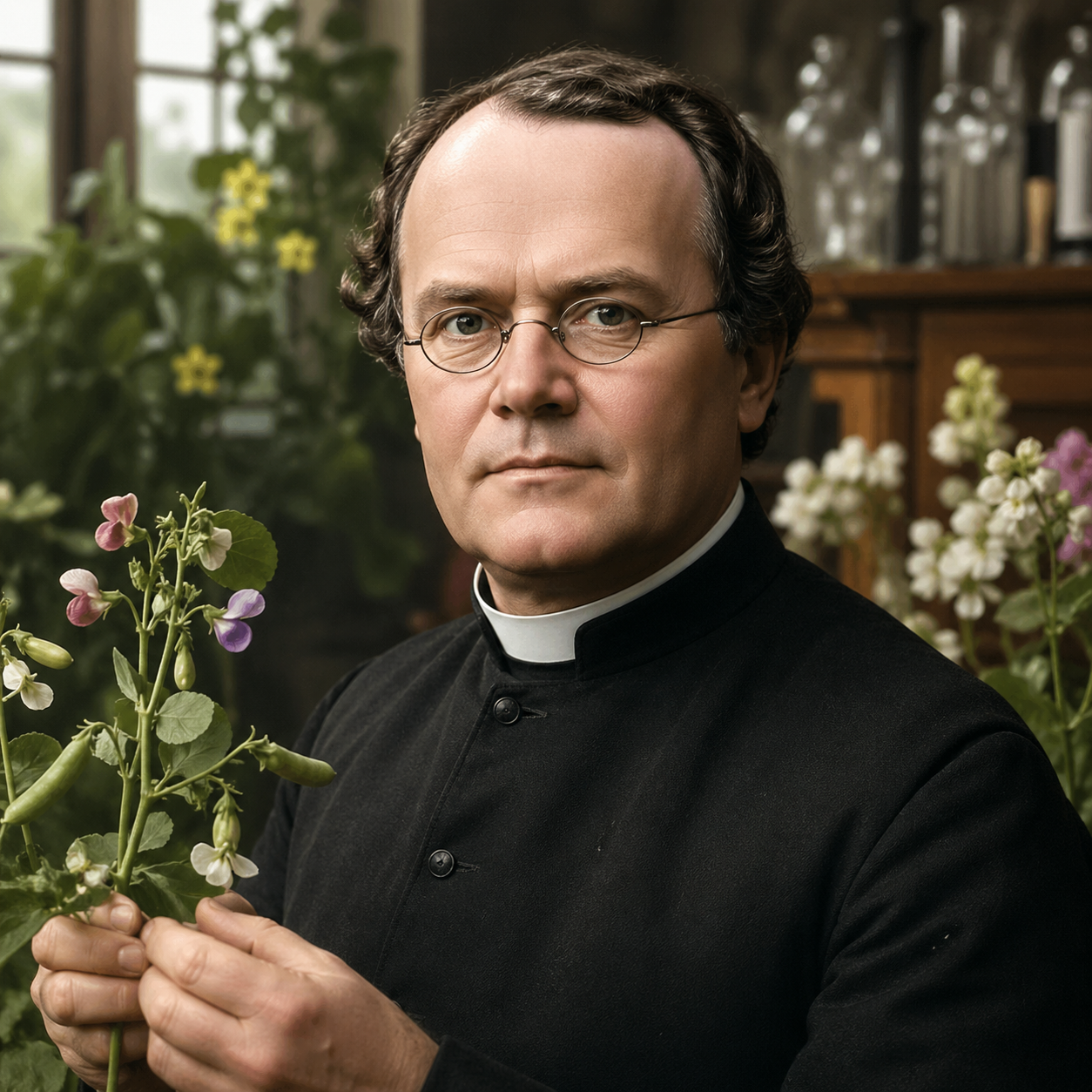
Gregor Mendel — "I hope that my experiments will furnish a new basis for the study of the history…"
I hope that my experiments will furnish a new basis for the study of the history of the organic forms.
I hope that my experiments will furnish a new basis for the study of the history of the organic forms.
Click any product to generate a realistic preview. Up to 3 at a time.
* Initial load can take up to 90 seconds — revising the preview in another color is nearly instant.
"The characters of the two parental forms are transmitted to the hybrid in an unchanged form."
"You should regard the numerical expressions as being only empirical, because they can not be proved rational."
"My scientific studies have afforded me great satisfaction; and I am convinced that it will not be long before the whole world acknowledges the results of my work."
"If I were to live a hundred years, I would not have enough time to test all the possible combinations."
"The experiments described were begun in 1856. The plants were grown in the garden of the monastery."
Found in 1 providers: grok
1 source checked
Mendel is expressing humble ambition — he hopes his pea plant experiments will create a new scientific foundation for understanding how living things have developed and changed across time. Rather than claiming discovery, he's hoping to give future scientists a framework: a rigorous, evidence-based approach to explaining biological inheritance and the historical patterns of life on Earth. He sees his work as a starting point, not a conclusion.
Mendel spent eight years crossing pea plants in a monastery garden in Brno, methodically recording thousands of offspring with monk-like precision. An Augustinian friar with no formal laboratory, he knew his 1866 paper was revolutionary but couched his ambitions in characteristic humility — 'I hope' rather than 'I have proved.' His lifelong belief that nature follows mathematical laws drove him to see heredity not as mystery but as a quantifiable, historical process.
Mendel published his findings in 1866, seven years after Darwin's On the Origin of Species reshaped science. Darwin's evolution theory urgently needed a mechanism explaining how traits pass between generations — a gap Mendel's laws of heredity would fill, though science wouldn't recognize it for 34 years. Biology was transitioning from descriptive natural history to experimental science, and Mendel's statistical approach to heredity was decades ahead of what most contemporaries could yet comprehend.
AI-generated insights based on extensive research and information for context. Factual errors? Email [email protected].
Your cart is empty