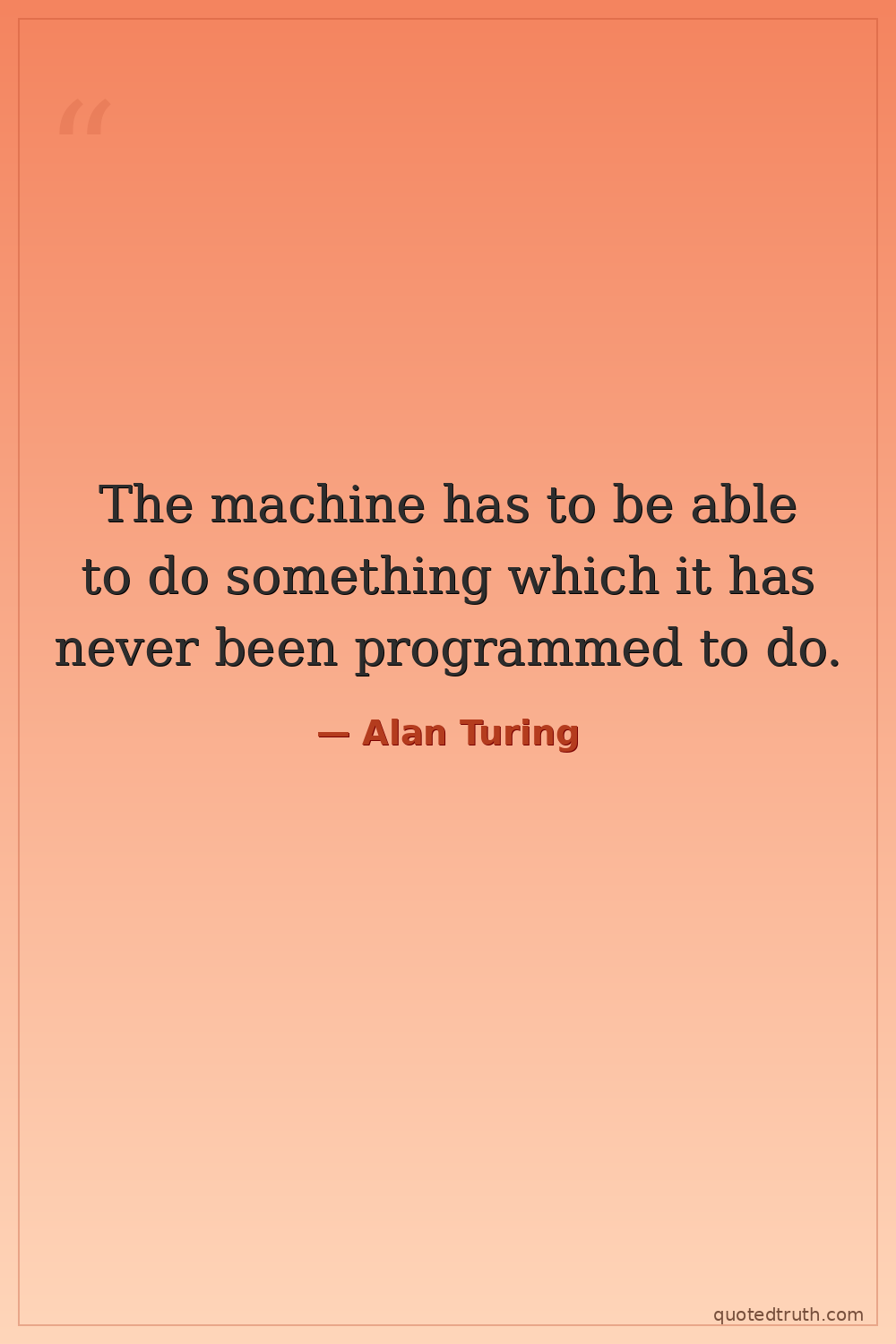
Alan Turing — "The machine has to be able to do something which it has never been programmed to…"
The machine has to be able to do something which it has never been programmed to do.
The machine has to be able to do something which it has never been programmed to do.
Click any product to generate a realistic preview. Up to 3 at a time.
* Initial load can take up to 90 seconds — revising the preview in another color is nearly instant.
"The true sign of intelligence is not knowledge but imagination."
"The important thing is not to stop questioning."
"The extent to which we regard mind as distinct from matter, is a matter of convention."
"The problems of biology can be reduced to physics and chemistry."
"The problem of constructing a universal machine is not insoluble."
Found in 1 providers: grok
1 source checked
True intelligence — human or machine — isn't just executing memorized instructions. A genuinely intelligent machine must generalize: facing a new problem it was never explicitly taught to solve, it should still find an answer. That gap between stored rules and novel action is where real thinking begins. It's the foundational idea behind modern machine learning, where systems trained on data handle situations no programmer ever anticipated.
Turing's landmark 1950 paper 'Computing Machinery and Intelligence' proposed the Turing Test and explored 'learning machines' — systems that adapt beyond initial programming. At Bletchley Park, he cracked Enigma not by brute memorization but by inferring hidden patterns, the same generalization he demanded of machines. Turing believed intelligence meant escaping rigid rules, a conviction his own unconventional, boundary-breaking thinking consistently demonstrated.
In the early 1950s, computers were enormous fixed-program machines — the Manchester Mark 1, ENIAC — strictly executing predefined instructions. The Cold War drove urgent interest in computation, but thinking machines were philosophical fantasy, not engineering goals. Turing's 1950 paper dropped into that world like a provocation: at a moment when programmers wrote every instruction by hand, he was already asking whether machines could outgrow their own code.
AI-generated insights based on extensive research and information for context. Factual errors? Email [email protected].
Your cart is empty