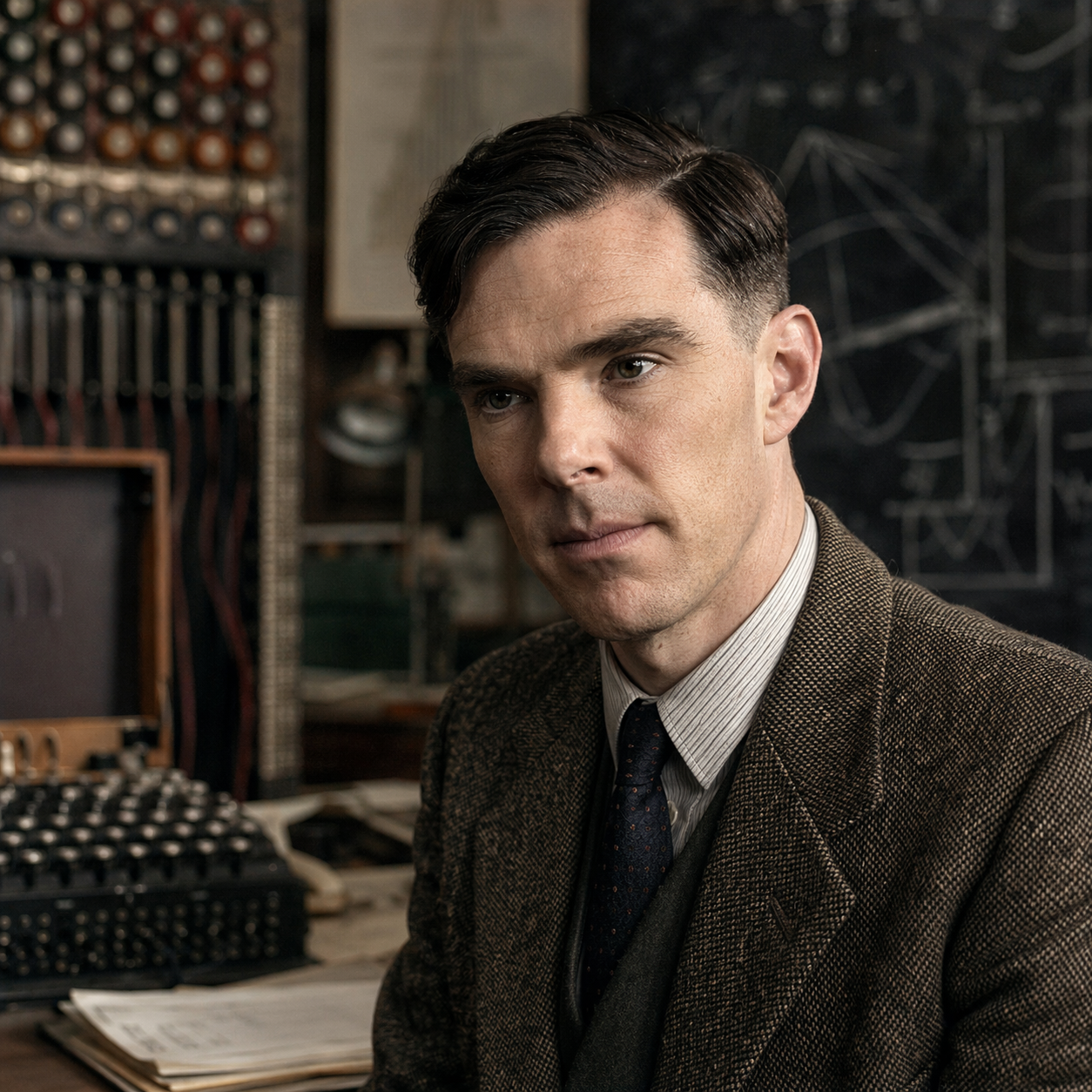
Alan Turing — "The machine should be able to use language."
The machine should be able to use language.
The machine should be able to use language.
Click any product to generate a realistic preview. Up to 3 at a time.
* Initial load can take up to 90 seconds — revising the preview in another color is nearly instant.
"The human mind is an emergent property of the brain."
"I expect to lie in the sun, talk French and modern Greek, and make love, though the sex and nationality... has yet to be decided: in fact it is quite possible that this item will be altogether omitted…"
"I believe that at the end of the century the use of words and general educated opinion will have altered so much that one will be able to speak of machines thinking without expecting to be contradicte…"
"Science is a differential equation. Religion is a boundary condition."
"The future belongs to those who believe in the beauty of their dreams."
Found in 1 providers: grok
1 source checked
The idea that a machine should not only calculate but actually use language — understand it, generate it, communicate with it. This cuts to the heart of what separates mere computation from intelligence. Language is the primary medium of human thought and social life, so a machine that can use it crosses a fundamental threshold. The statement anticipates modern AI, natural language processing, and the entire field of computational linguistics.
Turing's 1950 paper 'Computing Machinery and Intelligence' proposed what became the Turing Test: if a machine could converse indistinguishably from a human, it should be deemed intelligent. This wasn't abstract philosophy — Turing wrote actual programs to play chess and generate poetry. As a codebreaker at Bletchley Park, he saw language as structured and rule-governed. His entire career orbited the question of whether minds — and their language — could be simulated by machines.
In the early 1950s, computers were massive arithmetic engines — ENIAC, Colossus, the Manchester Mark 1. The public and scientific community saw them as glorified calculators, not thinking entities. Cold War pressures drove computation toward weapons and cryptography, not conversation. Turing's insistence that machines could use language challenged the era's mechanical worldview and laid groundwork for AI research that wouldn't bear fruit for decades. His vision was countercultural in a world of punch cards and military contracts.
AI-generated insights based on extensive research and information for context. Factual errors? Email [email protected].
Your cart is empty