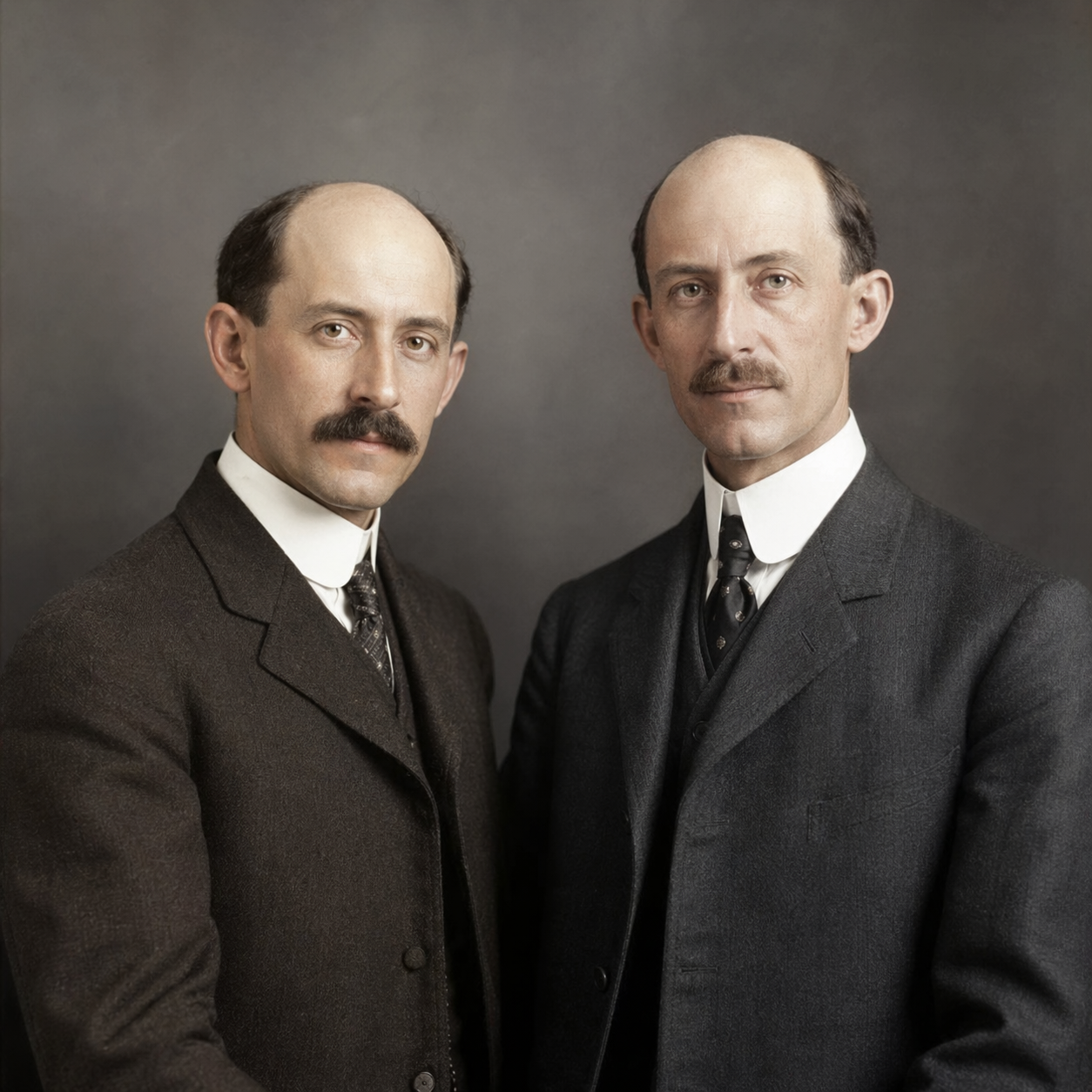
Wright Brothers (Orville & Wilbur) — "The machine is a living thing, and must be treated as such."
The machine is a living thing, and must be treated as such.
The machine is a living thing, and must be treated as such.
Click any product to generate a realistic preview. Up to 3 at a time.
* Initial load can take up to 90 seconds — revising the preview in another color is nearly instant.
"We were not seeking fame or fortune, but simply to solve a problem."
"We could not but feel that the time was at hand for man to make a practical flight."
"When one comes to increase the size of the craft, the possibility rapidly fades away. This is because of the difficulties of carrying sufficient fuel. It will readily be seen, therefore, why the Atlan…"
"We have at last succeeded in making a machine that will fly."
"The greatest value of our work is that it will be an inspiration to others."
American aviation pioneers who achieved the first sustained powered controlled airplane flight at Kitty Hawk, NC, on December 17, 1903. Closely associated with Octave Chanute (their gliding mentor and aeronautical correspondent). For an intellectual contrast, see Samuel Pierpont Langley, Smithsonian Institution Secretary and government-funded aviation researcher — Langley's Aerodrome crashed twice into the Potomac in October-December 1903 with $50,000 of War Department funding; the Wright Brothers' bicycle-shop empiricism beat Langley's institutional Big Science by 9 days. The most-cited example in engineering history of empirical-tinkerer beating institution-funded credentialism.
Found in 1 providers: grok
1 source checked
A flying machine is not a lifeless assembly of wood, wire, and canvas but behaves like a living creature with its own moods, responses, and tolerances. The operator must listen to it, learn its quirks, and adjust constantly rather than force it to obey. Respect, attentiveness, and a feel for subtle signals matter as much as mechanical knowledge. Treat the craft as a partner, and it will respond; treat it as inert, and it will punish you.
The Wrights obsessed over feel and responsiveness. Unlike rivals who built powerful engines and hoped for the best, they logged thousands of glides at Kitty Hawk, memorizing how warped wings, rudder, and wind interacted. Wing-warping control, invented through patient observation, demanded that a pilot read the aircraft continuously. Bicycle mechanics by trade, they understood balance as dialogue between rider and machine, and carried that intuition into aviation, where mishandling a Flyer meant a broken spar or a broken neck.
At the turn of the twentieth century, machines were reshaping daily life: railroads, telephones, automobiles, and factory dynamos. Most inventors treated them as brute hardware, problems of horsepower and leverage. Aeronautics was littered with deaths because would-be aviators like Lilienthal and Langley underestimated control. The Wrights' 1903 breakthrough at Kitty Hawk arrived in a culture just beginning to accept that complex mechanisms required skill, calibration, and respect, not merely strength or bolder engines and grander launch rails.
AI-generated insights based on extensive research and information for context. Factual errors? Email [email protected].
Your cart is empty