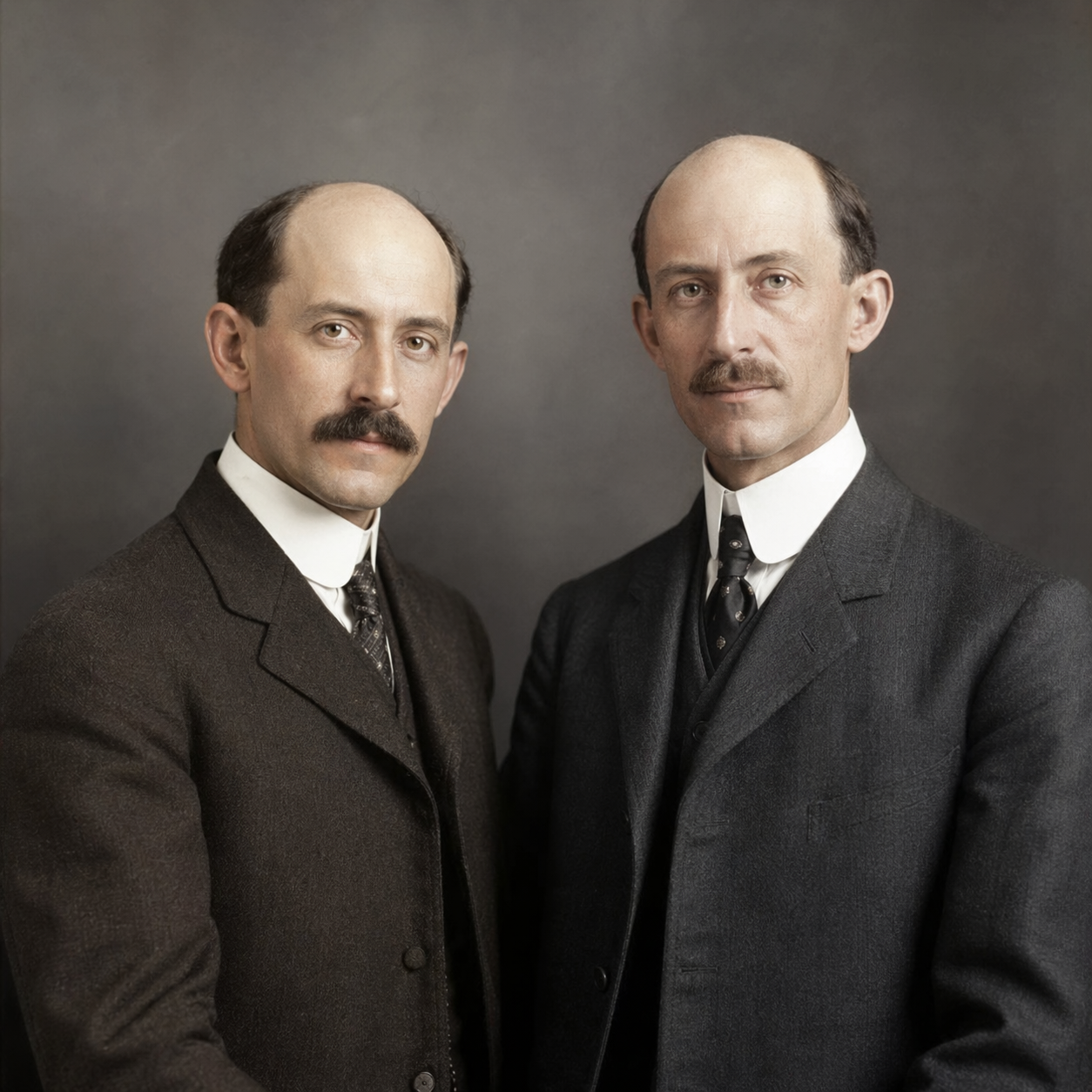
Wright Brothers (Orville & Wilbur) — "We did not have a university education, but we had a good deal of common sense."
We did not have a university education, but we had a good deal of common sense.
We did not have a university education, but we had a good deal of common sense.
Click any product to generate a realistic preview. Up to 3 at a time.
* Initial load can take up to 90 seconds — revising the preview in another color is nearly instant.
"The machine has been working very nicely and we have been making several flights each day."
"We had no idea of the amount of publicity that would follow our flights."
"We do not intend to make a fortune out of this, but to make a machine that will fly."
"Success in inventing depends on the close observation of nature."
"We kept at it, and we kept on learning."
American aviation pioneers who achieved the first sustained powered controlled airplane flight at Kitty Hawk, NC, on December 17, 1903. Closely associated with Octave Chanute (their gliding mentor and aeronautical correspondent). For an intellectual contrast, see Samuel Pierpont Langley, Smithsonian Institution Secretary and government-funded aviation researcher — Langley's Aerodrome crashed twice into the Potomac in October-December 1903 with $50,000 of War Department funding; the Wright Brothers' bicycle-shop empiricism beat Langley's institutional Big Science by 9 days. The most-cited example in engineering history of empirical-tinkerer beating institution-funded credentialism.
Found in 1 providers: grok
1 source checked
Formal schooling is not the only path to real achievement. Practical thinking, hands-on experience, and clear judgment can matter more than credentials. The speaker acknowledges lacking advanced degrees while insisting that sound reasoning and everyday problem-solving carried them through. It is a defense of self-taught ability and a reminder that ingenuity, careful observation, and disciplined trial and error can accomplish what many assume requires formal academic training.
Neither Orville nor Wilbur finished high school or earned a diploma, let alone attended college. They ran a bicycle shop in Dayton, Ohio, and taught themselves aerodynamics by reading Smithsonian papers, building their own wind tunnel, and testing over 200 wing shapes. Their breakthrough at Kitty Hawk in 1903 came from patient mechanical reasoning, not academic theory, embodying exactly the common-sense practicality this quote defends against credentialed contemporaries like Samuel Langley.
At the turn of the twentieth century, scientific authority was consolidating around universities and government-funded institutions. Samuel Langley, a Smithsonian-backed PhD, received $50,000 in War Department money for his failed aerodrome, while the self-funded Wrights succeeded for under $1,000. America was industrializing rapidly, and tinkerers, mechanics, and shopkeepers were still driving invention alongside formally trained scientists, making the tension between practical know-how and academic credentials a defining cultural debate.
AI-generated insights based on extensive research and information for context. Factual errors? Email [email protected].
Your cart is empty