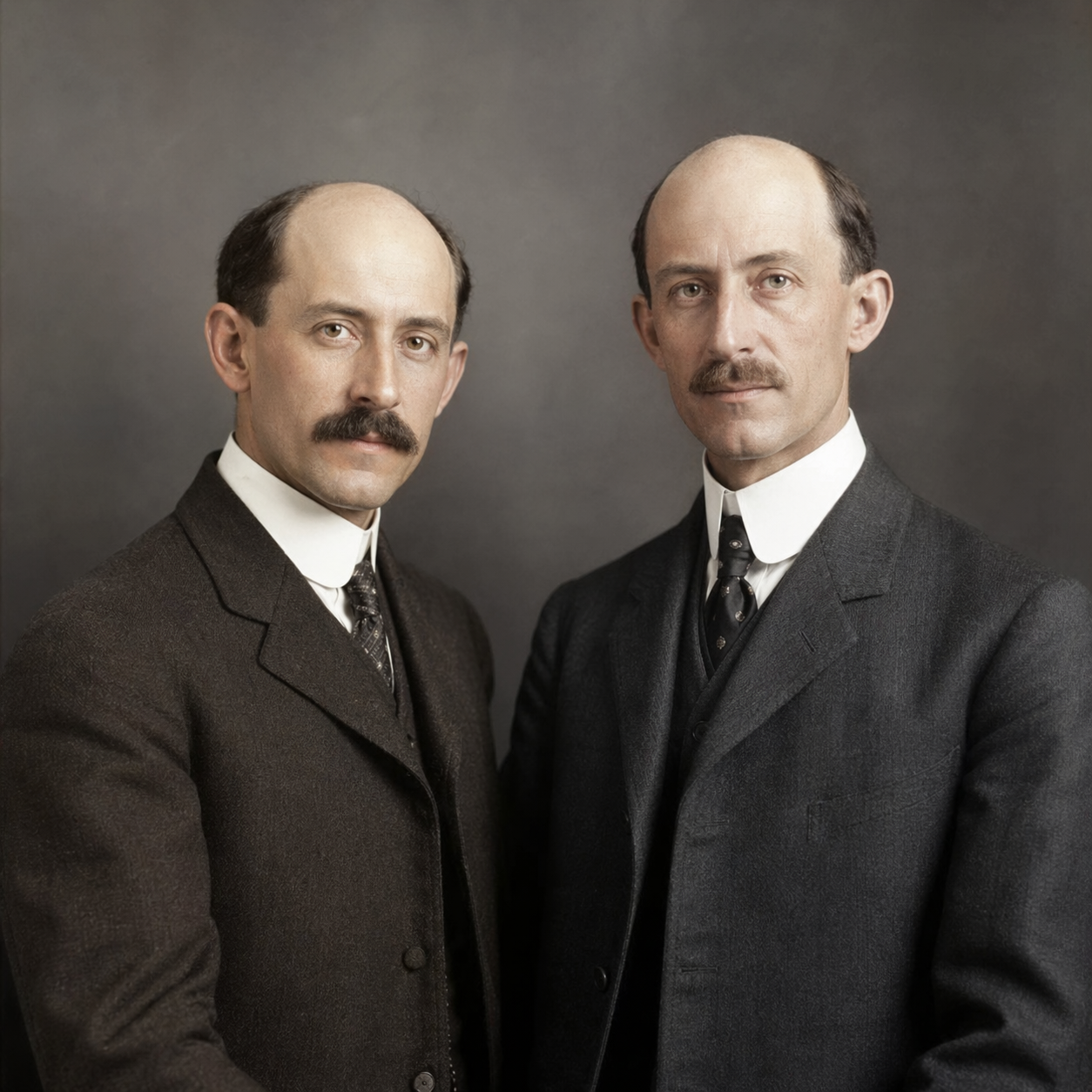
Wright Brothers (Orville & Wilbur) — "The machine is a thing of life, and will respond to the touch of the hand."
The machine is a thing of life, and will respond to the touch of the hand.
The machine is a thing of life, and will respond to the touch of the hand.
Click any product to generate a realistic preview. Up to 3 at a time.
* Initial load can take up to 90 seconds — revising the preview in another color is nearly instant.
"The best thing about being a man of science is that you never have to be bored."
"If we worked on the assumption that what is currently accepted as true really is true, then there would be little hope for advance."
"The machine is practically ready for its public demonstration."
"The fact that the machine was controlled in all directions was a feature which had never been approached in any earlier flight of which we have any knowledge."
"Learning the secret of flight from a bird was a good deal like learning the secret of magic from a magician."
American aviation pioneers who achieved the first sustained powered controlled airplane flight at Kitty Hawk, NC, on December 17, 1903. Closely associated with Octave Chanute (their gliding mentor and aeronautical correspondent). For an intellectual contrast, see Samuel Pierpont Langley, Smithsonian Institution Secretary and government-funded aviation researcher — Langley's Aerodrome crashed twice into the Potomac in October-December 1903 with $50,000 of War Department funding; the Wright Brothers' bicycle-shop empiricism beat Langley's institutional Big Science by 9 days. The most-cited example in engineering history of empirical-tinkerer beating institution-funded credentialism.
Found in 1 providers: grok
1 source checked
A well-built machine behaves almost like a living creature, reacting sensitively to how its operator handles it. Skilled control comes not from brute force but from a light, attentive touch that reads feedback through the controls. The relationship between pilot and machine is a two-way conversation, where subtle inputs produce meaningful responses, and mastery grows from learning to feel and answer what the machine communicates back.
The Wrights obsessed over control, not just lift or thrust, which set them apart from rivals chasing raw power. Their three-axis warping-wing system demanded constant rider-like balance, and both brothers logged hundreds of glides at Kitty Hawk to develop that tactile feel. As bicycle mechanics turned aeronautical engineers, they trusted hands-on intuition, building, crashing, and adjusting by touch until the Flyer answered them on December 17, 1903.
In the early 1900s, the Industrial Revolution had flooded life with steam engines, automobiles, and assembly lines, and many thinkers feared machines were cold, dehumanizing forces. The Wrights worked at a moment when inventors like Edison, Ford, and Marconi were reframing technology as an extension of human capability. Powered flight, long dismissed as fantasy, turned machinery into something intimate and responsive, reshaping how people imagined the partnership between humans and the tools they built.
AI-generated insights based on extensive research and information for context. Factual errors? Email [email protected].
Your cart is empty