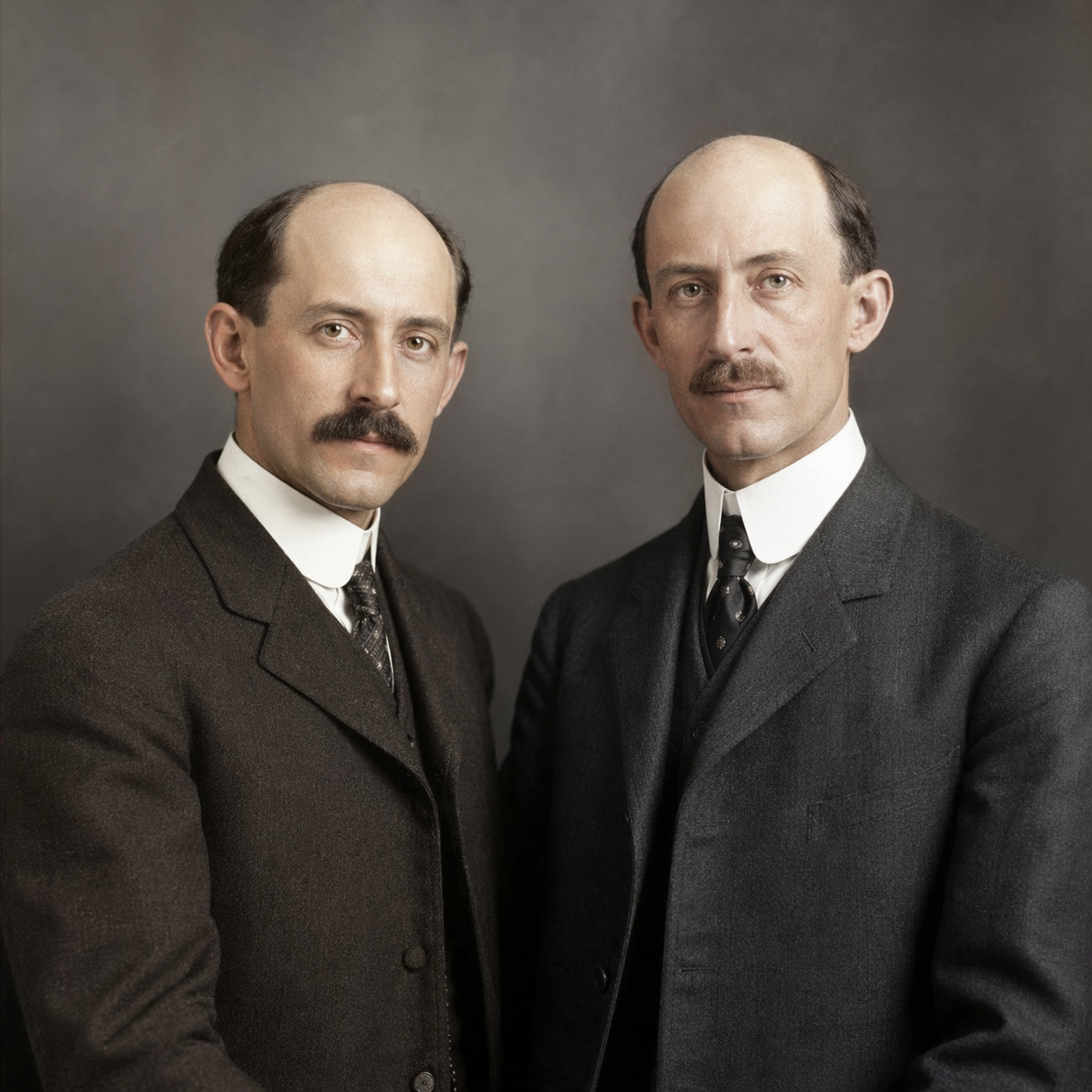
Wright Brothers (Orville & Wilbur) — "The machine is a triumph of human ingenuity."
The machine is a triumph of human ingenuity.
The machine is a triumph of human ingenuity.
Click any product to generate a realistic preview. Up to 3 at a time.
* Initial load can take up to 90 seconds — revising the preview in another color is nearly instant.
"It is not disputed that every person who is using this system today owes it to us and to us alone."
"The course of the experiment was not always smooth. The machine would start all right, but the propelling power was not sufficient to overcome the resistance of the air."
"We could hardly wait to get up in the morning."
"The time will come when man will fly."
"The machine is a thing of life, and will respond to the touch of the hand."
American aviation pioneers who achieved the first sustained powered controlled airplane flight at Kitty Hawk, NC, on December 17, 1903. Closely associated with Octave Chanute (their gliding mentor and aeronautical correspondent). For an intellectual contrast, see Samuel Pierpont Langley, Smithsonian Institution Secretary and government-funded aviation researcher — Langley's Aerodrome crashed twice into the Potomac in October-December 1903 with $50,000 of War Department funding; the Wright Brothers' bicycle-shop empiricism beat Langley's institutional Big Science by 9 days. The most-cited example in engineering history of empirical-tinkerer beating institution-funded credentialism.
Found in 1 providers: grok
1 source checked
This statement celebrates mechanical invention as proof of what human creativity can achieve. A machine, built from raw materials and careful design, represents problems solved through reasoning, experimentation, and persistence. Calling it a triumph means the builders overcame limits that once seemed fixed. The quote honors the mind behind the metal, suggesting that tools are not just objects but evidence of our capacity to think, plan, and reshape the physical world.
The Wrights spent years as bicycle mechanics before tackling flight, hand-building engines, propellers, and wind tunnels when no suppliers existed. They rejected prevailing aerodynamic data, calculated their own lift tables, and crafted the 1903 Flyer from spruce, muslin, and a custom aluminum engine. For them, a working machine was hard-won intellectual victory, not luck. This quote mirrors their conviction that disciplined tinkering, not inherited genius, turned the impossible dream of powered flight into a functioning aircraft at Kitty Hawk.
The Wrights flew in 1903, amid the Second Industrial Revolution's explosion of engines, electricity, telephones, and automobiles. Edison, Tesla, Ford, and Marconi were reshaping daily life, and the public believed technology could conquer any barrier. Yet respected scientists still declared heavier-than-air flight impossible. Against that backdrop, a functioning flying machine was not just novel but philosophically charged, proof that methodical human ingenuity, rather than divine limit or academic consensus, decided what was achievable in the dawning machine age.
AI-generated insights based on extensive research and information for context. Factual errors? Email [email protected].
Your cart is empty