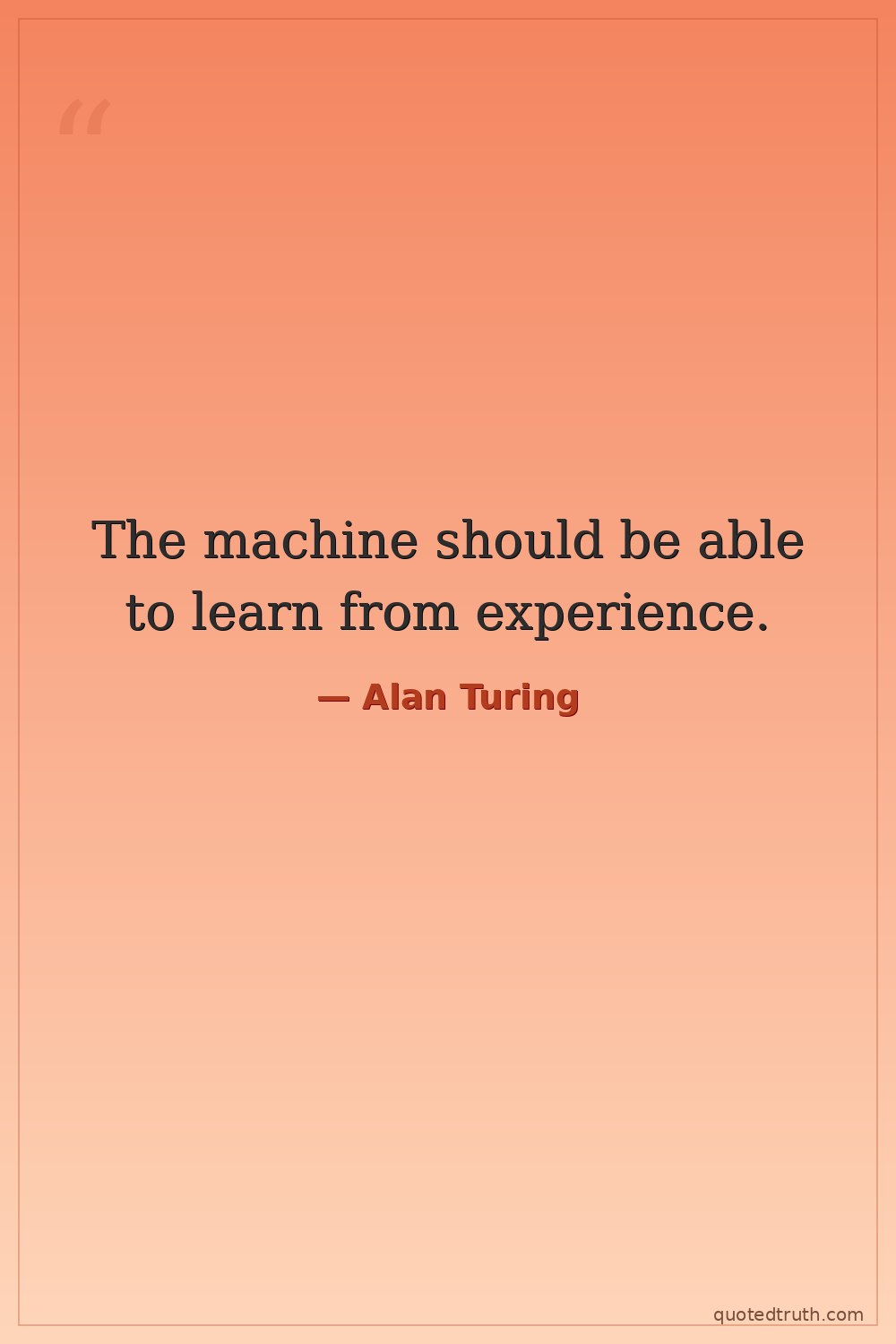
Alan Turing — "The machine should be able to learn from experience."
The machine should be able to learn from experience.
The machine should be able to learn from experience.
Click any product to generate a realistic preview. Up to 3 at a time.
* Initial load can take up to 90 seconds — revising the preview in another color is nearly instant.
"The extent to which we regard something as a machine is a matter of degree."
"Mathematical reasoning may be regarded rather schematically as the exercise of a combination of two facilities, which we may call intuition and ingenuity. The activity of the intuition consists in mak…"
"The view that machines cannot give rise to surprises is due, I believe, to a fallacy to which philosophers and mathematicians are particularly subject. This is the assumption that as soon as a fact is…"
"The problem of consciousness is a difficult one, and I do not have a solution to it."
"The true sign of intelligence is not knowledge but imagination."
Found in 1 providers: grok
1 source checked
Machines should not just execute fixed rules — they should improve through experience, adjusting behavior based on what they encounter. This is the core principle behind modern machine learning: systems that refine their performance on data rather than relying solely on hand-crafted logic. Every neural network, recommendation algorithm, and large language model running today is a direct descendant of this single insight.
Turing proposed this in his landmark 1950 paper on computing machinery and intelligence, where he introduced the Turing Test. He believed intelligence was developmental — his child machine concept envisioned systems trained like children rather than pre-programmed as adults. As a codebreaker at Bletchley Park, he understood adaptation as survival: Enigma solutions required machines that could update as German operators changed their cipher settings daily.
Turing wrote this in 1950, a postwar era when computers were massive, room-filling calculators executing rigid instructions. The dominant view held that machines were deterministic tools incapable of anything resembling thought. Turing's claim was radical — almost heretical in academic circles still skeptical that mathematics could explain mind. Cold War urgency around computation and cryptography gave governments reason to fund these ideas, even as Turing himself faced persecution for his sexuality.
AI-generated insights based on extensive research and information for context. Factual errors? Email [email protected].
Your cart is empty