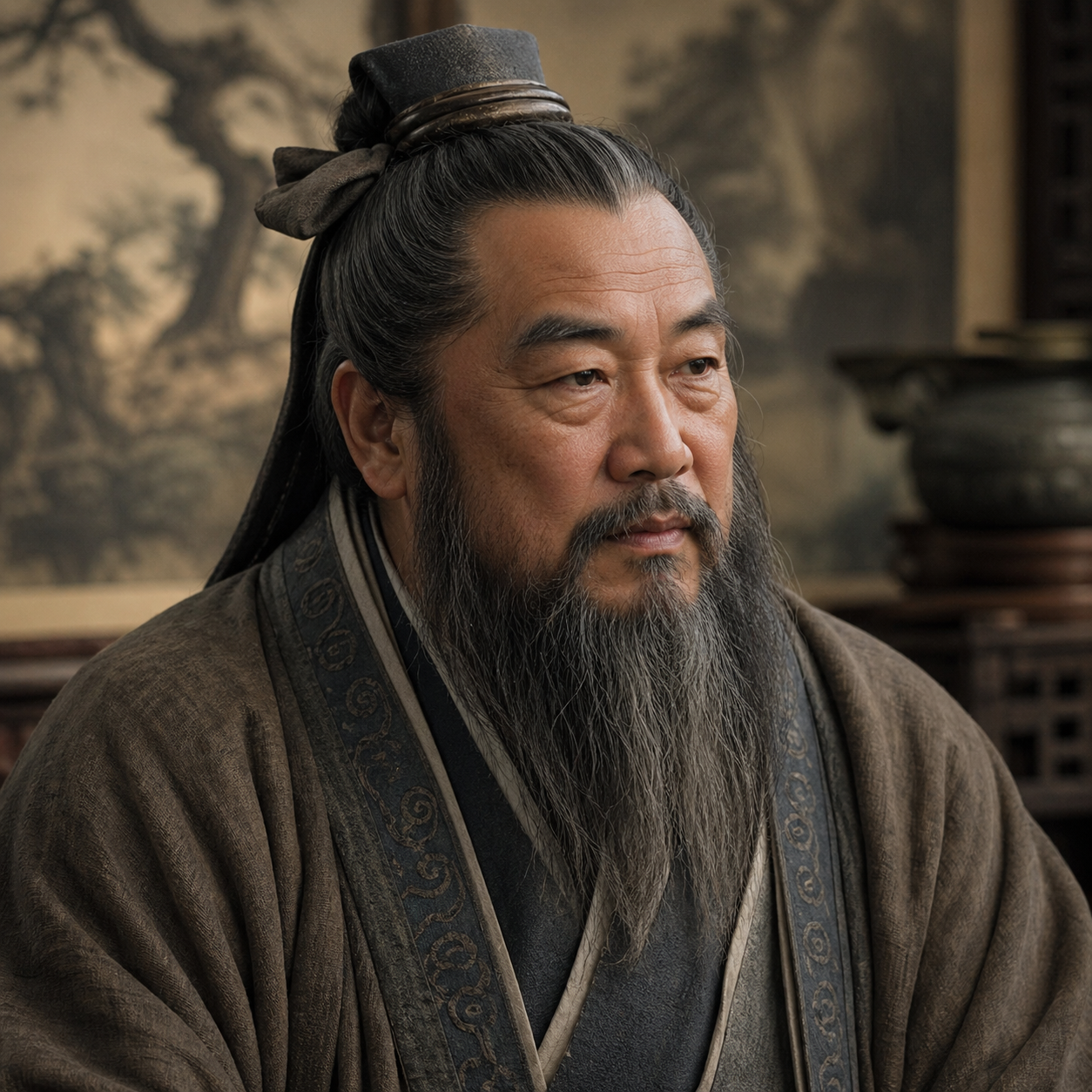
Confucius — "The Master said, 'A man can enlarge the Way, but the Way cannot enlarge a man.'"
The Master said, 'A man can enlarge the Way, but the Way cannot enlarge a man.'
The Master said, 'A man can enlarge the Way, but the Way cannot enlarge a man.'
Click any product to generate a realistic preview. Up to 3 at a time.
* Initial load can take up to 90 seconds — revising the preview in another color is nearly instant.
"The superior man is easy to serve but difficult to please; the inferior man is difficult to serve but easy to please."
"The gentleman considers righteousness to be essential. He performs it according to the rules of propriety. He brings it forth in humility. He completes it with sincerity. This is indeed a gentleman."
"The superior man is dignified, but not contentious; social, but not clannish."
"If the mechanic wishes to do his work well, he must first sharpen his tools."
"If a man in the morning hear the right way, he may die in the evening hear regret."
Chinese philosopher and teacher whose teachings (compiled by his students in the Analects) became the foundational ethical framework of East Asian civilization for 2,500 years. Closely associated with Mencius (his most-influential follower a century later). For an intellectual contrast, see Laozi, near-contemporary Chinese sage and Tao Te Ching author — Confucius systematized social order through ritual and family hierarchy; Laozi's Taoist effortless-action philosophy argued such systems were the disease, not the cure. The two founding poles of Chinese moral philosophy — every East Asian moral tradition since has positioned itself between them.
The standard scholarly entry points to Confucius's work: Philip J. Ivanhoe (Georgetown, Chinese philosophy) — Confucian Moral Self Cultivation (2000); Edward Slingerland (UBC, Asian Studies) — Effortless Action: Wu-wei as Conceptual Metaphor (2003); Tu Weiming (Harvard, Confucian scholar) — Confucian Thought: Selfhood as Creative Transformation (1985). These are the works graduate seminars cite when teaching Confucius.
Found in 1 providers: grok
1 source checked
Principles and ideals don't elevate a person automatically. A human being must actively embody, expand, and bring meaning to a moral path through their choices and effort. The path itself is inert without someone living it out. Growth depends on human agency and commitment, not on passively belonging to a tradition or doctrine. You make the philosophy matter, not the other way around.
Confucius spent his life as a wandering teacher trying to revive ancient virtues in rulers who ignored him. He believed moral cultivation required personal effort, study, and ritual practice, not mere lineage or titles. His emphasis on self-improvement, sincerity, and junzi (the exemplary person) shaped this view: the Way (Dao) lives only through disciplined individuals actively enlarging it through daily conduct.
Confucius lived during the late Spring and Autumn period (551-479 BCE), when the Zhou dynasty was fracturing and warlords ignored traditional rites. Social chaos made many question whether old values still mattered. Confucius insisted that cultural renewal depended on committed individuals, not nostalgic rules. His teaching circulated as China moved toward the Warring States era, where competing schools debated whether humans or heaven ultimately carried moral order.
AI-generated insights based on extensive research and information for context. Factual errors? Email [email protected].
Your cart is empty