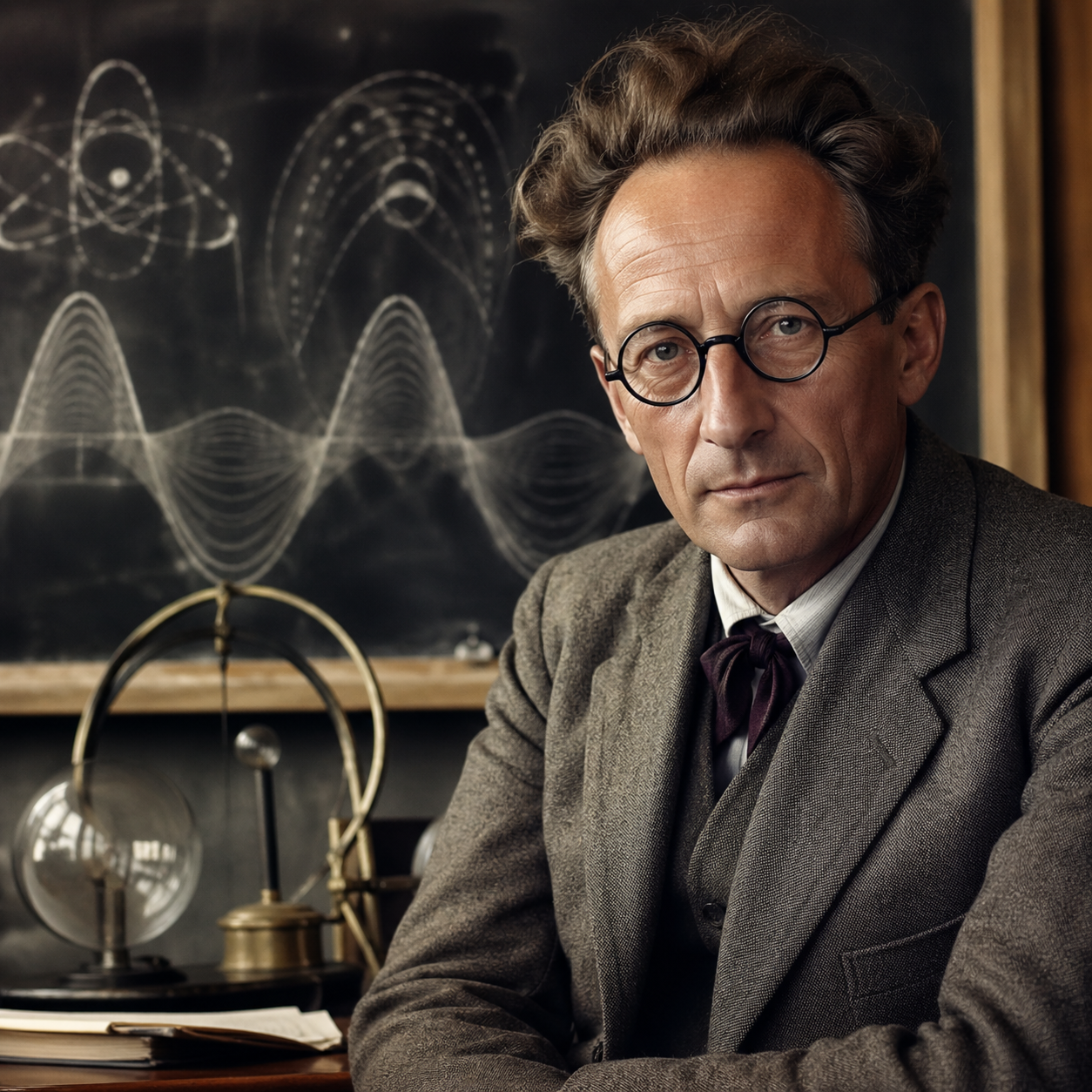
Erwin Schrodinger — "The meaning of life is to be found in the experience of living itself."
The meaning of life is to be found in the experience of living itself.
The meaning of life is to be found in the experience of living itself.
Click any product to generate a realistic preview. Up to 3 at a time.
* Initial load can take up to 90 seconds — revising the preview in another color is nearly instant.
"The fact that life exists and that it is maintained by a continuous stream of 'negentropy' from the outside, is the most profound mystery of all."
"Science without religion is lame, religion without science is blind."
"The problem of the 'thing in itself' is not a problem that can be solved by science. It is a philosophical problem."
"If we were to take the general view of the world as consisting of individual consciousnesses, each one having its own unique experience, then we would be faced with an enormous number of independent w…"
"We do not belong to this material world that science constructs for us. We are not in it; we are outside. We are only spectators. The reason why we believe that we are in it, that we belong to the pic…"
Austrian physicist who shared the 1933 Nobel for the wave equation that bears his name and the famous cat thought-experiment. Closely associated with Werner Heisenberg (matrix-mechanics rival who reached the same physics by different math) and Albert Einstein (his pen-pal on quantum interpretation). For an intellectual contrast, see Niels Bohr, Danish physicist and architect of the Copenhagen interpretation — Schrödinger's cat thought-experiment was specifically designed to ridicule Bohr's 'observer-dependent reality' reading of quantum mechanics — Schrödinger thought the Copenhagen interpretation was absurd; the cat was meant as reductio ad absurdum.
Found in 1 providers: grok
1 source checked
Life's purpose isn't some external destination or abstract truth waiting to be discovered—it's woven directly into conscious experience itself. Every moment of sensing, thinking, and engaging with the world is where meaning genuinely resides. Rather than searching for a fixed answer outside oneself, this view holds that the full texture of lived experience—its joys, struggles, and perceptions—constitutes meaning directly and completely.
Schrödinger's 1944 book What Is Life? extended physics into biology and consciousness, demonstrating his belief that science must grapple with subjective experience. He studied Vedantic philosophy deeply, particularly the concept that individual consciousness is part of universal awareness. His wave mechanics reframed particles as probability fields—reality as fluid process rather than fixed matter—making experiential existence central to his worldview, not peripheral.
The mid-20th century witnessed existentialism's rise—Sartre declared existence precedes essence, Camus confronted absurdity—as post-WWII trauma shattered traditional religious and philosophical certainties. Simultaneously, quantum mechanics had demolished deterministic Newtonian physics, revealing a universe where observation and experience shaped reality. In this climate of radical uncertainty, locating meaning in subjective experience rather than external authority felt both scientifically and culturally urgent.
AI-generated insights based on extensive research and information for context. Factual errors? Email [email protected].
Your cart is empty