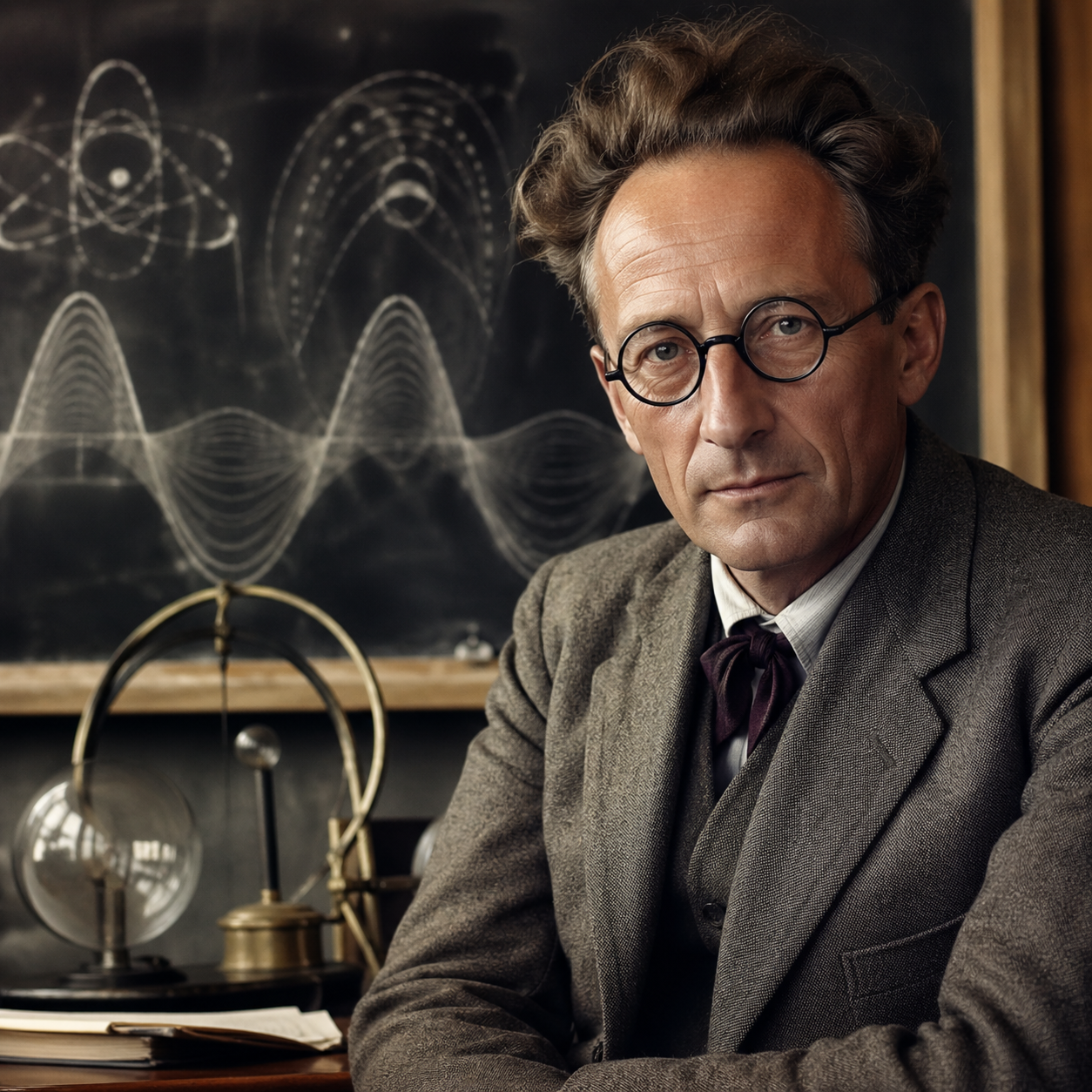
Erwin Schrodinger — "The fact that life exists and that it is maintained by a continuous stream of 'n…"
The fact that life exists and that it is maintained by a continuous stream of 'negentropy' from the outside, is the most profound mystery of all.
The fact that life exists and that it is maintained by a continuous stream of 'negentropy' from the outside, is the most profound mystery of all.
Click any product to generate a realistic preview. Up to 3 at a time.
* Initial load can take up to 90 seconds — revising the preview in another color is nearly instant.
"The best way to escape from the problem is to solve it."
"The present quantum mechanics is not a theory in the sense of the old theories, but rather a collection of rules for the calculation of probabilities."
"The human mind is a universe in itself."
"What is life? The physicist's answer to this question is a series of surprises."
"The greatest discovery of all is that the universe is alive."
Austrian physicist who shared the 1933 Nobel for the wave equation that bears his name and the famous cat thought-experiment. Closely associated with Werner Heisenberg (matrix-mechanics rival who reached the same physics by different math) and Albert Einstein (his pen-pal on quantum interpretation). For an intellectual contrast, see Niels Bohr, Danish physicist and architect of the Copenhagen interpretation — Schrödinger's cat thought-experiment was specifically designed to ridicule Bohr's 'observer-dependent reality' reading of quantum mechanics — Schrödinger thought the Copenhagen interpretation was absurd; the cat was meant as reductio ad absurdum.
Found in 1 providers: grok
1 source checked
Life defies the universal tendency toward disorder by constantly importing order from its environment—eating, breathing, metabolizing. Without this continuous intake of organized energy, living things would decay into chaos like everything else. Life isn't special because it breaks physics; it's remarkable because it works relentlessly within physics, sustaining improbable structure against thermodynamic gravity.
Schrödinger's 1944 book 'What Is Life?' introduced negentropy to biology, directly inspiring Watson and Crick's DNA search. As architect of wave mechanics, he thought in terms of physical law underlying all phenomena. His willingness to apply quantum physics to living systems was radical—treating biology as a branch of physics rather than a separate mystical domain.
Written during World War II, when physics had just split the atom and biologists still lacked a molecular framework for heredity. Thermodynamics was well-established but its connection to living systems was unexplored territory. Schrödinger's framing bridged the gap between physics and biology, helping launch molecular biology as a discipline in the postwar decades.
AI-generated insights based on extensive research and information for context. Factual errors? Email [email protected].
Your cart is empty