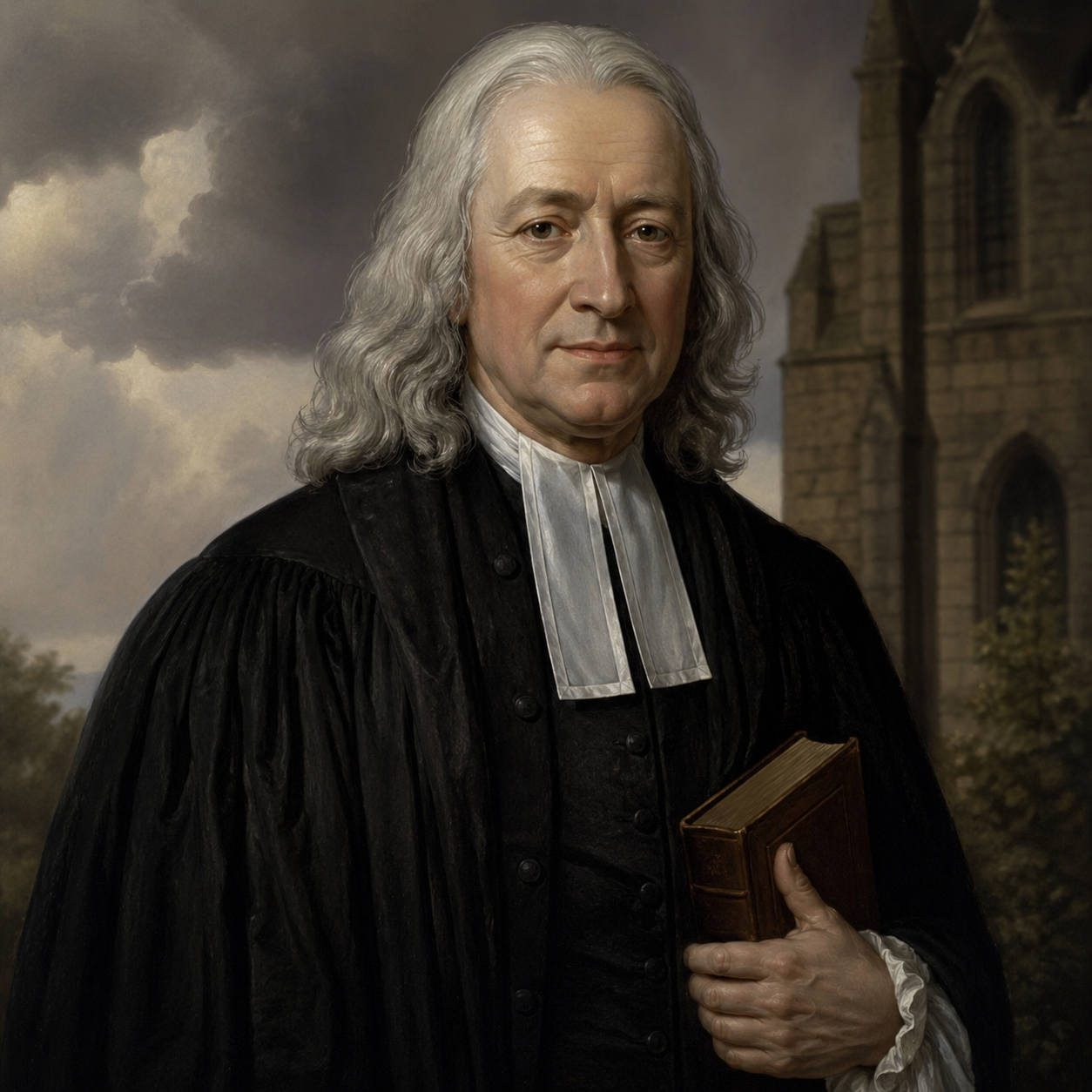
John Wesley — "The Methodists do not desire to be distinguished from other men, but by the Spir…"
The Methodists do not desire to be distinguished from other men, but by the Spirit which they breathe.
The Methodists do not desire to be distinguished from other men, but by the Spirit which they breathe.
Click any product to generate a realistic preview. Up to 3 at a time.
* Initial load can take up to 90 seconds — revising the preview in another color is nearly instant.
"I desire to have but one thing in view, to please God."
"It is a melancholy proof of the blindness and ignorance of mankind, that they are not aware of the evil of sin."
"I am as much a High-Churchman as ever I was."
"I have often thought, that if I were to choose a servant, it should be one that needed no wages."
"It is not the being in a place, but the being in a state, that makes us happy."
English Anglican cleric and founder of Methodism, whose open-air preaching and class-meeting structure created the largest 18th-century evangelical revival. Closely associated with Charles Wesley (his hymn-writing brother) and George Whitefield (early co-revivalist, later doctrinal opponent). For an intellectual contrast, see George Whitefield, Calvinist evangelical revivalist — Whitefield's predestinarian Calvinism vs Wesley's free-grace Arminian theology split the early Methodist movement permanently in the 1739-41 break. The founding evangelical Calvinist-Arminian schism — the two parallel evangelical traditions American Christianity descends from.
Found in 1 providers: grok
1 source checked
Methodists don't want to be set apart by outward markers—clothing, rituals, or institutional labels—but by an inward spiritual quality that pervades their entire way of living. 'The Spirit which they breathe' suggests faith so integrated into character that it becomes involuntary, like breathing: expressed through daily compassion, humility, and devotion rather than religious performance. Identity comes not from group membership but from embodying a particular moral and spiritual disposition.
Wesley was an ordained Anglican priest who never formally left the Church of England; he built Methodist societies as a renewal movement within it, not a separate sect. His ministry centered on practical holiness—visiting prisoners, preaching to coal miners in open fields, organizing poor relief. He taught that true Christianity was lived, not merely professed. This quote embodies his lifelong conviction that spiritual character, not denominational identity, distinguishes genuine believers.
Wesley preached in 18th-century England during rapid industrialization and urban crowding, when the established Anglican Church largely served the propertied classes and ignored the poor. Religious sectarianism was intense—Dissenters, Anglicans, and Catholics divided sharply over doctrine and social standing. Wesley's emphasis on spirit over outward distinction pushed back against this tribalism, offering a faith defined by love and moral transformation rather than institutional affiliation, at a moment when such distinctions carried real social consequences.
AI-generated insights based on extensive research and information for context. Factual errors? Email [email protected].
Your cart is empty