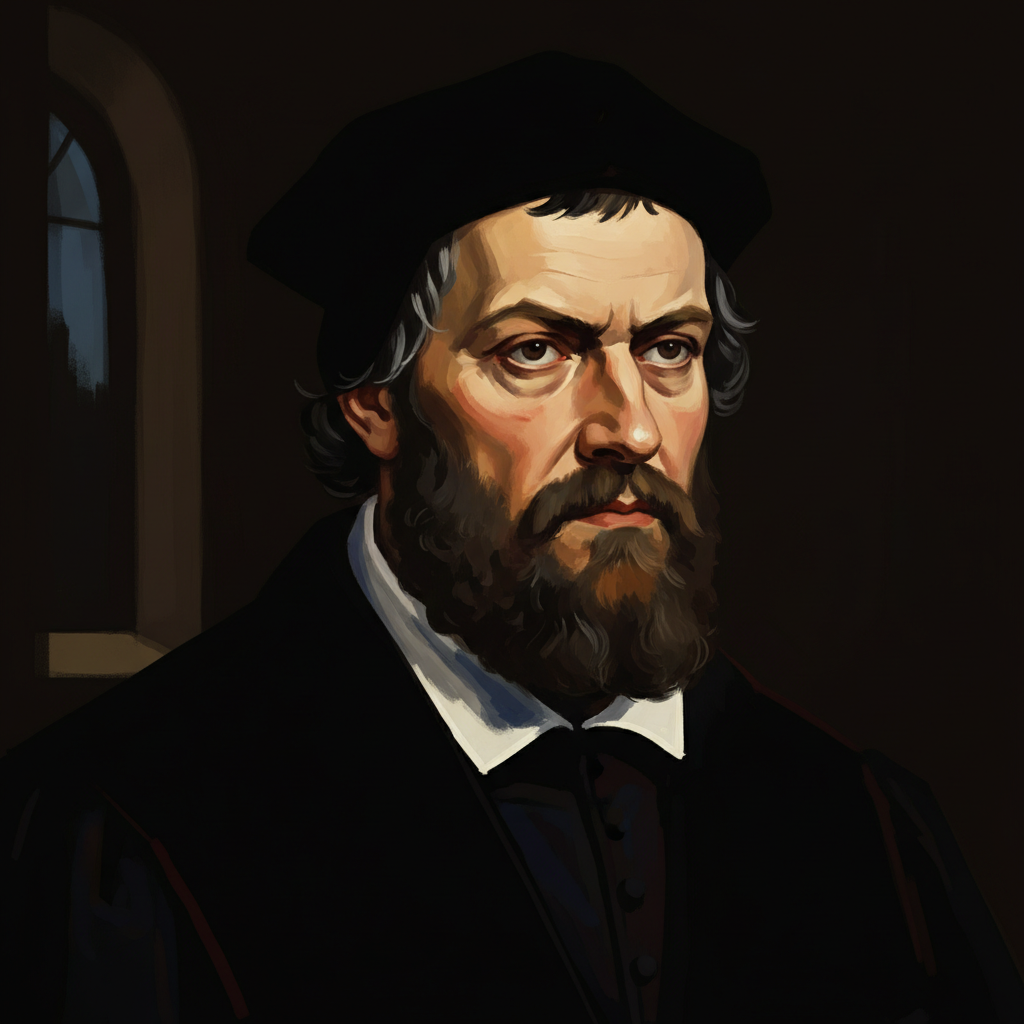
Martin Luther — "The more a man is skilled in the Scriptures, the more he is tempted."
The more a man is skilled in the Scriptures, the more he is tempted.
The more a man is skilled in the Scriptures, the more he is tempted.
Click any product to generate a realistic preview. Up to 3 at a time.
* Initial load can take up to 90 seconds — revising the preview in another color is nearly instant.
"In lying fashion you ignore what even children know."
"Let goods and kindred go, this mortal life also; The body they may kill: God's truth abideth still, His kingdom is forever."
"Sleep is a most excellent thing, for it makes us forget all the miseries of life."
"Fourthly, their rabbis must be forbidden under threat of death to teach any more."
"The world is like a drunken peasant. If you lift him into the saddle on one side, he will fall off on the other."
German theologian whose 95 Theses (1517) launched the Protestant Reformation and broke the Catholic Church's monopoly on Western Christianity. Closely associated with Philipp Melanchthon (Lutheran systematizer) and John Calvin (later Reformer who built on Luther's break). For an intellectual contrast, see Pope Leo X, Renaissance pope (1513-1521) — Leo X's indulgence sales triggered Luther's break and Leo excommunicated him in 1521 — Luther's entire Reformation is structured as a direct answer to the indulgence-funded Vatican Leo represented.
Found in 1 providers: grok
1 source checked
Deep knowledge of religious texts does not shield you from temptation—it often intensifies it. The more you understand spiritual truth, the more the pull toward doubt, pride, or wrongdoing grows. Expertise creates higher stakes: you know exactly what you are supposed to believe and do, which makes every lapse sharper and every challenge to faith more pointed. Learning does not deliver immunity; it raises the battle.
Luther lived this personally. As an Augustinian monk and biblical scholar who translated the New Testament into German, he immersed himself in Scripture daily and still wrestled with violent spiritual despair he called Anfechtung. His deep exegesis of Romans fueled the Reformation, yet also exposed him to relentless doubt, accusations of heresy, and inner torment. For Luther, mastering the Word meant constant combat with the devil, not peace.
In early modern Europe, the Bible was largely locked inside Latin clergy control until printing and Reformation translation opened it to laypeople. Luther's 1517 Ninety-Five Theses ignited schism, papal excommunication, the Diet of Worms, and religious wars. Scripture became a battlefield: scholars debated indulgences, sacraments, and salvation while facing execution for wrong readings. Knowing the text deeply put one squarely in the crossfire of Rome, reformers, and radical sects—all citing the same pages.
AI-generated insights based on extensive research and information for context. Factual errors? Email [email protected].
Your cart is empty