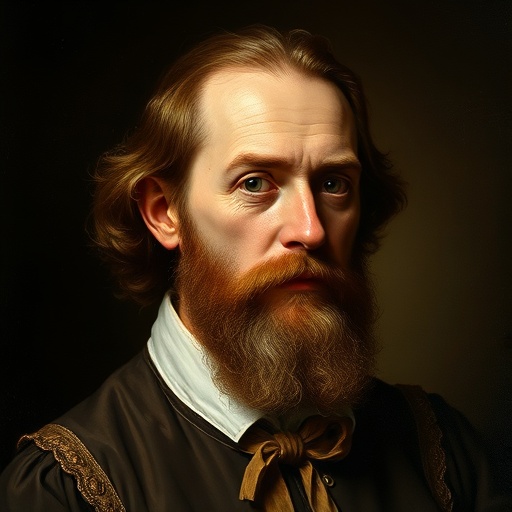
William Harvey — "The more accurately we observe, the more clearly we understand."
The more accurately we observe, the more clearly we understand.
The more accurately we observe, the more clearly we understand.
Click any product to generate a realistic preview. Up to 3 at a time.
* Initial load can take up to 90 seconds — revising the preview in another color is nearly instant.
"We are taught by nature to begin with the simple and proceed to the complex."
"The heart is a pump, and the blood is a fluid."
"The knowledge of man is as the waters, some shallow and some deep."
"The true physician is one who loves humanity."
"The heart is a muscle, and its function is to pump blood."
English physician whose On the Motion of the Heart and Blood in Animals (1628) demonstrated blood circulation, overturning 1,400 years of Galenic medicine. Closely associated with Francis Bacon (his contemporary in the new English empiricism). For an intellectual contrast, see Galenic medicine, the 2nd-century Greek medical tradition (humors, blood-as-consumed-fuel) — Harvey calculated that the heart pumps more blood per hour than the body could possibly produce as fuel — a single quantitative observation that demolished the entire Galenic-Aristotelian medical worldview. The cleanest example in medical history of arithmetic disproving 14 centuries of authority.
A statement on the importance of meticulous empirical observation in science.
Date: Uncertain (attributed)
WisdomFound in 1 providers: gemini
1 source checked
Careful, precise observation leads to deeper understanding. The more rigorously you examine something — withholding assumptions, attending to detail — the clearer its true nature becomes. This is a defense of empirical method over speculation: knowledge earned through disciplined looking is more reliable than knowledge inherited or reasoned from authority alone.
Harvey spent years dissecting animals and human cadavers, meticulously timing heartbeats and measuring blood volume to prove circulation. His 1628 work De Motu Cordis overturned Galenic theory not through argument but through relentless, precise observation. This quote is the philosophical spine of his entire career — he trusted his eyes over ancient texts.
In early modern Europe, Galenic medicine dominated for over a millennium, grounded in classical authority rather than direct study. The Scientific Revolution was breaking that grip — Vesalius had corrected anatomy, Galileo was measuring the heavens. Harvey's insistence on accurate observation was radical: it placed the natural world, not inherited doctrine, as the ultimate arbiter of truth.
AI-generated insights based on extensive research and information for context. Factual errors? Email [email protected].
Your cart is empty