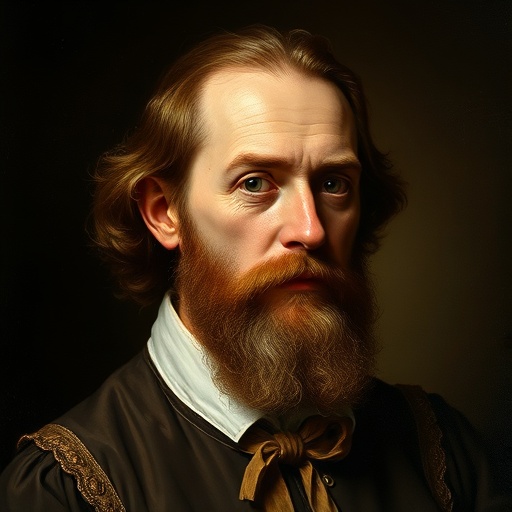
William Harvey — "The world is full of wonders, but man is the greatest wonder of all."
The world is full of wonders, but man is the greatest wonder of all.
The world is full of wonders, but man is the greatest wonder of all.
Click any product to generate a realistic preview. Up to 3 at a time.
* Initial load can take up to 90 seconds — revising the preview in another color is nearly instant.
"All we know is still infinitely less than all that still remains unknown."
"I confess that I have been led to embrace this opinion by a careful consideration of the structure and use of the valves in the veins."
"What remains to be said is of so novel and unheard of a character that I not only fear injury to myself from the envy of a few, but I tremble lest I have mankind at large for my enemies, so much to wo…"
"I have often wondered, and indeed not a little, at the great difference of opinion among anatomists and physicians in the matter of the pulse and the motion of the heart."
"Errors are not to be removed by violence, but by reason."
English physician whose On the Motion of the Heart and Blood in Animals (1628) demonstrated blood circulation, overturning 1,400 years of Galenic medicine. Closely associated with Francis Bacon (his contemporary in the new English empiricism). For an intellectual contrast, see Galenic medicine, the 2nd-century Greek medical tradition (humors, blood-as-consumed-fuel) — Harvey calculated that the heart pumps more blood per hour than the body could possibly produce as fuel — a single quantitative observation that demolished the entire Galenic-Aristotelian medical worldview. The cleanest example in medical history of arithmetic disproving 14 centuries of authority.
A philosophical statement on human uniqueness, similar to Linnaeus.
Date: Uncertain (attributed)
WisdomFound in 1 providers: gemini
1 source checked
Among all the extraordinary things in nature—celestial bodies, living creatures, natural phenomena—the human being stands apart as the most astonishing. Human complexity, whether physical, intellectual, or spiritual, surpasses every other marvel we encounter. It is a call to recognize our own nature as the ultimate subject of inquiry, worthy of more awe and study than any external phenomenon the world presents to us.
Harvey dedicated his life to proving this through anatomy. His landmark 1628 discovery that the heart circulates blood through the body revealed a living machine of staggering elegance—a pump driving fluid through vessels in perfect rhythm. He performed hundreds of dissections and animal experiments, treating human physiology with scientific rigor previously reserved for celestial mechanics. To Harvey, the body was not merely flesh but a masterwork demanding systematic investigation.
Harvey lived during the Scientific Revolution, when Europe was overturning centuries of Galenic medical dogma through direct observation. Renaissance humanism had already elevated humanity to the center of intellectual concern, while Vesalius's anatomical atlases had recently shocked scholars with accurate depictions of the human body. Amid new telescopes scanning distant stars, Harvey's generation argued that the greatest discoveries lay not in the heavens but inside the human form itself.
AI-generated insights based on extensive research and information for context. Factual errors? Email [email protected].
Your cart is empty