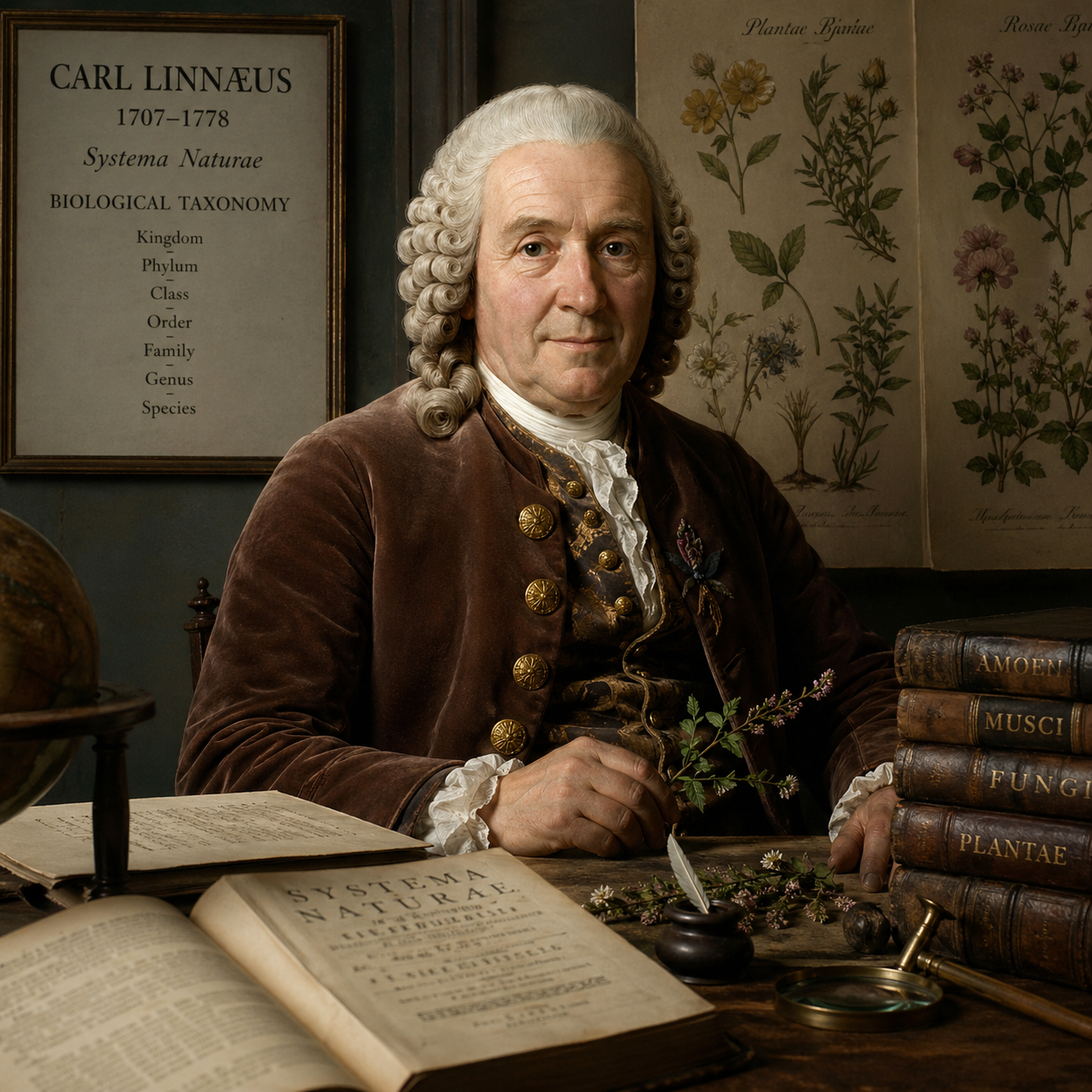
Carl Linnaeus — "The more hidden the flower, the sweeter the scent."
The more hidden the flower, the sweeter the scent.
The more hidden the flower, the sweeter the scent.
Click any product to generate a realistic preview. Up to 3 at a time.
* Initial load can take up to 90 seconds — revising the preview in another color is nearly instant.
"The earth is the Lord's, and the fullness thereof; the world, and they that dwell therein."
"The whole world is a collection of wonders."
"The classes are for the genera, the genera for the species, the species for the individuals."
"The classification of animals is easier than that of plants."
"Nature's economy shall be the base for our own, for it is immutable, but ours is secondary. An economist without knowledge of nature is therefore like a physicist without knowledge of mathematics."
Swedish botanist and the father of modern taxonomy whose Systema Naturae (1735) introduced binomial nomenclature for naming all species. Closely associated with Joseph Banks (British naturalist who carried Linnaean classification on Cook's voyages). For an intellectual contrast, see Comte de Buffon, French naturalist and Histoire Naturelle author (1749-1788) — Buffon explicitly attacked Linnaean fixed-categories taxonomy as artificial and rejected the binomial system; his gradualist, environment-shaped natural history was the explicit alternative. Anticipates the fixed-species-vs-evolution debate Darwin would later resolve.
A poetic observation, possibly metaphorical, about nature or virtue.
Date: Uncertain (attributed)
Nature & WorldFound in 1 providers: gemini
1 source checked
Things of greatest value often hide from plain sight. The quote suggests that beauty, truth, or quality not immediately obvious to a casual observer carries deeper reward for those who seek it out. Hiddenness intensifies worth — the effort required to find something rare makes the discovery sweeter. It argues quietly against superficiality: what demands patience and attention ultimately yields more than whatever announces itself loudly.
Linnaeus spent his life cataloguing plants many found obscure or overlooked. His taxonomic system required venturing into forests, bogs, and remote terrain to find and classify species invisible to most people. His apostles — students sent worldwide to collect specimens — literally sought hidden flora. His Systema Naturae was built on finding order in what others ignored entirely, reflecting his belief that nature's deepest truths rewarded the careful, dedicated observer.
The 18th-century Enlightenment celebrated rational inquiry and the systematic uncovering of hidden natural laws. European powers funded botanical expeditions to remote continents, believing nature held undiscovered cures, resources, and knowledge. Most people had no framework for understanding plant diversity — flora of distant regions was genuinely mysterious. Linnaeus's era was one of revelation: the natural world's secrets were being named and ordered for the first time in recorded human history.
AI-generated insights based on extensive research and information for context. Factual errors? Email [email protected].
Your cart is empty