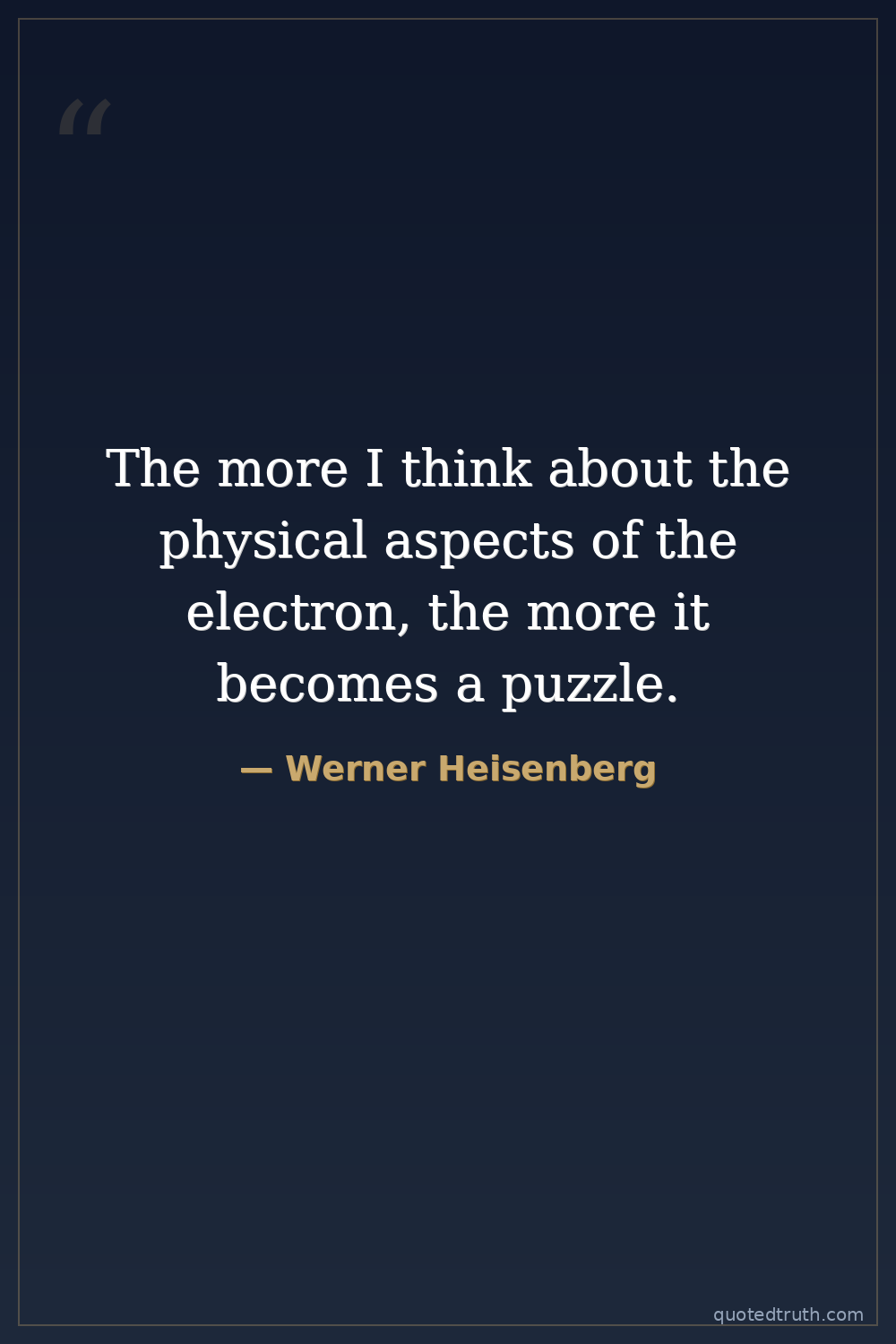
Werner Heisenberg — "The more I think about the physical aspects of the electron, the more it becomes…"
The more I think about the physical aspects of the electron, the more it becomes a puzzle.
The more I think about the physical aspects of the electron, the more it becomes a puzzle.
Click any product to generate a realistic preview. Up to 3 at a time.
* Initial load can take up to 90 seconds — revising the preview in another color is nearly instant.
"There are things that are so serious that you can only joke about them."
"The physical world is not real in the sense that it exists independently of our observing it."
"In the history of science, it has often happened that a new discovery had to be rejected for a long time because it contradicted the current prejudices."
"The history of physics is not only a sequence of experimental discoveries and observations, but also a history of concepts."
"The path to the new physics was paved by the discovery of the quantum of action."
Found in 1 providers: grok
1 source checked
The closer you examine something fundamental, the stranger and less comprehensible it becomes. What looks like a simple object reveals itself as deeply mysterious under scrutiny. Rather than gaining clarity through analysis, you accumulate questions. True understanding isn't a straight path toward certainty; it often leads into genuine perplexity, where the basic building blocks of reality refuse to behave like the familiar objects of everyday experience.
Heisenberg spent his career wrestling with the electron's bizarre behavior, formulating matrix mechanics in 1925 and the uncertainty principle in 1927. He discovered that electrons cannot have simultaneously definite position and momentum, overturning classical intuition. His willingness to admit bewilderment reflects his philosophical bent, influenced by Bohr and Plato, and his honest acknowledgment that quantum reality defies visualization. Puzzlement, for him, was not failure but the doorway to deeper physics.
In the 1920s and 30s, classical physics was collapsing. Rutherford's atom, Bohr's orbits, and experimental anomalies demanded a new framework. Heisenberg worked amid the Copenhagen circle during a revolutionary decade when determinism itself was being dismantled. World War I had shattered European confidence, and physics mirrored that upheaval. Later, under the Nazi regime, Heisenberg led Germany's wartime nuclear program, navigating moral and scientific puzzles that extended far beyond the electron.
AI-generated insights based on extensive research and information for context. Factual errors? Email [email protected].
Your cart is empty