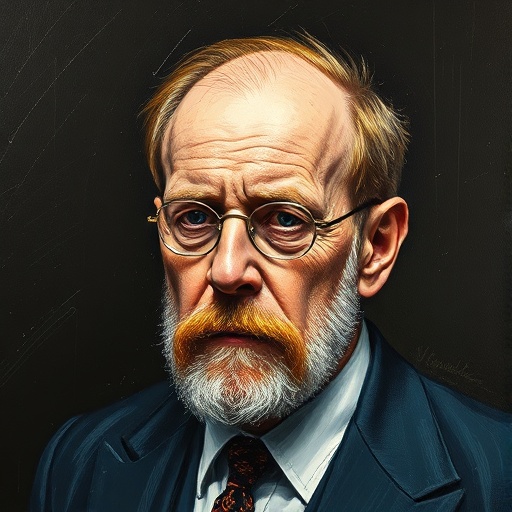
Werner Heisenberg — "The world is not composed of 'things' but of 'events'."
The world is not composed of 'things' but of 'events'.
The world is not composed of 'things' but of 'events'.
Click any product to generate a realistic preview. Up to 3 at a time.
* Initial load can take up to 90 seconds — revising the preview in another color is nearly instant.
"The problems of language here are really serious. We wish to speak in some way about the structure of the atoms. But we cannot speak about atoms in ordinary language."
"The idea of a simple, objective reality existing independently of the observer has become untenable."
"The problems of atomic physics are not problems of technology, but problems of philosophy."
"Can nature possibly be so absurd as it seemed to us in these atomic experiments?"
"I was very much afraid of the consequences of the atom bomb, and I tried to delay its development."
Found in 1 providers: grok
1 source checked
Reality isn't made of solid, static objects sitting in space. Instead, it's built from happenings, interactions, and processes unfolding over time. What we call a 'thing' is really a pattern of activity, a stable sequence of events we perceive as an object. Rocks, atoms, even people are ongoing processes rather than fixed stuff. To understand reality, look at what happens, not what sits still.
Heisenberg founded quantum mechanics and formulated the uncertainty principle in 1927, which showed particles lack definite position and momentum simultaneously. His matrix mechanics treated observable events, not hidden properties, as fundamental. He argued electrons don't have trajectories between measurements, only interactions. This quote captures his lifelong philosophical stance that physics describes processes and observations, not underlying substances, aligning with his Copenhagen interpretation and readings of Greek philosophy.
Early 20th-century physics overturned Newton's clockwork universe of solid particles moving through absolute space. Between 1900 and 1930, relativity and quantum theory dissolved classical notions of matter, time, and causality. Heisenberg worked amid Weimar Germany's scientific ferment, later under Nazi rule and WWII atomic research. Philosophers, physicists, and process thinkers like Whitehead were simultaneously rejecting substance metaphysics, reshaping Western thought toward dynamic, relational, event-based descriptions of nature.
AI-generated insights based on extensive research and information for context. Factual errors? Email [email protected].
Your cart is empty