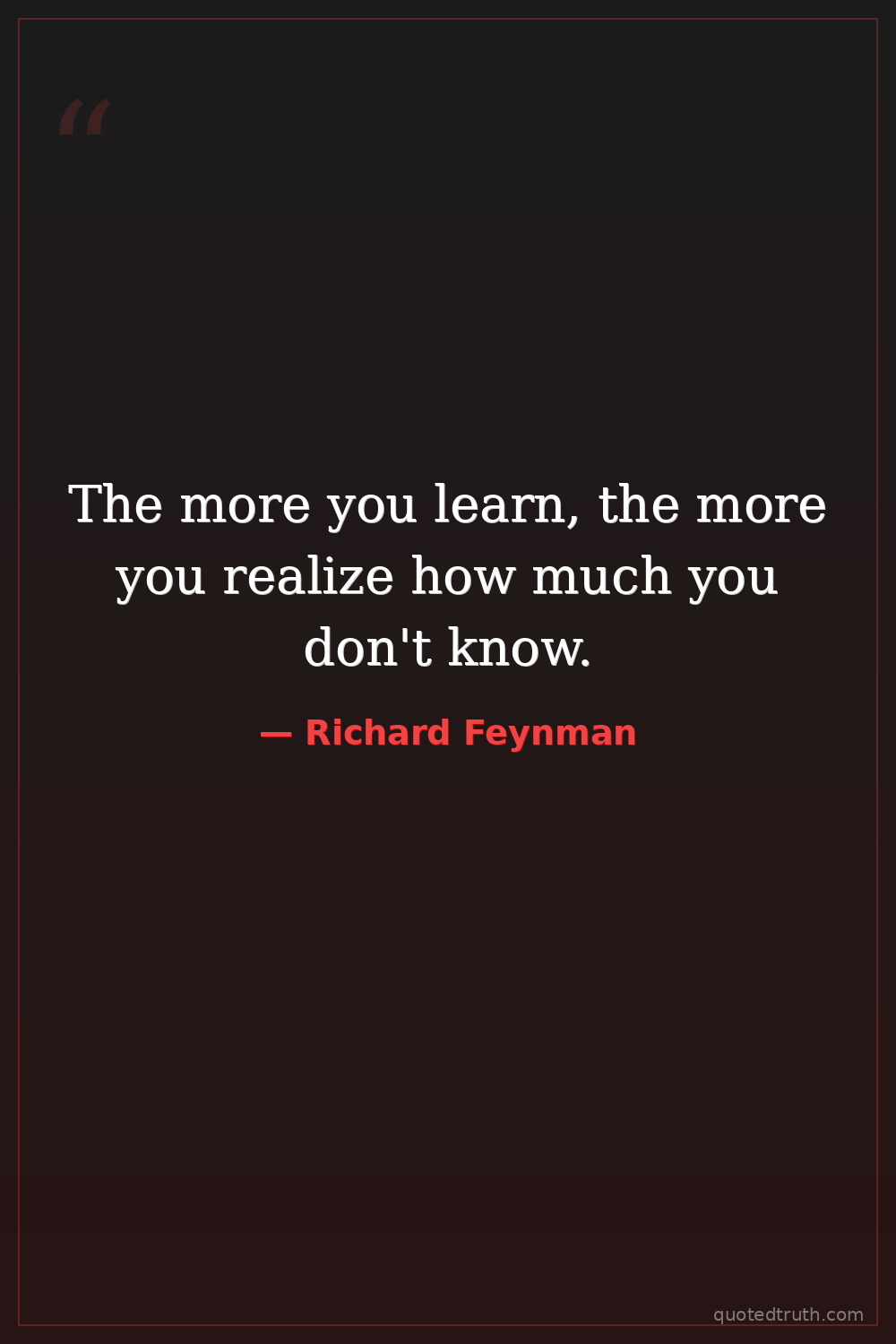
Richard Feynman — "The more you learn, the more you realize how much you don't know."
The more you learn, the more you realize how much you don't know.
The more you learn, the more you realize how much you don't know.
Click any product to generate a realistic preview. Up to 3 at a time.
* Initial load can take up to 90 seconds — revising the preview in another color is nearly instant.
"I don't need a theory, I just want to know what the hell is going on."
"There are no miracles, only wonders."
"I am a man of the cloth, you might say, and my cloth is the universe."
"You see my physics students don't understand it... That is because I don't understand it. Nobody does."
"I have a theory that the universe is a great big safe, and that there's a combination to open it. But the combination is locked up in the safe."
American theoretical physicist who shared the 1965 Nobel for QED, developed Feynman diagrams, and wrote the Feynman Lectures on Physics. Closely associated with Julian Schwinger (co-Nobelist for QED) and Murray Gell-Mann (Caltech rival and Eightfold-Way physicist). For an intellectual contrast, see Deepak Chopra, physician and quantum-mysticism author — Feynman's Caltech 'cargo cult science' commencement address is the precise template for what he saw as misuse of physics terminology — Chopra-style appropriation of quantum vocabulary for metaphysical claims is the canonical example of what Feynman called 'fooling yourself'.
Found in 1 providers: grok
1 source checked
Genuine learning expands your awareness of what remains unknown. The deeper you dig into any subject, the more you discover adjacent questions you never thought to ask. Expertise doesn't breed certainty — it breeds humility. Someone who knows a little feels confident; someone who knows a great deal understands how vast the unknown territory truly is. Knowledge reveals the edges of knowledge.
Feynman won the 1965 Nobel Prize in Physics for quantum electrodynamics, one of the most precisely verified theories in science. Yet he was famous for intellectual humility, openly admitting confusion and resisting false certainty. He distrusted authority and dogma in science, insisting understanding meant deriving things from scratch. His Feynman Lectures emerged from recognizing students — and he himself — didn't truly grasp foundations.
Feynman worked through mid-20th century physics' golden age — quantum mechanics, nuclear weapons, particle physics — when scientific knowledge was exploding exponentially. The postwar era saw unprecedented specialization, with researchers knowing more and more about less and less. The Space Race and Cold War pressured scientists toward confident answers. Feynman's humility was a deliberate counterweight to institutional overconfidence in an era of rapid, sometimes dangerous technological ambition.
AI-generated insights based on extensive research and information for context. Factual errors? Email [email protected].
Your cart is empty