Albert Einstein — "The most beautiful emotion we can experience is the mystical. It is the sower of…"
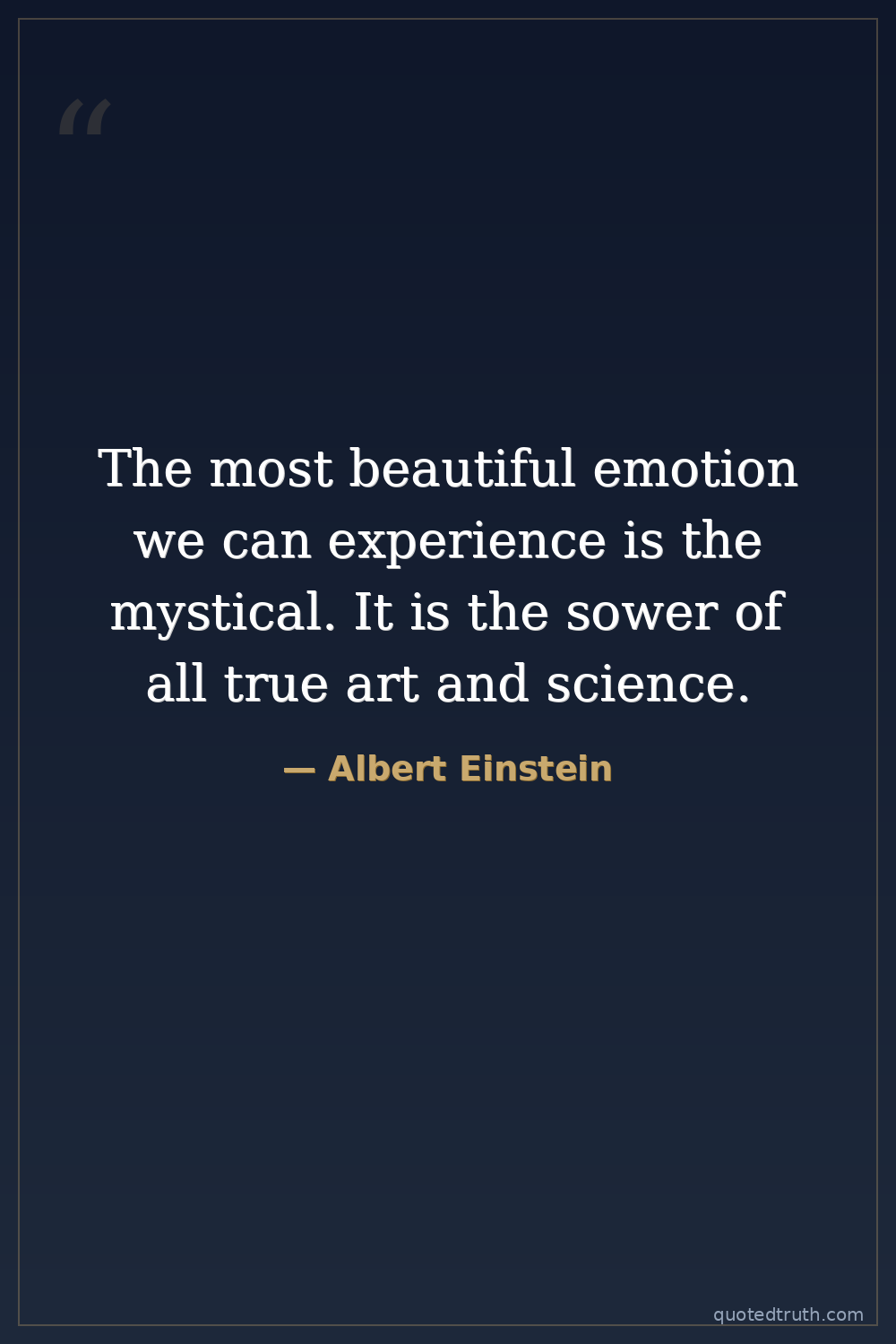
The most beautiful emotion we can experience is the mystical. It is the sower of all true art and science.
The most beautiful emotion we can experience is the mystical. It is the sower of all true art and science.
Click any product to generate a realistic preview. Up to 3 at a time.
* Initial load can take up to 90 seconds — revising the preview in another color is nearly instant.
"I must confess that the degree of their brutality and cowardice came as something of a surprise."
"The Negroes are certainly more primitive than us, but not in a negative sense."
"I believe in intuitions and inspirations. I sometimes feel that I am right. I do not know that I am."
"The world is a dangerous place to live; not because of the people who are evil, but because of the people who don't do anything about it."
"Falling in love is not at all the most stupid thing that people do-but gravitation cannot be held responsible for it."
Similar to his 'mysterious' quote, but 'mystical' sometimes used as a variant.
Date: 1931
EducationalFound in 1 providers: grok
1 source checked
The deepest, most profound human experience is a sense of wonder at things beyond full comprehension. This feeling of awe before mystery is the essential seed from which genuine creative and scientific work grows. Without it, art becomes decoration and science becomes mere calculation. Authentic achievement in either domain begins with being genuinely moved by what you cannot yet explain.
Einstein repeatedly credited wonder and intuitive feeling over pure calculation. He described his discovery of relativity not through equations but through imagining riding a light beam—a mystical thought experiment. He played violin to access non-rational insight. He wrote extensively that scientists who lack the capacity for awe are no better than craftsmen, firmly believing emotional sensitivity was prerequisite to his greatest breakthroughs.
Einstein wrote this in the early 20th century as scientific rationalism and logical positivism dominated intellectual culture, reducing truth to what was measurable and verifiable. Against this mechanistic tide, he defended the emotional and intuitive dimensions of discovery. Simultaneously, modernist art movements—Expressionism, Surrealism—were similarly rejecting pure rationality, making his words resonate across both scientific and artistic communities grappling with meaning after World War I.
AI-generated insights based on extensive research and information for context. Factual errors? Email [email protected].
Your cart is empty