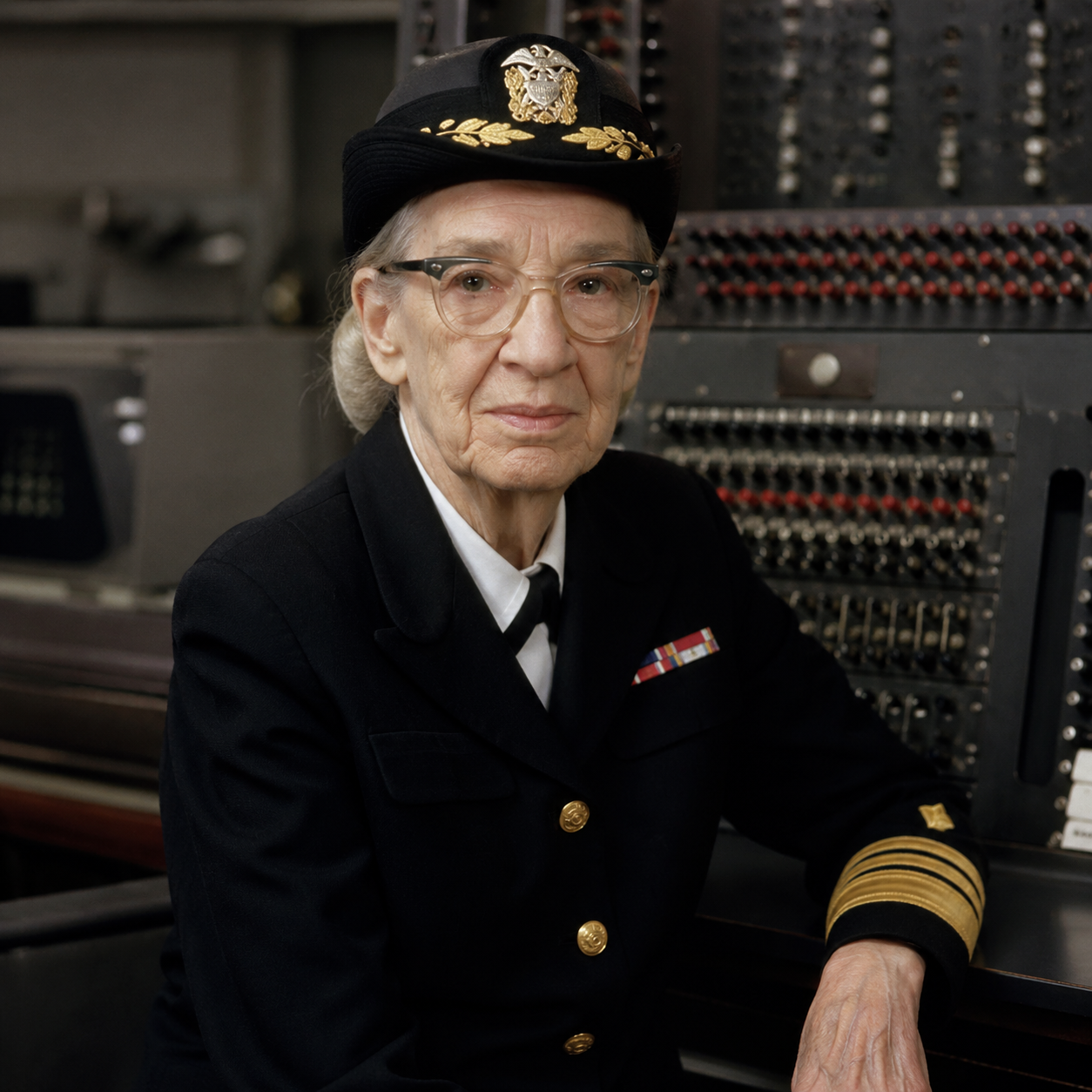
Grace Hopper — "The most important thing I've accomplished, other than building the compiler, is…"
The most important thing I've accomplished, other than building the compiler, is training young people.
The most important thing I've accomplished, other than building the compiler, is training young people.
Click any product to generate a realistic preview. Up to 3 at a time.
* Initial load can take up to 90 seconds — revising the preview in another color is nearly instant.
"There are two things that are hard in computer science: cache invalidation, naming things, and off-by-one errors."
"I am now going to make you a gift that will stay with you the rest of your life. For the rest of your life, every time you say, 'We've always done it that way,' my ghost will appear and haunt you for …"
"The glass is neither half empty nor half full. It's simply larger than it needs to be."
"I will not take what you need to give me. I will take what you want to give me."
"If we're going to have computers, we're going to have to have programmers."
Emphasizing her belief in education and mentorship over her technical innovations.
Date: Late 20th century (often cited)
ShockingFound in 1 providers: gemini
1 source checked
Technical achievements have a fixed scope—a single person can only build so much in one lifetime. But mentorship compounds across generations, multiplying impact far beyond any individual invention. Hopper is saying that teaching young programmers to think, solve problems, and push boundaries mattered more than any code she personally wrote, because their collective future work would reshape technology for decades to come.
Hopper taught mathematics at Vassar College before joining the Navy in WWII, so education was foundational to her identity. She built the first compiler and helped create COBOL, but she also lectured extensively at universities, famously distributing nanosecond-length wires to make computing tangible. She actively mentored young engineers throughout her career and continued until retiring as Rear Admiral at age 79.
Computing exploded from the 1940s through the 1980s—Hopper's entire active career. Room-sized mainframes gave way to minicomputers and personal computers, creating urgent demand for trained programmers. No formal computer science curriculum existed in the early decades, and the Cold War poured government funding into technology. Pioneers had to invent the field and simultaneously train the workforce, making mentorship as critical as any technical breakthrough.
AI-generated insights based on extensive research and information for context. Factual errors? Email [email protected].
Your cart is empty