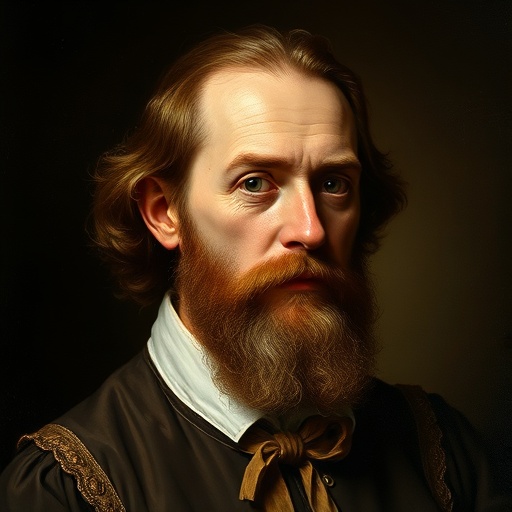
William Harvey — "The motion of the blood is constant and circular."
The motion of the blood is constant and circular.
The motion of the blood is constant and circular.
Click any product to generate a realistic preview. Up to 3 at a time.
* Initial load can take up to 90 seconds — revising the preview in another color is nearly instant.
"The art of medicine is to prolong life, not to shorten it."
"The blood in the animal body is impelled in a circle, and is in a state of ceaseless motion."
"The animal's heart is the basis of its life, its chief member, the sun of its microcosm; on the heart all its activity depends, from the heart all its liveliness and strength arise. Equally is the kin…"
"The heart is the seat of the soul."
"Nature is a free and open book, to be read and understood by all who have the patience and the power to do so."
English physician whose On the Motion of the Heart and Blood in Animals (1628) demonstrated blood circulation, overturning 1,400 years of Galenic medicine. Closely associated with Francis Bacon (his contemporary in the new English empiricism). For an intellectual contrast, see Galenic medicine, the 2nd-century Greek medical tradition (humors, blood-as-consumed-fuel) — Harvey calculated that the heart pumps more blood per hour than the body could possibly produce as fuel — a single quantitative observation that demolished the entire Galenic-Aristotelian medical worldview. The cleanest example in medical history of arithmetic disproving 14 centuries of authority.
Found in 1 providers: grok
1 source checked
Blood does not sit still or move randomly through the body; it travels in an unbroken loop, pumped outward and returned continuously. The heart drives this perpetual circuit, and life depends on its unceasing rhythm. Movement is the defining property of blood, not rest, and that movement follows a fixed, repeating path rather than being consumed or produced at different organs.
Harvey spent decades dissecting animals and studying cadavers, timing heartbeats and measuring blood volume to prove the heart pumps far more blood per hour than the liver could possibly produce. His 1628 work De Motu Cordis staked his reputation against Galenic orthodoxy. This phrase distills his central finding: circulation, not generation, is the fundamental truth of blood physiology.
In Harvey's early modern Europe, Galen's 1,400-year-old model held that the liver continuously manufactured blood, which organs then consumed. Challenging this was intellectually dangerous and professionally risky. The Scientific Revolution was dismantling ancient authority through observation, and Harvey's quantitative, experimental approach exemplified the new method, arriving just as Vesalius had already shaken anatomical dogma with dissection evidence.
AI-generated insights based on extensive research and information for context. Factual errors? Email [email protected].
Your cart is empty