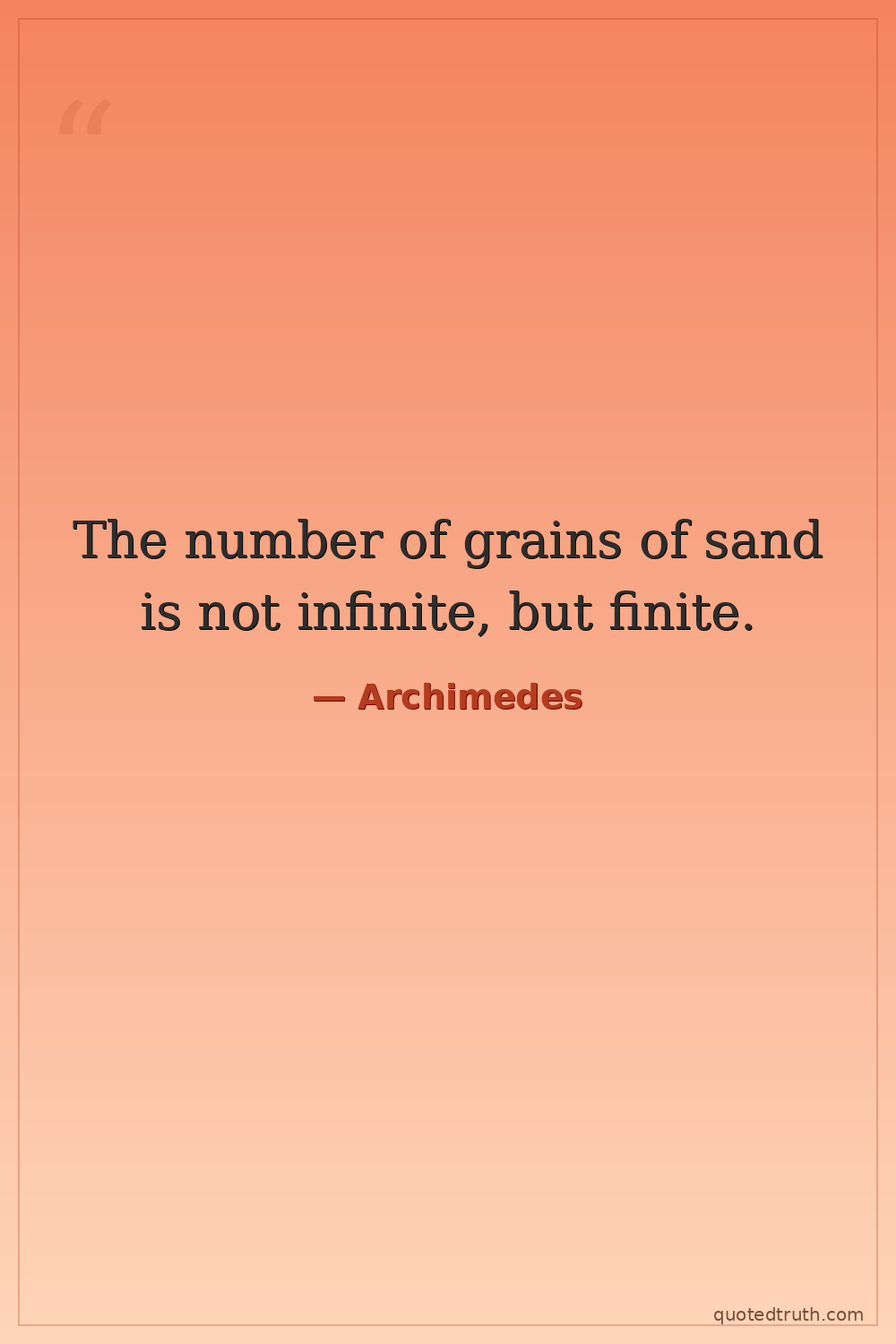
Archimedes — "The number of grains of sand is not infinite, but finite."
The number of grains of sand is not infinite, but finite.
The number of grains of sand is not infinite, but finite.
Click any product to generate a realistic preview. Up to 3 at a time.
* Initial load can take up to 90 seconds — revising the preview in another color is nearly instant.
"The cone is one third of the cylinder on the same base and of the same height."
"Every solid body immersed in a fluid is buoyed up by a force equal to the weight of the fluid displaced by the body."
"The diameter of the Earth is greater than the diameter of the Moon and the diameter of the Sun is greater than the diameter of the Earth."
"The sphere is the most perfect of all solids."
"Any solid lighter than a fluid will, if placed in the fluid, be so far immersed that the weight of the fluid displaced by the immersed portion will be equal to the weight of the solid."
From 'The Sand Reckoner', directly refuting the idea of infinite sand.
Date: c. 250 BCE
GeneralFound in 1 providers: grok
1 source checked
Even quantities that feel impossibly vast — like every grain of sand on every beach — are still finite; they can be counted and expressed as a number. The universe is mathematically knowable. Nothing is truly beyond enumeration if you build the right tools. This is a rejection of intellectual surrender: 'too many to count' is laziness, not truth. Mathematics can reach anywhere quantity exists.
This line comes directly from Archimedes's treatise The Sand Reckoner, written to King Gelon II of Syracuse, where he calculated an upper bound for grains of sand filling the cosmos. To do it, he invented a new notation system for expressing numbers beyond the Greek myriad — a direct ancestor of scientific notation. It embodies his core belief that no physical reality, however staggering in scale, lies outside mathematics's reach.
Around 250 BCE, Greek numeral systems topped out at the myriad — ten thousand — making enormous quantities effectively inexpressible. Philosophers including Zeno and Aristotle treated infinity as paradoxical or philosophically off-limits, and 'countless as the sand' was a standard idiom meaning literally uncountable. Archimedes's Sand Reckoner directly dismantled that cultural assumption, asserting that cosmos-scale quantities were finite, nameable, and computable — a provocative intellectual stance against his era's mathematical ceiling.
AI-generated insights based on extensive research and information for context. Factual errors? Email [email protected].
Your cart is empty