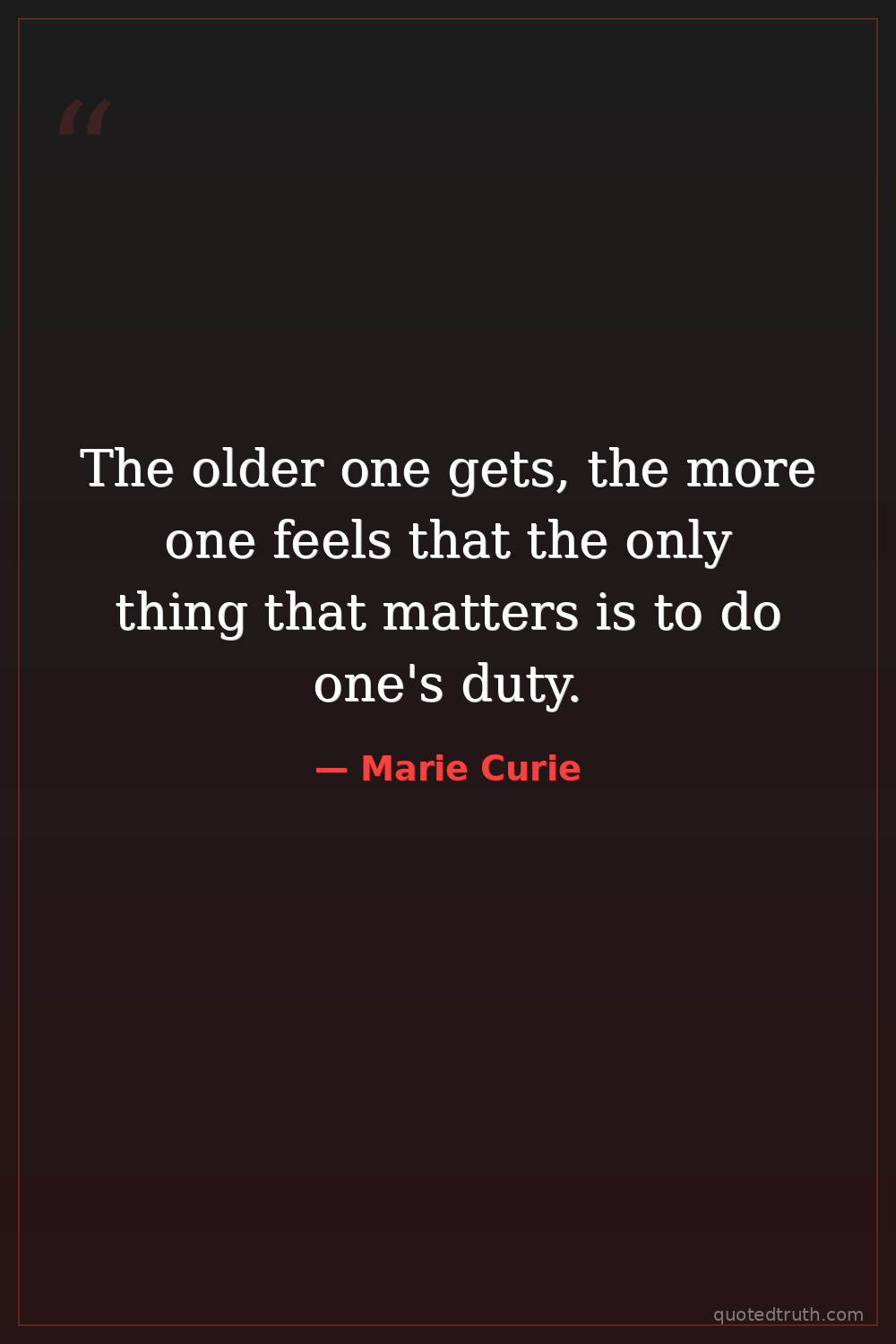
Marie Curie — "The older one gets, the more one feels that the only thing that matters is to do…"
The older one gets, the more one feels that the only thing that matters is to do one's duty.
The older one gets, the more one feels that the only thing that matters is to do one's duty.
Click any product to generate a realistic preview. Up to 3 at a time.
* Initial load can take up to 90 seconds — revising the preview in another color is nearly instant.
"I have been reproached for having given myself to science. I have been reproached for having neglected my family. I have been reproached for having neglected my country. I have been reproached for hav…"
"The way of progress was neither swift nor easy."
"I never had a moment of doubt that science was the right path for me."
"I am a Polish woman, and I am proud of it. And I am proud of my work. And I am proud of my discoveries. And I am proud of my contributions to humanity."
"The greatest scientists are artists as well."
Found in 1 providers: grok
1 source checked
As people age, they realize that fulfilling their responsibilities is what truly gives life meaning. Pleasures, ambitions, recognition, and distractions fade in importance, while the quiet work of showing up and completing what you've committed to becomes the thing that actually matters. Duty here means obligation to family, work, or a cause, and the speaker argues this is the lasting measure of a worthwhile life.
Marie Curie lived this sentiment. She labored in a leaky shed processing tons of pitchblende to isolate radium, continued teaching and research after her husband Pierre's death, and ran mobile X-ray units at the front during World War I. She refused to patent radium isolation so medicine could benefit, and she worked despite radiation sickness that ultimately killed her, treating science as obligation rather than glory.
Curie's era spanned late-Victorian rigor through World War I and interwar Europe, when duty was a dominant moral vocabulary and women were largely excluded from science. As the first woman to win a Nobel and the only person to win in two sciences, she navigated French academic sexism, wartime mobilization, and the birth of atomic physics. Public devotion to work and country was expected, and personal sacrifice for research or nation was widely honored.
AI-generated insights based on extensive research and information for context. Factual errors? Email [email protected].
Your cart is empty