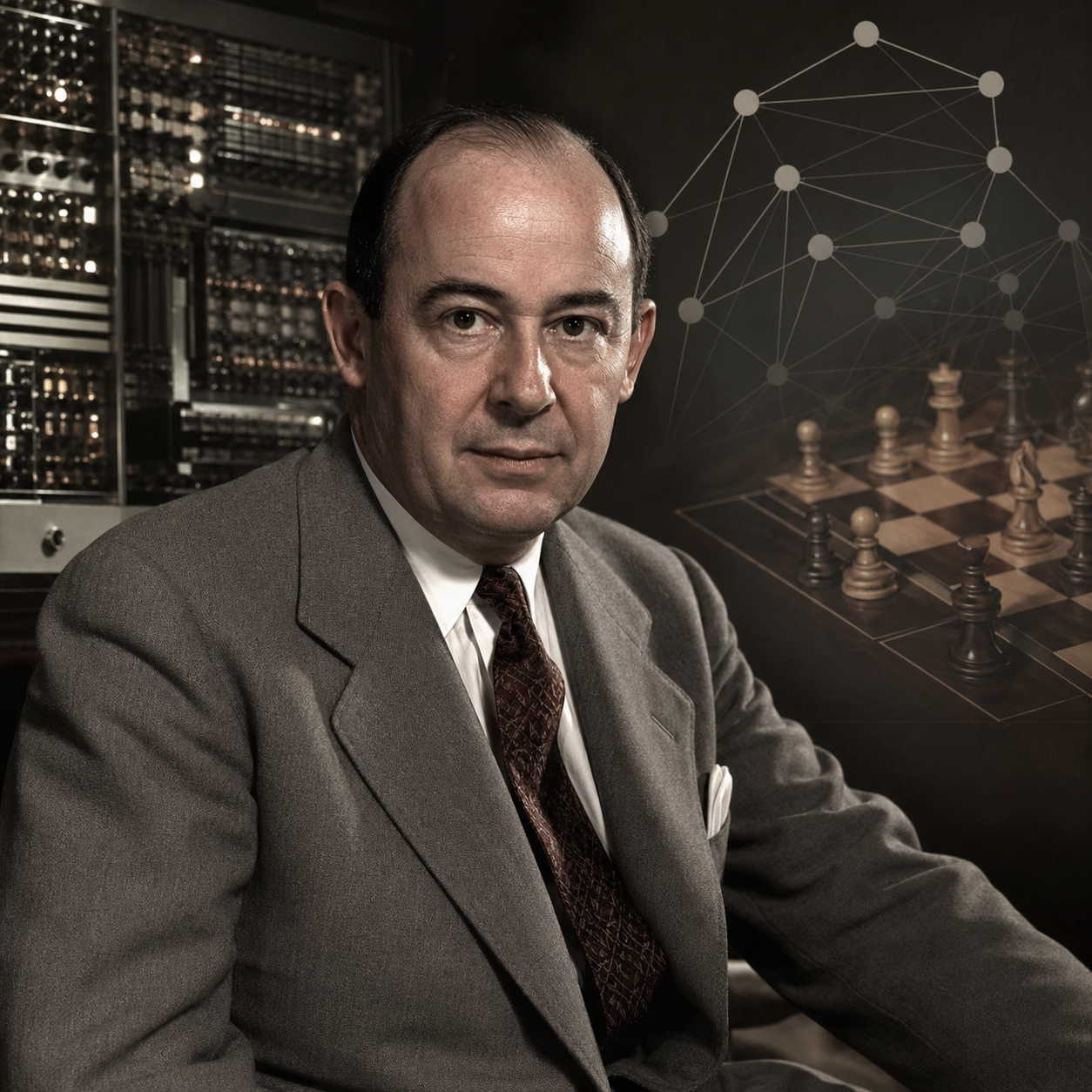
John von Neumann — "The only difference between a madman and a genius is that the genius is lucky."
The only difference between a madman and a genius is that the genius is lucky.
The only difference between a madman and a genius is that the genius is lucky.
Click any product to generate a realistic preview. Up to 3 at a time.
* Initial load can take up to 90 seconds — revising the preview in another color is nearly instant.
"The world is so complicated that it cannot be described in any other way than by itself."
"Technological possibilities are irresistible to man. If man can go to the moon, he will. If he can control the climate, he will."
"Mathematics is a game played according to certain simple rules with meaningless marks on paper."
"I am thinking about something much more important than bombs. I am thinking about computers."
"Computers are like humans - they do everything except think."
Found in 1 providers: grok
1 source checked
Genius and madness share the same root — unconventional thinking that defies accepted reality. What separates a celebrated visionary from a dismissed crank isn't the quality of ideas or raw intelligence; it's whether circumstances, timing, and chance validate those ideas. Success converts eccentricity into genius; failure leaves it as madness. The quote strips away the mythology surrounding genius and replaces it with honest probabilism.
Von Neumann embodied this tension directly. He developed game theory when it seemed purely abstract, yet Cold War strategy adopted it wholesale. He proposed stored-program computer architecture when computers filled rooms solving narrow problems. He contributed to nuclear weapon design and cellular automata theory simultaneously. Each leap could have been dismissed as overreach. His success across a dozen fields was partly structural brilliance, partly the fortunate alignment of history's urgent demands with his particular mind.
Von Neumann worked during the 20th century's great scientific upheaval: quantum mechanics challenged classical physics, nuclear weapons redrew geopolitics, and digital computing emerged from wartime necessity. Many scientists pursued radical theories — some vindicated, others discredited. The Manhattan Project concentrated brilliant eccentrics and rewarded audacity. Cold War urgency then funded theoretical risk-taking at scale. In this climate, the line between visionary and crank was razor-thin, and institutional backing often determined which side history recorded.
AI-generated insights based on extensive research and information for context. Factual errors? Email [email protected].
Your cart is empty