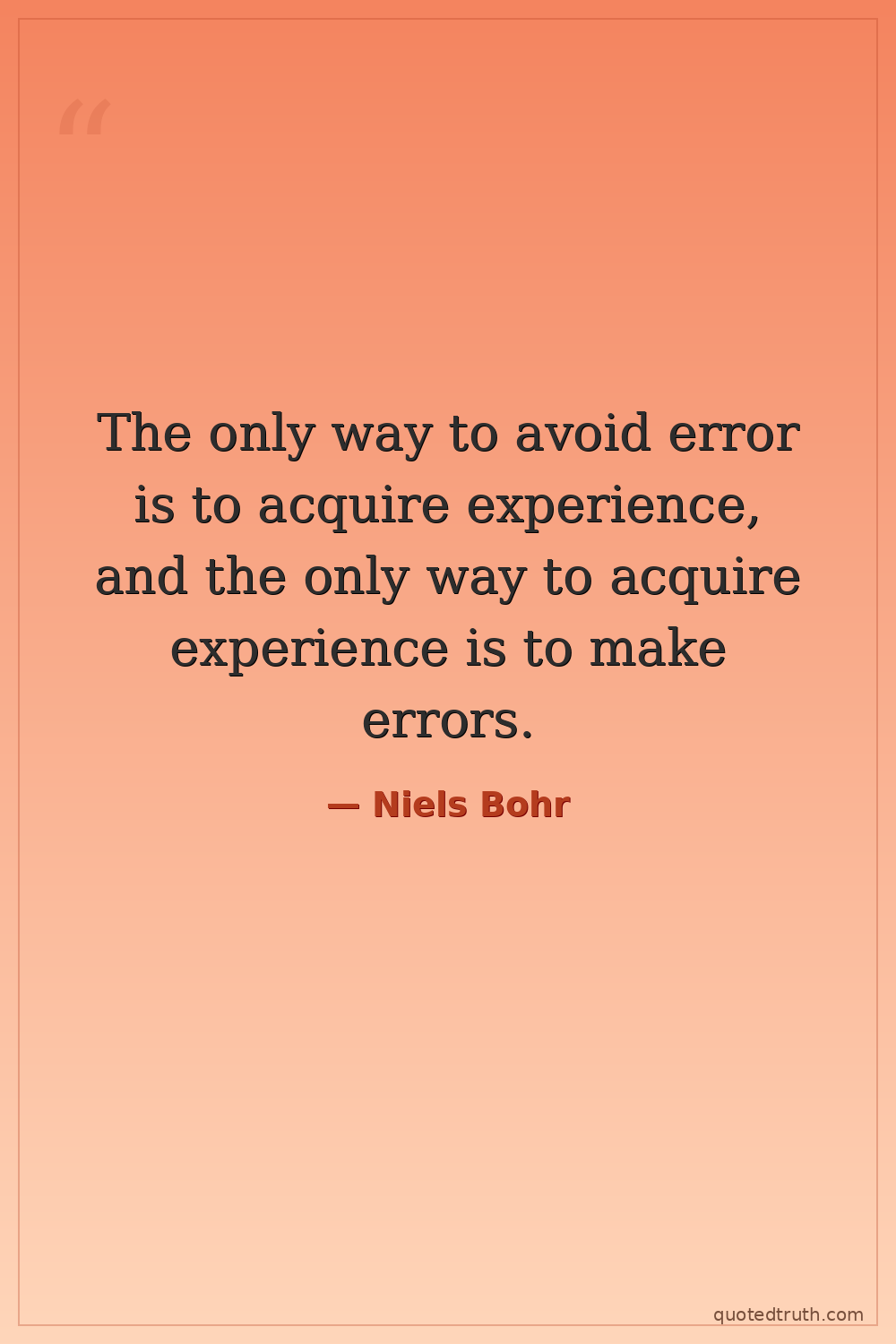
Niels Bohr — "The only way to avoid error is to acquire experience, and the only way to acquir…"
The only way to avoid error is to acquire experience, and the only way to acquire experience is to make errors.
The only way to avoid error is to acquire experience, and the only way to acquire experience is to make errors.
Click any product to generate a realistic preview. Up to 3 at a time.
* Initial load can take up to 90 seconds — revising the preview in another color is nearly instant.
"The meaning of our words is always context-dependent."
"The atom is not a mechanical system, but a system of relationships."
"The best weapon of a dictatorship is secrecy, but the best weapon of a democracy should be the weapon of openness."
"Your theory is crazy, but it's not crazy enough to be true."
"It is not the job of science to tell us how the world is, but what we can say about it."
Found in 1 providers: grok
1 source checked
You cannot learn without failing first. Trying to stay safe by never risking mistakes guarantees you never gain real knowledge. Growth requires walking directly into uncertainty, making wrong calls, and extracting lessons from the wreckage. There is no shortcut — the discomfort of being wrong is the actual mechanism by which understanding is built, not an unfortunate side effect of it.
Bohr built his revolutionary atomic model by discarding classical physics rules that 'should' have prevented electrons from behaving as they do. His quantum leap — electrons occupying discrete energy levels — contradicted established electrodynamics. He repeatedly revised wrong models, engaged in famous debates with Einstein where both men made errors, and treated contradiction and failure as scientific instruments. His Copenhagen interpretation itself emerged from years of wrestling with paradoxes no one could cleanly resolve.
Bohr worked during the early 20th century quantum revolution, when classical Newtonian physics was visibly breaking down. Experiments like the photoelectric effect and atomic spectra produced results that contradicted every established theory. Scientists had to abandon centuries of certainty and embrace iterative, error-driven theorizing. World War II further shattered confidence in human mastery, making intellectual humility about the limits of knowledge both scientifically and culturally resonant.
AI-generated insights based on extensive research and information for context. Factual errors? Email [email protected].
Your cart is empty