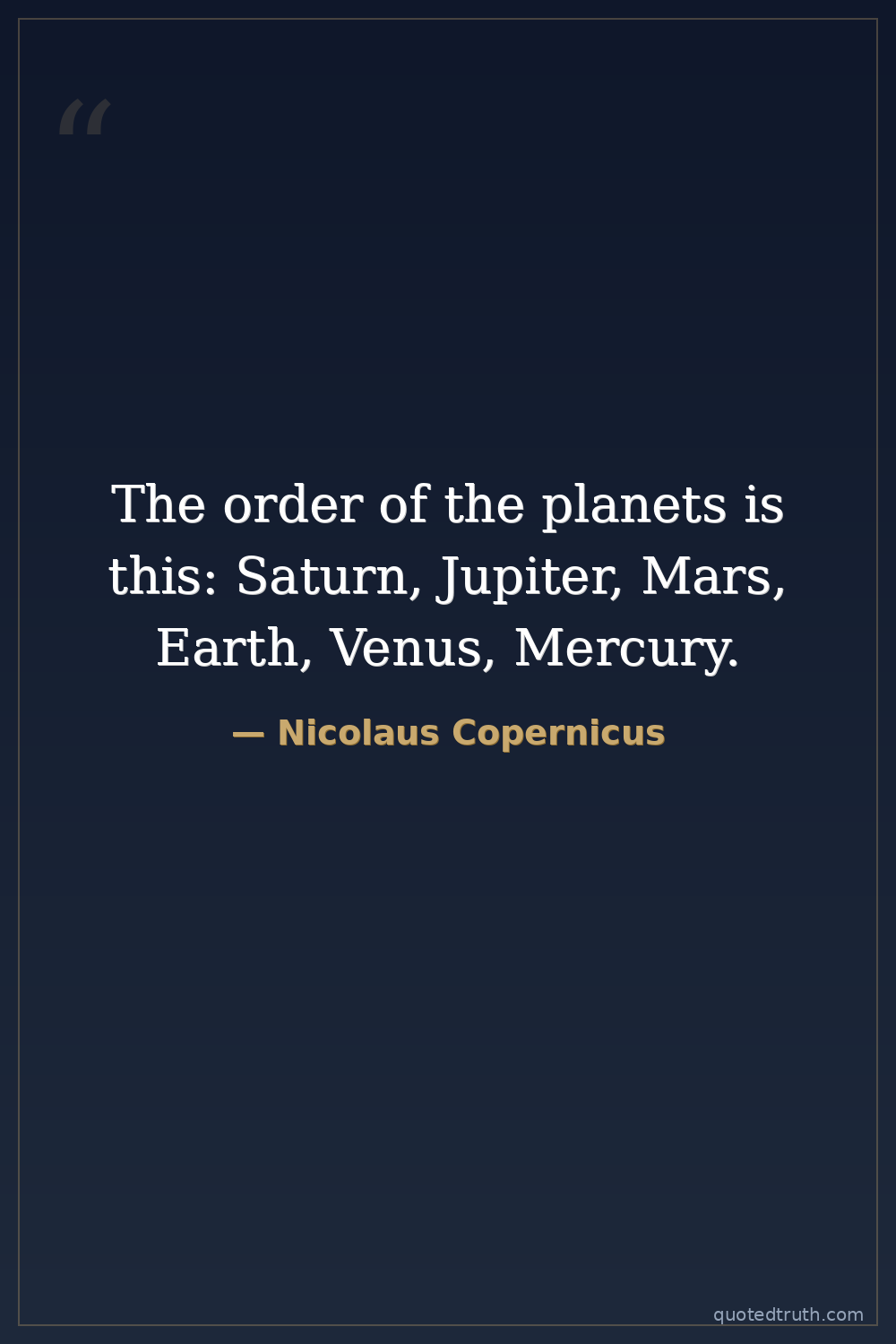
Nicolaus Copernicus — "The order of the planets is this: Saturn, Jupiter, Mars, Earth, Venus, Mercury."
The order of the planets is this: Saturn, Jupiter, Mars, Earth, Venus, Mercury.
The order of the planets is this: Saturn, Jupiter, Mars, Earth, Venus, Mercury.
Click any product to generate a realistic preview. Up to 3 at a time.
* Initial load can take up to 90 seconds — revising the preview in another color is nearly instant.
"In the midst of all dwells the Sun. For who indeed could place this lamp of a better position in this most beautiful temple, than that from which it can at once illuminate all?"
"For it is clear that the earth performs a double motion: one about its axis, and another about the sun."
"It is the duty of a good astronomer to seek for truth in all things, and to follow it wherever it may lead."
"For I have found that the motions of the planets are more regular and orderly if the Earth is assumed to move."
"The Sun is the center of the universe, and all the planets revolve around it."
Found in 1 providers: grok
1 source checked
Six planets are placed in a definite sequence measured by distance from the Sun. Earth sits in the middle of that sequence—not at the universe's center, but as one world among others. The list reframes cosmic reality: the familiar and the distant are ranked by orbital position, not divine importance. Order here means physical arrangement, a measurable fact, not a hierarchy of spiritual significance.
Copernicus spent over 30 years developing his heliocentric system, publishing De revolutionibus orbium coelestium in 1543, the year he died. As a Polish canon and mathematician, he worked from observation and geometry, not a telescope. This precise sequencing—Saturn outermost, Mercury innermost—was the structural core of his entire theory. Placing Earth third from the Sun, between Venus and Mars, was his boldest claim: humanity's home is just another orbiting body.
In the early 1500s, Ptolemy's geocentric model—Earth fixed at the universe's center—had governed European astronomy for 1,400 years, endorsed by the Catholic Church as cosmological truth. Copernicus wrote during the Renaissance, when ancient texts were being reexamined and natural philosophy was gaining credibility. His planetary ordering directly contradicted established doctrine. The Protestant Reformation also fractured religious authority, creating space for unorthodox ideas, though scientific heresy still carried serious institutional risk.
AI-generated insights based on extensive research and information for context. Factual errors? Email [email protected].
Your cart is empty