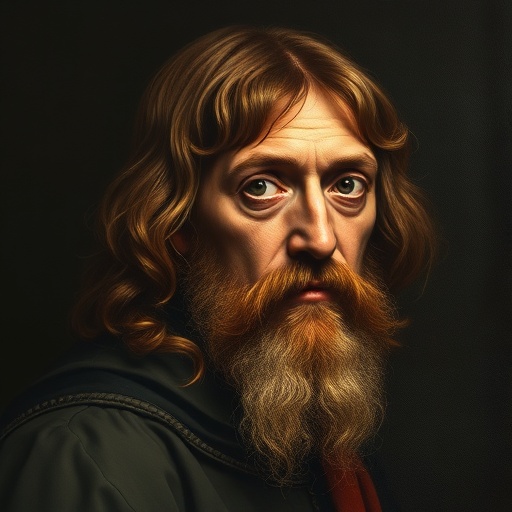
Nicolaus Copernicus — "Therefore, I propose that the earth moves, and that the fixed stars are immovabl…"
Therefore, I propose that the earth moves, and that the fixed stars are immovable.
Therefore, I propose that the earth moves, and that the fixed stars are immovable.
Click any product to generate a realistic preview. Up to 3 at a time.
* Initial load can take up to 90 seconds — revising the preview in another color is nearly instant.
"Indeed, I am aware that a philosopher's thoughts are far removed from the judgment of the multitude, for his aim is to seek the truth in all things, to the extent permitted to human reason by God."
"I have been so long in preparing this work that I have almost despaired of publishing it."
"Those things which I am saying now may be obscure, yet they will be made clearer in their proper place."
"For I have found that the motions of the planets are more regular and orderly if the Earth is assumed to move."
"It is not incredible that the earth moves, but that it stands still, that is incredible."
Found in 1 providers: grok
1 source checked
The earth is not stationary at the universe's center — it moves through space, while the distant stars remain fixed in place. This overturns the instinctive human assumption that we stand still while everything revolves around us. Movement is real, but it belongs to us, not to the heavens. What we perceive as the stars' motion is actually our own motion projected outward.
Copernicus spent decades as a cathedral canon in Frombork, quietly revolutionizing astronomy on the side. His heliocentric model, published in De Revolutionibus (1543), directly contradicted Ptolemy's Earth-centered system that had dominated for 1,400 years. Cautious by nature, he delayed publication until near death. This single proposition encapsulates the audacious core of his life's work: displacing Earth from cosmic privilege.
In the early 16th century, Ptolemaic geocentrism was inseparable from Christian theology — Earth's central position reflected humanity's special divine status. The Church, universities, and common sense all agreed the Earth stood still. Questioning this was philosophically and religiously dangerous. Copernicus wrote carefully, dedicating his work to Pope Paul III, yet his idea ignited the Scientific Revolution and ultimately the Galileo controversy decades later.
AI-generated insights based on extensive research and information for context. Factual errors? Email [email protected].
Your cart is empty