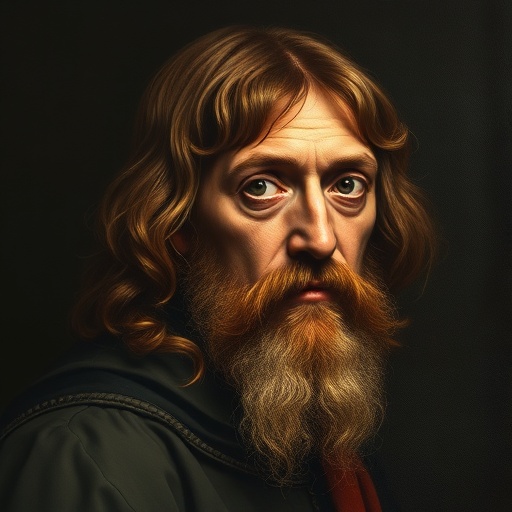
Nicolaus Copernicus — "The order of the planets is as follows: Saturn, Jupiter, Mars, Earth, Venus, Mer…"
The order of the planets is as follows: Saturn, Jupiter, Mars, Earth, Venus, Mercury, and in the middle of all, the Sun.
The order of the planets is as follows: Saturn, Jupiter, Mars, Earth, Venus, Mercury, and in the middle of all, the Sun.
Click any product to generate a realistic preview. Up to 3 at a time.
* Initial load can take up to 90 seconds — revising the preview in another color is nearly instant.
"Knowledge makes a bloody entrance."
"The Sun, as if seated on a royal throne, governs the family of stars which wheel around it."
"Perhaps there will be babblers who, although completely ignorant of mathematics, nevertheless dare to pass judgment on these things and, on the strength of some passage in Scripture, twisted to their …"
"Mathematics is written for mathematicians."
"The world is spherical; whether it is finite or infinite is an open question."
Found in 1 providers: grok
1 source checked
The planets orbit the Sun in a specific sequence, with the Sun fixed at the center of the solar system. This describes a fundamental cosmic architecture where everything revolves around one central star. The ordering reflects observable orbital periods and distances, placing Earth as one planet among many rather than the privileged center around which everything else moves.
Copernicus spent decades developing his heliocentric model, published in De Revolutionibus Orbium Coelestium in 1543, the year he died. This planetary ordering was his revolutionary contribution, repositioning Earth as an ordinary planet. As a church canon and amateur astronomer working in Frombork, Poland, he risked theological controversy by demoting Earth from cosmic center to merely the third planet in sequence.
In early 16th-century Europe, Ptolemy's geocentric model had dominated astronomy for 1,400 years, supported by Catholic doctrine placing humanity at creation's center. Copernicus worked during the Renaissance, when ancient authorities were being questioned across disciplines. His reordering threatened both scientific consensus and religious cosmology, arriving just as the Reformation was already fracturing European Christendom's intellectual unity.
AI-generated insights based on extensive research and information for context. Factual errors? Email [email protected].
Your cart is empty