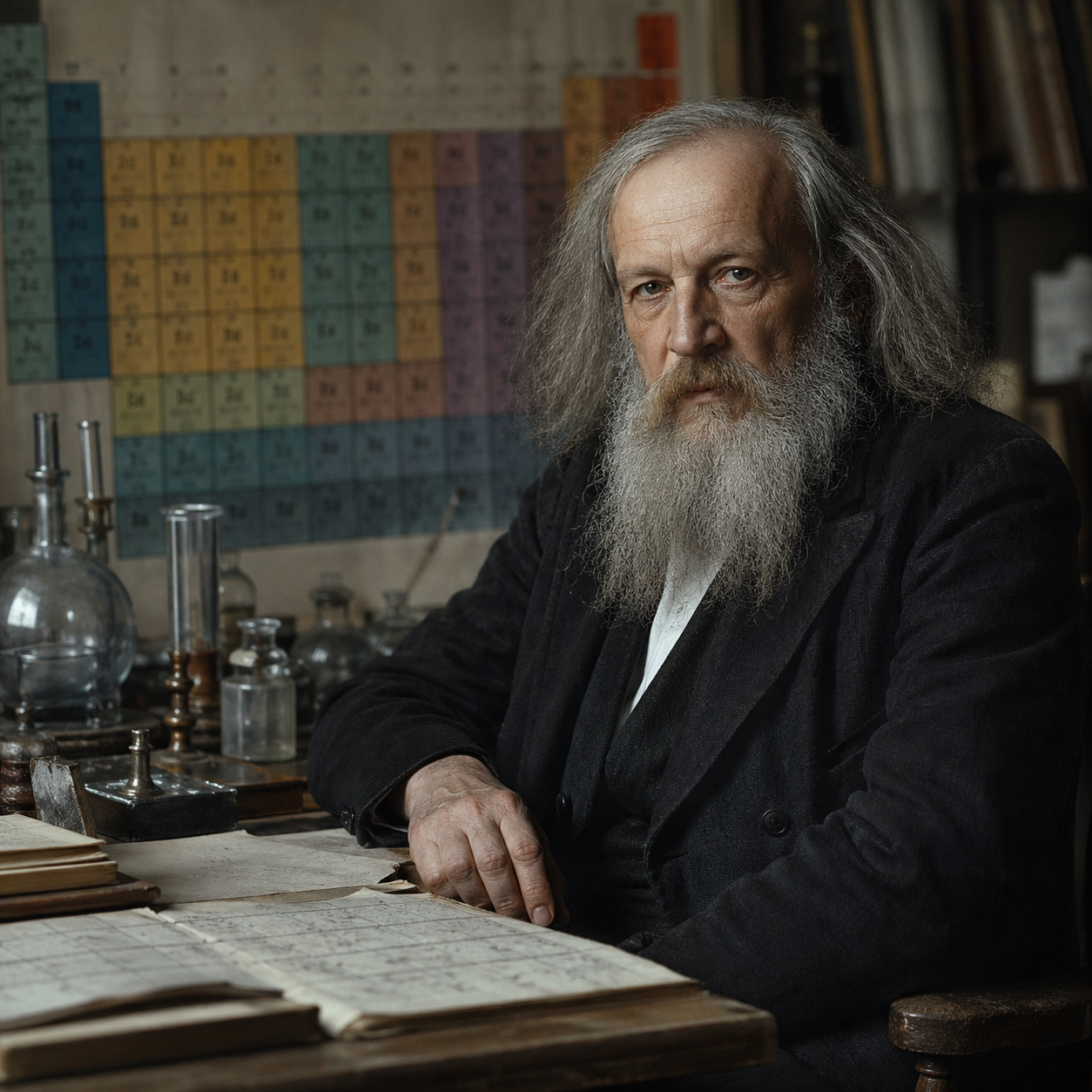
Dmitri Mendeleev — "The periodic table is a work of art, a testament to the elegance and order of th…"
The periodic table is a work of art, a testament to the elegance and order of the natural world.
The periodic table is a work of art, a testament to the elegance and order of the natural world.
Click any product to generate a realistic preview. Up to 3 at a time.
* Initial load can take up to 90 seconds — revising the preview in another color is nearly instant.
"It is the duty of the chemist to teach the world how to use the elements wisely."
"The greatest value of a scientific discovery is not so much in the discovery itself as in the stimulus it provides for further investigation."
"The progress of science is a series of corrections."
"Refrain from illusions, insist on work, and not on words, patiently search divine and scientific truth."
"The edifice of science not only requires material, but also a plan. Without the material, the plan alone is but a castle in the air—a mere possibility; whilst the material without a plan is but useles…"
Describing his most famous creation, highlighting its aesthetic and philosophical significance.
Date: Unknown, likely after the development of the periodic table (1869)
ShockingFound in 1 providers: gemini
1 source checked
This statement frames the periodic table not as a dry scientific chart but as something beautiful. It argues that the way elements arrange themselves by properties and atomic structure reveals a deep, underlying harmony in nature. The speaker is saying science can be aesthetic: discovering how the universe organizes its building blocks is as moving as viewing a masterpiece, because the pattern itself is proof that reality has structure.
Mendeleev published his periodic table in 1869, arranging 63 known elements by atomic weight and spotting gaps he boldly predicted would be filled by undiscovered elements like gallium and germanium. He saw the table as revealing a natural law, not inventing one. His faith in its elegance let him trust the pattern over conflicting data, a conviction that defined his career and legacy.
Mendeleev worked in 19th-century Russia during a surge of chemical discovery, when dozens of new elements were being isolated but no unifying framework existed. Europe was debating atomic theory itself, and chemistry risked becoming a catalog of disconnected facts. His table arrived as industrialization demanded systematic knowledge of materials, and it transformed chemistry into a predictive science, aligning with the era's broader faith in rational order underlying nature.
AI-generated insights based on extensive research and information for context. Factual errors? Email [email protected].
Your cart is empty