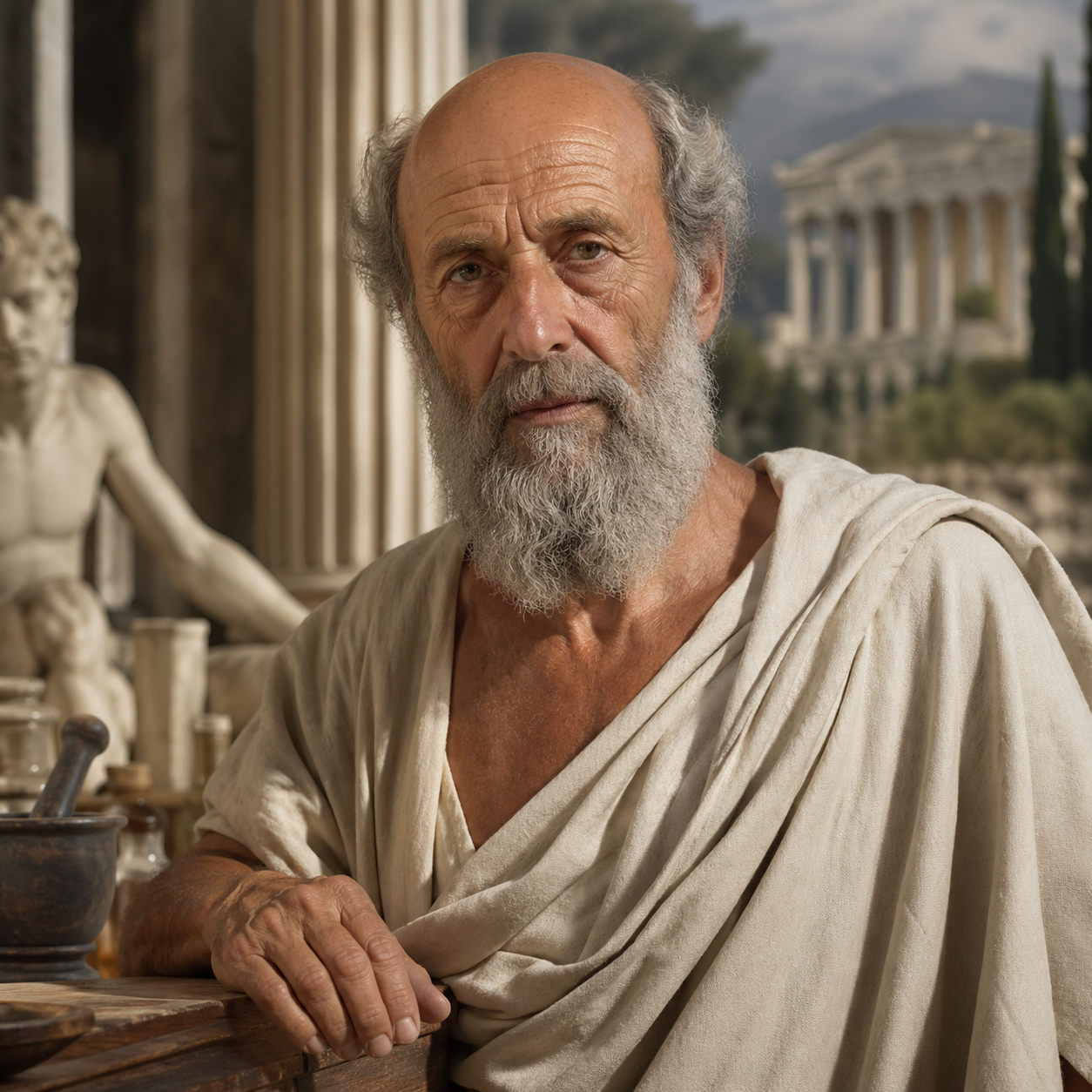
Hippocrates — "The physician must be able to tell the future."
The physician must be able to tell the future.
The physician must be able to tell the future.
Click any product to generate a realistic preview. Up to 3 at a time.
* Initial load can take up to 90 seconds — revising the preview in another color is nearly instant.
"All diseases begin in the gut."
"The physician must not only be prepared to do what is right himself, but also to make the patient, the attendants, and externals cooperate."
"Positive health requires a knowledge of man's primary constitution and of the powers of various foods, both those natural to them and those resulting from human skill. But eating alone is not enough f…"
"The brain is the seat of the soul."
"The physician is the servant of nature."
A statement on the physician's need for prognostic ability, which in ancient times might have seemed mystical.
Date: c. 460-370 BCE
WisdomFound in 1 providers: gemini
1 source checked
A good doctor doesn't just treat present symptoms — they anticipate how a disease will progress, predict outcomes, and act before problems worsen. Medical prognosis, meaning the forecasting of illness trajectory, matters as much as diagnosis and treatment. A physician who foresees complications, recovery patterns, or deterioration gives patients a decisive edge over one who only reacts to what's already visible.
Hippocrates made prognosis a cornerstone of his medical system, dedicating an entire treatise — the Prognostica — to predicting disease outcomes. He believed accurately forecasting whether a patient would recover or die was central to a physician's credibility. Rather than relying on divine intervention, he used careful bedside observation of symptoms, breathing, and pulse to project illness trajectories — a radical empirical shift from the temple-based healing dominant in his era.
In 5th-century BCE Greece, illness was widely attributed to divine punishment, and healing was performed in Asclepian temples through prayer and ritual. Hippocrates practiced on the island of Cos during Classical Athens, when rational philosophy was challenging supernatural explanations. The devastating Athenian Plague of 430 BCE made prognosis urgently practical — families needed to know who would survive. Forecasting based on observation, not oracles, was a radical claim that medicine belonged to reason, not religion.
AI-generated insights based on extensive research and information for context. Factual errors? Email [email protected].
Your cart is empty