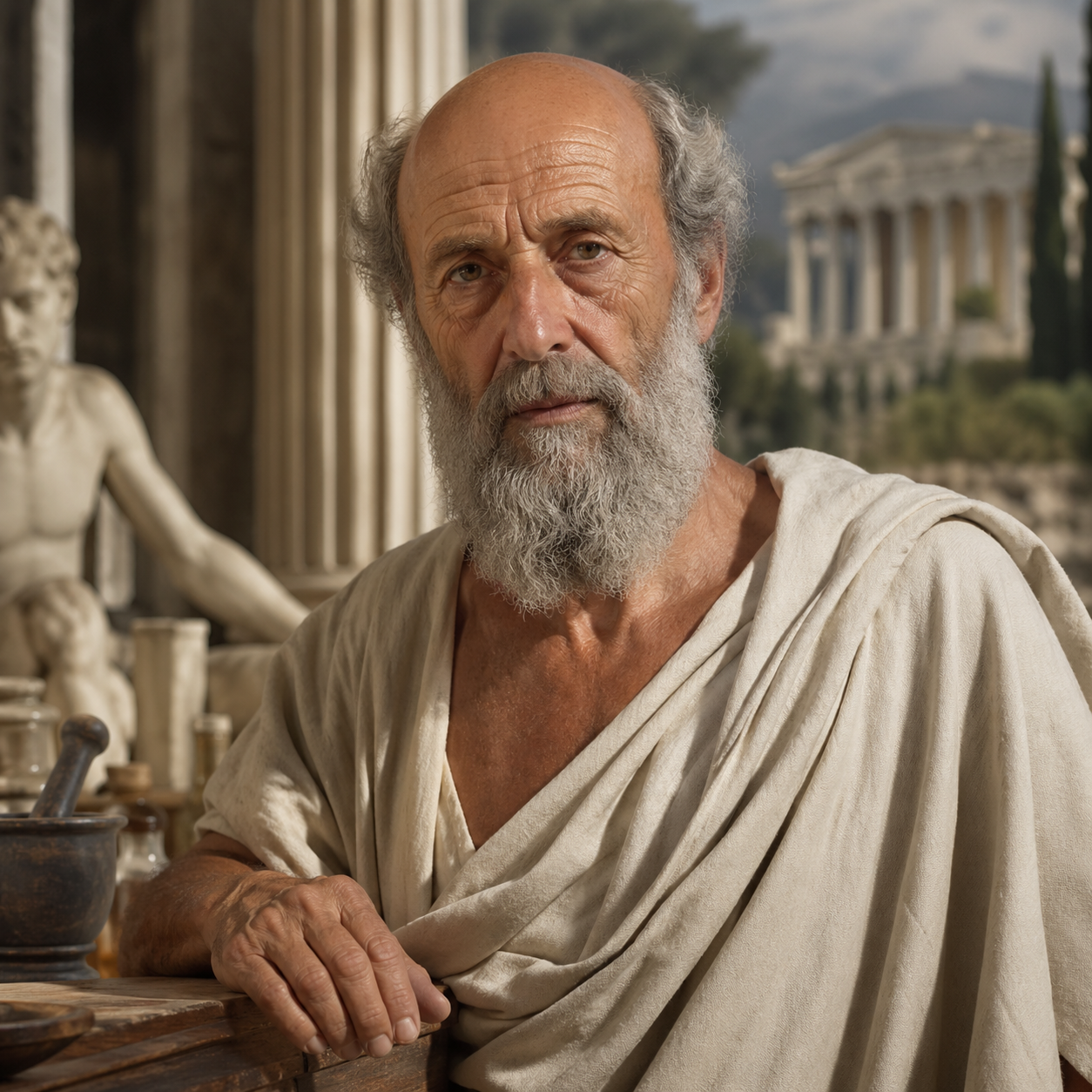
Hippocrates — "The powers of the physician are not in his drugs, but in his wisdom."
The powers of the physician are not in his drugs, but in his wisdom.
The powers of the physician are not in his drugs, but in his wisdom.
Click any product to generate a realistic preview. Up to 3 at a time.
* Initial load can take up to 90 seconds — revising the preview in another color is nearly instant.
"The greatest joy in life is to be healthy."
"War is the only surgeon that can cure a nation."
"The body of man is a miniature of the world."
"It is far more important to know what person the disease has than what disease the person has."
"When a man has a pain in his head, and it is in the back of his head, it is a sign that he will have a fever."
Emphasizing the physician's judgment and knowledge over mere pharmaceutical agents.
Date: c. 460-370 BCE
Power & LeadershipFound in 1 providers: gemini
1 source checked
A healer's effectiveness comes from understanding—observation, diagnosis, and reasoned judgment—not merely from the substances administered. Drugs are tools; without the wisdom to know when, why, and how to use them, they are inert or harmful. True medical power lies in accurately reading the patient, interpreting symptoms, and choosing a course of action grounded in knowledge and experience rather than ritual or guesswork.
Hippocrates (~460–370 BCE) built medicine on systematic clinical observation rather than divine intervention or magical cures. He documented patient histories, tracked disease progressions, and tied outcomes to natural causes. His Hippocratic Corpus and famous Oath prioritize reasoned judgment over any specific remedy. A physician who embodied careful thought, he spent his career demonstrating that understanding the patient—not wielding exotic potions—was the true foundation of healing.
In 5th-century BCE Greece, healing remained entwined with religion—sick Greeks visited temples of Asclepius seeking divine cures, while folk healers peddled herbal concoctions without systematic knowledge. Hippocrates and the Cos school broke from this tradition by insisting disease had natural causes. With no antibiotics, no chemistry, no diagnostics beyond the senses, a physician's reasoned interpretation of symptoms was genuinely the most powerful medical instrument available.
AI-generated insights based on extensive research and information for context. Factual errors? Email [email protected].
Your cart is empty