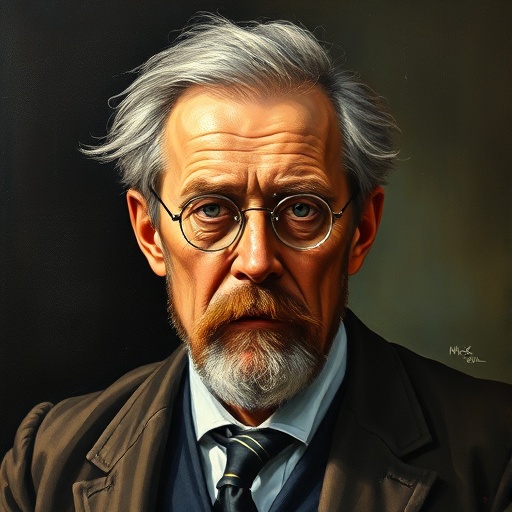
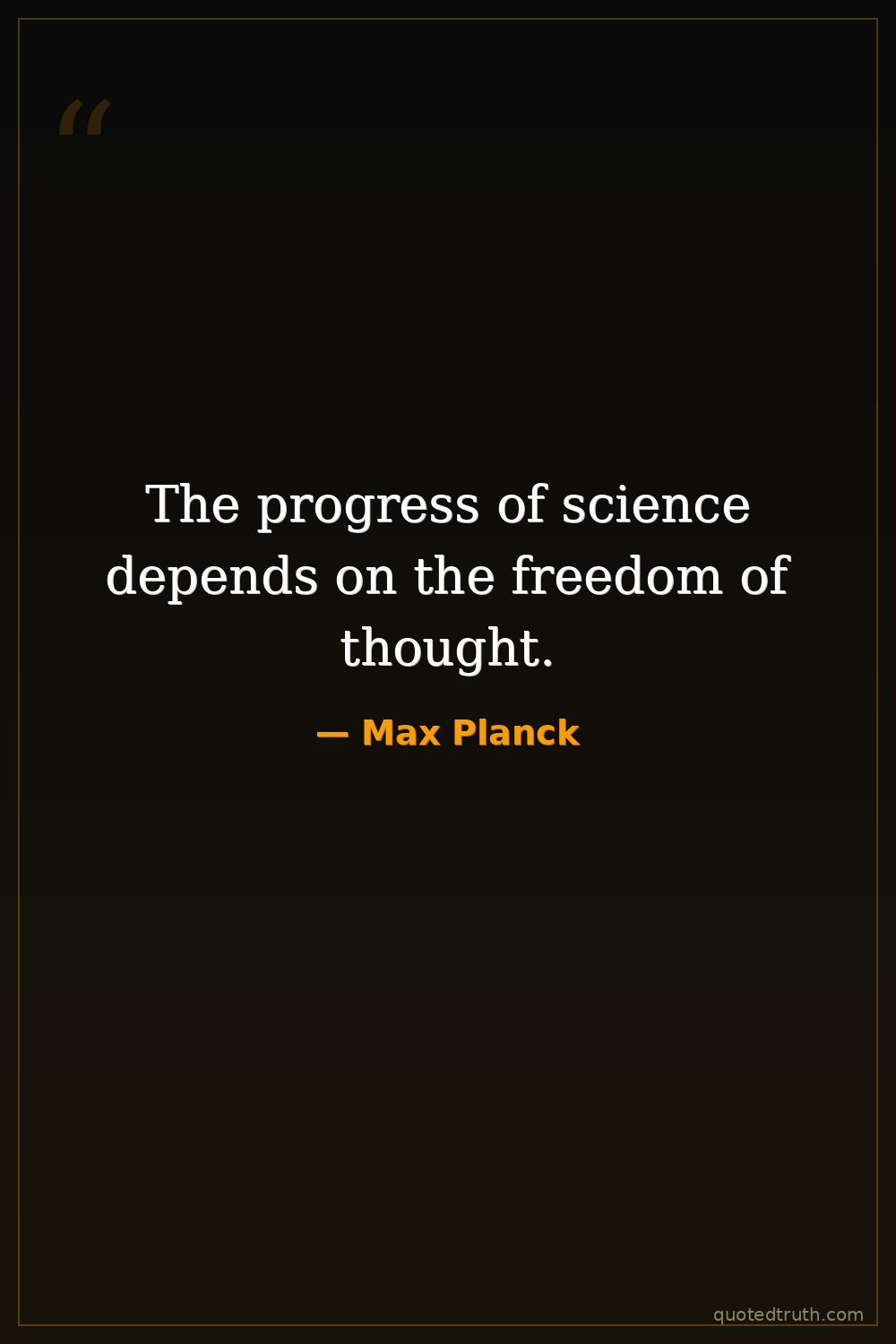
Max Planck — "The progress of science depends on the freedom of thought."
The progress of science depends on the freedom of thought.
The progress of science depends on the freedom of thought.
Click any product to generate a realistic preview. Up to 3 at a time.
* Initial load can take up to 90 seconds — revising the preview in another color is nearly instant.
"There can never be any real opposition between religion and science; for the one is the complement of the other."
"Physics is a branch of knowledge which aims at the discovery of the laws governing the phenomena of nature."
"Physics is a science of the real world, not of the subjective impressions of the individual."
"The highest court is in the end one's own conscience and conviction—that goes for you and for Einstein and every other physicist—and before any science there is first of all belief. For me, it is beli…"
"I was never a revolutionary. I just wanted to do something useful."
Found in 1 providers: grok
1 source checked
Scientific advancement requires that researchers be free to question established ideas, propose unconventional theories, and follow evidence wherever it leads. When authorities, ideologies, or social pressures dictate what scientists may investigate or conclude, discovery stalls. Real breakthroughs come from minds permitted to challenge orthodoxy, test heretical hypotheses, and publish findings without fear of censorship or punishment. Intellectual liberty is not a luxury for science; it is the engine that makes progress possible at all.
Planck shattered classical physics in 1900 by proposing energy comes in discrete quanta, an idea so radical he initially doubted it himself. He needed intellectual freedom to break from Newtonian orthodoxy. Later, under the Nazi regime, he watched Jewish colleagues like Einstein driven from German science and saw firsthand how political control devastated research. He personally appealed to Hitler to protect Jewish scientists, knowing forced conformity would cripple German physics for generations.
Planck lived through the early twentieth century, when physics underwent its most dramatic revolution since Newton, producing relativity and quantum mechanics. He also witnessed the Nazi era, when the Third Reich purged Jewish scientists, denounced 'Jewish physics,' and demanded ideological loyalty over evidence. Soviet science similarly suffered under Lysenkoism. Planck saw German physics, once the world's leader, hollowed out by political interference, making the link between freedom and scientific progress brutally visible in his own lifetime.
AI-generated insights based on extensive research and information for context. Factual errors? Email [email protected].
Your cart is empty