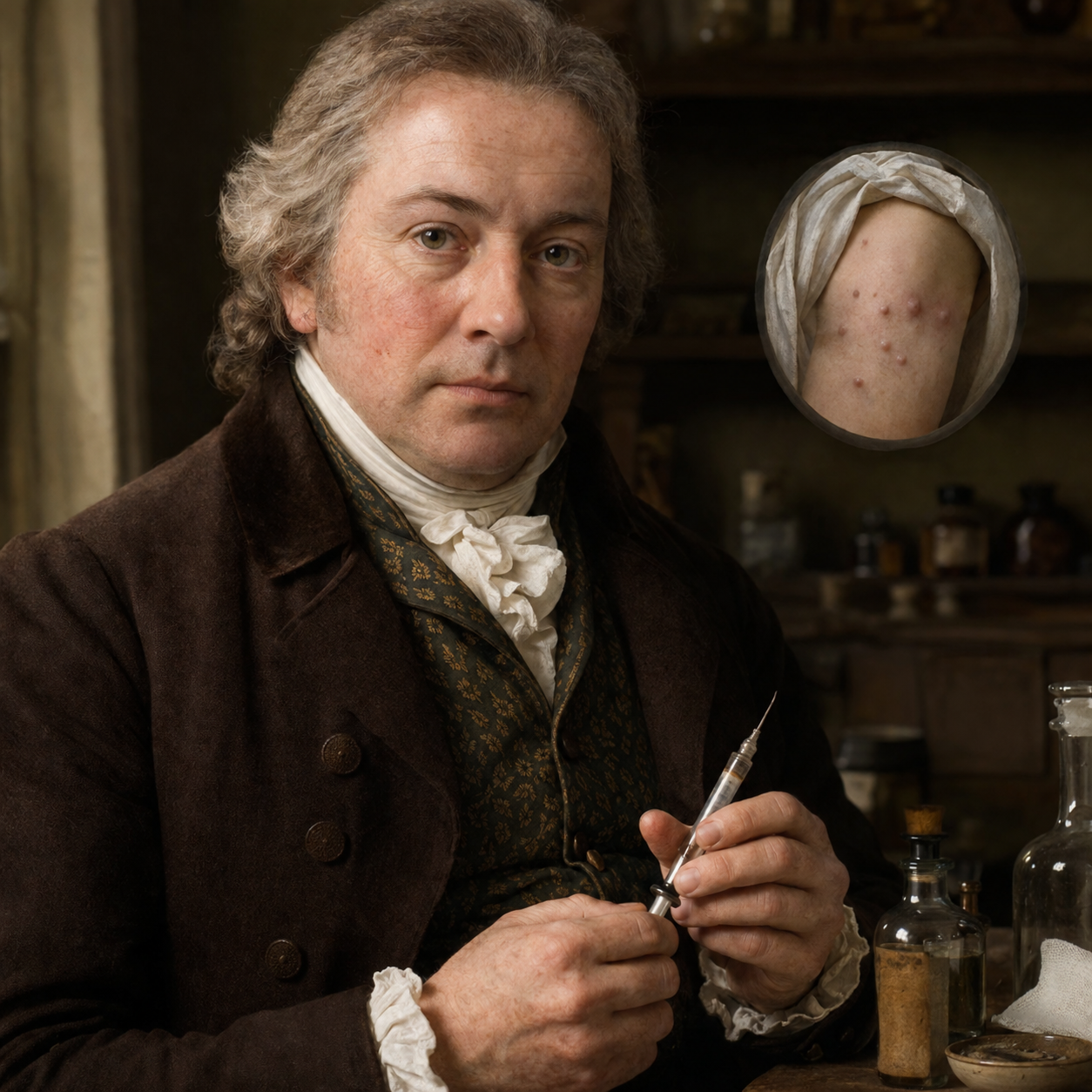
Edward Jenner — "The progress of science is slow, but it is sure."
The progress of science is slow, but it is sure.
The progress of science is slow, but it is sure.
Click any product to generate a realistic preview. Up to 3 at a time.
* Initial load can take up to 90 seconds — revising the preview in another color is nearly instant.
"The joy I felt at the prospect before me of being the instrument destined to take away from the world one of its greatest calamities was so excessive that I sometimes found myself in a kind of reverie…"
"I have often been struck with the wonderful harmony that prevails throughout the works of nature."
"I have always endeavoured to be guided by reason, and not by prejudice."
"I have often wished that I had more time to devote to my favourite studies."
"The greatest reward for my labours is the satisfaction of having done good to my fellow creatures."
Found in 1 providers: grok
1 source checked
Scientific advancement doesn't happen overnight — it demands patience, repeated observation, and incremental steps. Evidence accumulates slowly but reliably, and truth will eventually prevail over skepticism, mockery, and institutional resistance. Progress may feel frustratingly gradual, but its conclusions are grounded in observable reality and ultimately get accepted and widely applied. Slow doesn't mean uncertain — it means thorough, and thorough means lasting.
Jenner observed milkmaids' apparent immunity to smallpox for roughly twenty years before conducting his 1796 cowpox experiment on James Phipps. The Royal Society rejected his initial paper; physicians and clergy attacked vaccination as dangerous and ungodly. He persisted through decades of ridicule and institutional resistance. By his death in 1823, vaccination had been adopted across Europe — a slow but definitive vindication he had long anticipated.
Smallpox killed roughly 400,000 Europeans annually in Jenner's lifetime and left survivors blind or permanently scarred. Germ theory didn't exist — disease was attributed to miasmas or divine punishment. The Enlightenment was establishing empirical science as a legitimate path to truth, but religious authority and folk superstition remained powerful obstacles. Jenner's era saw science beginning to win practical battles — vaccination, anatomy, chemistry — while still fighting for broad cultural credibility.
AI-generated insights based on extensive research and information for context. Factual errors? Email [email protected].
Your cart is empty