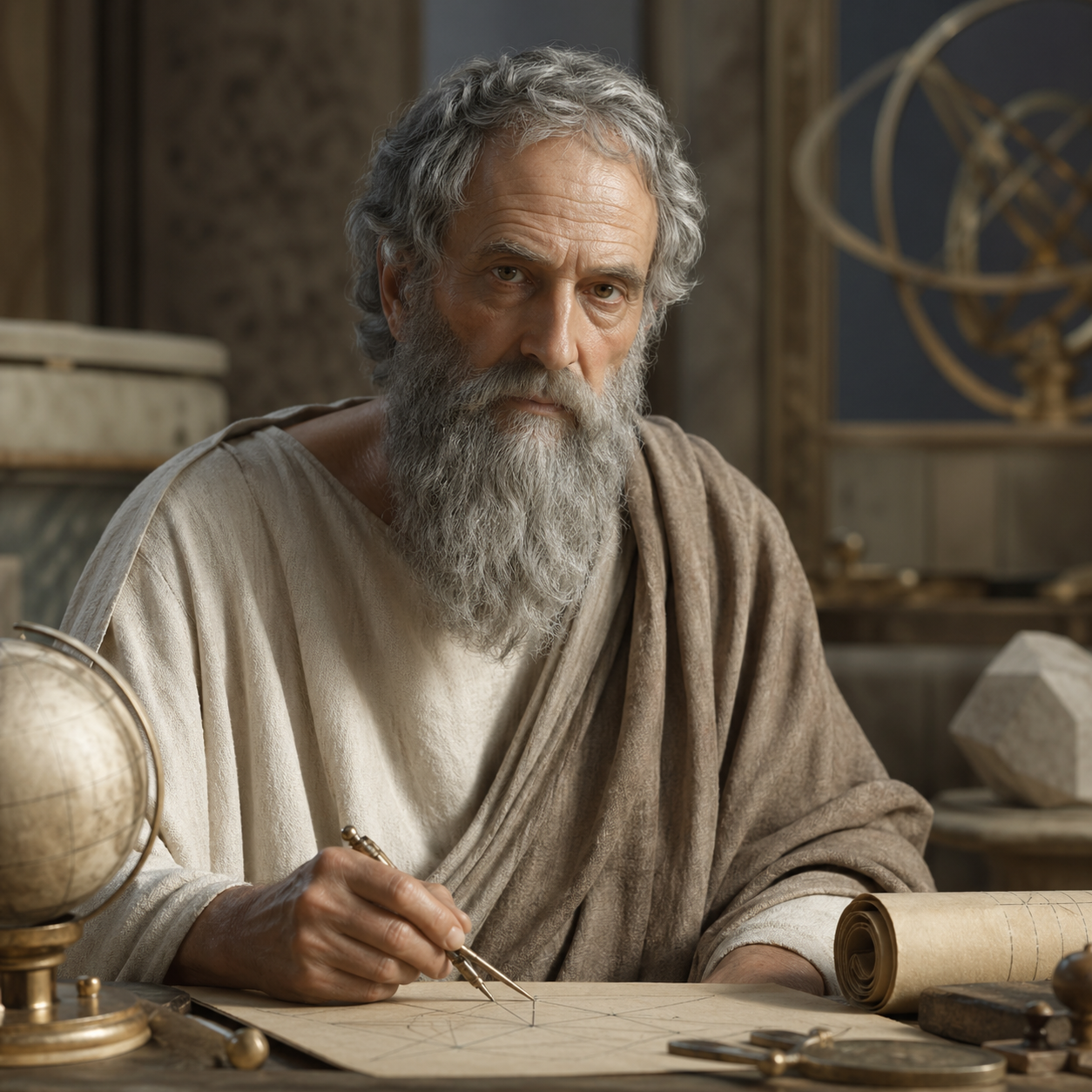
Euclid — "The properties of figures are derived from their definitions and postulates."
The properties of figures are derived from their definitions and postulates.
The properties of figures are derived from their definitions and postulates.
Click any product to generate a realistic preview. Up to 3 at a time.
* Initial load can take up to 90 seconds — revising the preview in another color is nearly instant.
"Things which coincide with one another are equal to one another."
"The laws of nature are but the mathematical thoughts of God."
"The square on the side subtending the right angle in right-angled triangles is equal to the squares on the sides containing the right angle."
"A quantity is said to be a part of a quantity, the less of the greater, when it measures the greater."
"What has been affirmed without proof can also be denied without proof."
Found in 1 providers: grok
1 source checked
Geometric truths don't come from observation alone — they follow necessarily from agreed-upon starting points. Accept a definition of a triangle and basic axioms about lines and points, and everything about triangles can be proven from those foundations alone. Knowledge built this way is certain and universal, independent of physical measurement. This is deductive reasoning: once you accept the premises, the conclusions are inevitable.
Euclid's Elements (c. 300 BCE) opens with 23 definitions, 5 postulates, and 5 common notions, then derives 465 propositions purely from those foundations. This quote is his working method stated plainly. He built all of geometry from minimal, carefully chosen starting points, insisting on derivation over empirical guessing. That rigor made the Elements the most reprinted textbook in history after the Bible and defined Western mathematics for two millennia.
Around 300 BCE in Alexandria, Greek thinkers debated how knowledge could be certain rather than merely probable. Earlier geometers like Thales and Pythagoras had discovered truths but lacked rigorous proof systems. The Platonic tradition held abstract forms more real than physical objects. Euclid's axiomatic approach answered both challenges: making assumptions explicit and deriving everything else produced knowledge immune to physical counterexample — a revolution in how humans conceived of certainty.
AI-generated insights based on extensive research and information for context. Factual errors? Email [email protected].
Your cart is empty